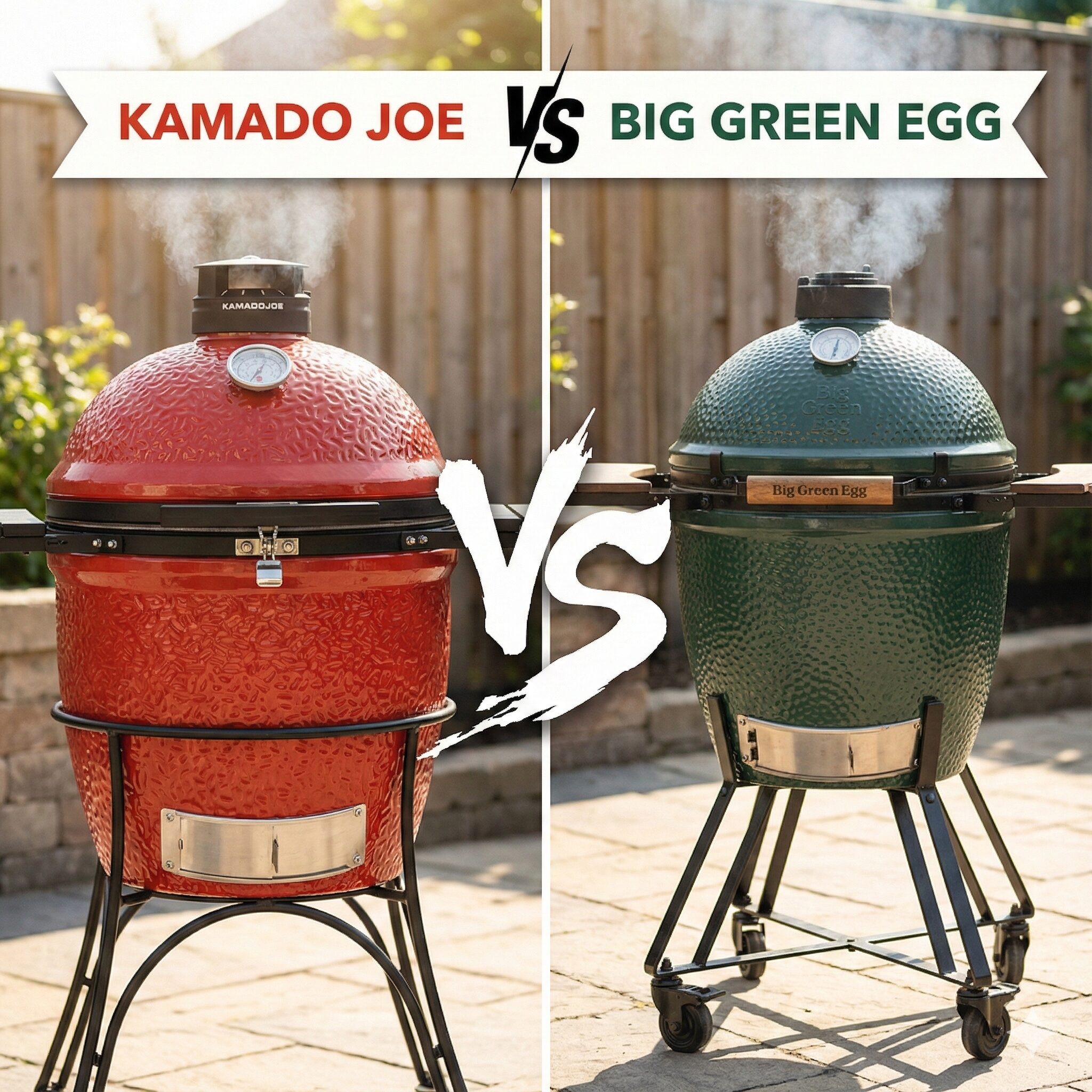
Red vs. Green: Which Ceramic Grill Reigns Supreme?
In the high-stakes world of outdoor cooking, few rivalries are as intense as the battle between Big Green Egg and Kamado Joe. For decades, the Big Green Egg stood alone as the undisputed king of kamado-style cooking, a ceramic vessel capable of smoking brisket at 225°F for 18 hours or searing steaks at 750°F with equal ease.
Then came Kamado Joe. Entering the market with a bright red finish and a mission to disrupt, they didn’t just copy the Egg—they attempted to fix its flaws. They introduced better hinges, superior gaskets, and a revolutionary cooking rack system, all while undercutting the price.
If you are preparing to drop a significant amount of money on a lifetime grill, you need to know: Is the original still the best, or has the student become the master? This guide strips away the marketing hype to compare build quality, innovation, cooking performance, and value.
At a Glance: The Tale of the Tape
Before we dive into the nuts and bolts, here is a quick overview of how the flagship models—the Big Green Egg Large and the Kamado Joe Classic II—stack up against each other.
| Feature | Big Green Egg (Large) | Kamado Joe (Classic II) |
|---|---|---|
| Origin | The Original (Since 1974) | The Challenger (Since 2009) |
| Included Accessories | Bare Bones (Grill body only mostly) | Fully Loaded (Stand, shelves, tools) |
| Hinge System | Standard Spring Loaded | Air Lift Hinge (Featherlight) |
| Cooking System | Standard Stainless Grid | Divide & Conquer Flexible System |
| Top Vent | Cast Iron Daisy Wheel (Classic) | Kontrol Tower (Rainproof) |
| Gasket | Felt (Needs replacement often) | Wire Mesh Fiberglass (Long life) |
| Warranty | Limited Lifetime | Limited Lifetime |
While both are excellent ceramic cookers, the core difference lies in their philosophy. Big Green Egg relies on a massive dealer network and a “build your own” approach, while Kamado Joe offers an “all-in-one” package that is ready to cook out of the box.

Round 1: Innovation and Features
The ceramic composition of both grills provides incredible insulation, which is why they excel at maintaining temperature compared to thin-walled metal grills. This efficiency is what makes them superior to many standard setups, as discussed in our comparison of pellet grills vs charcoal grills. However, how you interact with that heat differs wildly between the two.
The Air Lift Hinge (Kamado Joe)
This is arguably the biggest game-changer. The dome of a ceramic grill is heavy—weighing upwards of 50-70 pounds. On a Big Green Egg, lifting the lid requires some muscle, and if you let it drop, it can crack the ceramic base. Kamado Joe developed the Air Lift Hinge, a counterbalanced system that reduces the dome weight by about 96%. You can lift the lid with a single finger, and it will stay open at any angle.
The Divide & Conquer System
Kamado Joe revolutionized the interior of the grill with the “Divide & Conquer” flexible cooking system. Instead of a single grate, they split the rack in half. This allows you to place one half-moon grate on the lower level (close to the fire for searing) and the other half on the upper level (for roasting). Big Green Egg eventually released the “EGGspander” system to compete, but it is an expensive add-on, whereas KJ includes it standard.
Ventilation
The top vent controls your airflow and temperature.
- Big Green Egg: Uses a cast-iron daisy wheel. It is iconic but has flaws. If you open the lid quickly, the wheel can lose its setting. It also lets rain in, which can mess with your cook during a storm.
- Kamado Joe: Uses the “Kontrol Tower” top vent. It is made of cast aluminum (no rust) and is designed so that rain cannot get inside. Crucially, it doesn’t move when you open the lid.
Round 2: Build Quality and Aesthetics
The Ceramics
Both brands use high-fire, heat-resistant ceramics. Big Green Egg ceramics are manufactured in Mexico using technology developed by NASA. They are renowned for their durability. Kamado Joe manufactures in China. While purists argue the Egg’s ceramics are superior, real-world testing over the last decade shows both hold heat exceptionally well and are equally prone to cracking if dropped.
The Gasket
The gasket seals the lid to the body to prevent air leaks.
Big Green Egg uses a standard felt gasket. It works well initially but degrades quickly under high heat (pizza nights) and often needs replacing every year or two.
Kamado Joe uses a wire-mesh fiberglass gasket. It looks like a thick, grey braid. It is designed to handle extreme temperatures and lasts significantly longer than felt.
Maintenance is key for either unit. If you do notice buildup, knowing how to clean mold from your grill is essential to protecting the porous ceramic interior.
Round 3: Cooking Performance
When the lid is closed, can you taste the difference?
Honestly, no. Both grills are thermodynamic marvels. Once you dial in the airflow, both can hold 225°F for 15+ hours on a single load of charcoal. Both can hit 700°F+ for searing steaks. The flavor profile comes from the lump charcoal and wood chunks you use, not the brand of the ceramic.
However, the versatility differs. Because of the included heat deflectors and split racks, Kamado Joe makes it easier to switch between indirect and direct grilling instantly. With the Egg, switching modes often involves lifting a hot, greasy grate to insert or remove the ceramic “ConvEGGtor” plate.
For flavor enhancement, regardless of the grill, the choice of fuel matters. Check out our guide on wood chips vs wood chunks to master your smoke profile.
Round 4: Price and Ecosystem
The “Naked” Truth
When you see a price tag for a Big Green Egg, it usually is for the grill body only. By the time you add a “Nest” (stand), “Mates” (shelves), a “ConvEGGtor” (heat deflector), and an ash tool, you have added several hundred dollars to the bill.
Kamado Joe prices their units as bundles. A Classic II comes with the heavy-duty cart, side shelves, the Divide & Conquer system (which includes heat deflectors), an ash tool, and a grate gripper. Value-wise, Kamado Joe is almost always the winner.
The Cult of the Egg
However, Big Green Egg has the “Egghead” community. There are “Eggfests” held globally. The aftermarket support is massive. If you want a custom teak table for your grill, there are dozens of makers building them specifically for Eggs. While KJ is catching up, the Egg community is a lifestyle.
If you are looking for versatility beyond just the ceramic cooker, you might also be interested in how these compare to other fuel types in our Kamado grill vs gas grill breakdown.
Pros and Cons Breakdown
Big Green Egg Pros
- Legacy & Resale: Holds value incredibly well; huge brand recognition.
- Ceramic Quality: NASA-grade ceramics made in North America (Mexico).
- Ecosystem: Massive community and aftermarket support.
- Simplicity: Fewer moving parts to break over time.
Big Green Egg Cons
- Price: Everything is an extra. The “starter” price is deceptive.
- Dated Tech: Felt gaskets and daisy wheels feel old-fashioned.
- Heavy Lid: No air-lift hinge means the dome is heavy to lift.
Kamado Joe Pros
- Innovation: Air Lift Hinge, Kontrol Tower, and ash drawer are superior features.
- Value: Comes fully loaded with everything you need to cook.
- Versatility: Divide & Conquer system is standard.
- Ash Cleanup: Patented slide-out ash drawer makes cleaning easy.
Kamado Joe Cons
- Complexity: More mechanical parts (hinge, latch) that could theoretically fail.
- Fit & Finish: Occasional minor QC issues with stand alignment compared to BGE.
The Verdict: Which One Should You Buy?
Choosing between these two is like choosing between a Mercedes and a BMW. You are going to be happy either way, but the driving experience differs.
Buy the Big Green Egg If:
- You value heritage and want to be part of the massive “Egghead” community.
- You prefer a simpler, more traditional grilling experience without complex mechanical hinges.
- You plan to build the grill into a custom outdoor kitchen and don’t need the factory stand or shelves.
Buy the Kamado Joe If:
- You want the best bang for your buck and refuse to pay extra for essential accessories.
- You appreciate engineering improvements like the easy-lift hinge and rainproof vent.
- You want the flexibility of two-zone cooking right out of the box.
Our Winner: For the sheer value and feature set, the Kamado Joe Classic II (or III) is the logical choice for the modern griller. It took the template of the Egg and improved every single interaction point.
Frequently Asked Questions
Are Kamado Joe accessories compatible with Big Green Egg?
Mostly, yes. The 18-inch cooking grid size is standard for both the Large Big Green Egg and the Kamado Joe Classic. This means the popular Joetisserie (rotisserie attachment) fits the Large Big Green Egg perfectly. However, always measure before buying.
Why is Big Green Egg not sold on Amazon?
Big Green Egg is fiercely protective of its dealer network. They believe in the in-store experience and service. Buying one online from unauthorized third parties often voids the warranty. Kamado Joe has embraced online retail, making them easier to purchase for many people.
How long does the charcoal last in these grills?
Due to the thick ceramic insulation, a single load of lump charcoal can burn for 18+ hours at smoking temperatures (225°F-250°F). This makes them excellent for overnight cooks of brisket or pork butt without needing to refuel.
Do ceramic grills crack easily?
They are durable against heat but fragile against impact. If you tip them over or drop them during assembly, they will shatter. However, they can withstand freezing winters and scorching summers without structural issues, unlike some metal grills that rust.