Can You Smoke Meat with Pine Wood? (The Dangerous Truth)
1. The Short Answer: Don’t Do It
You are out of hickory, the brisket is rubbed, and you spot some pine logs or scrap 2x4s in the backyard. You might wonder, “Wood is wood, right? Can I smoke with pine?”
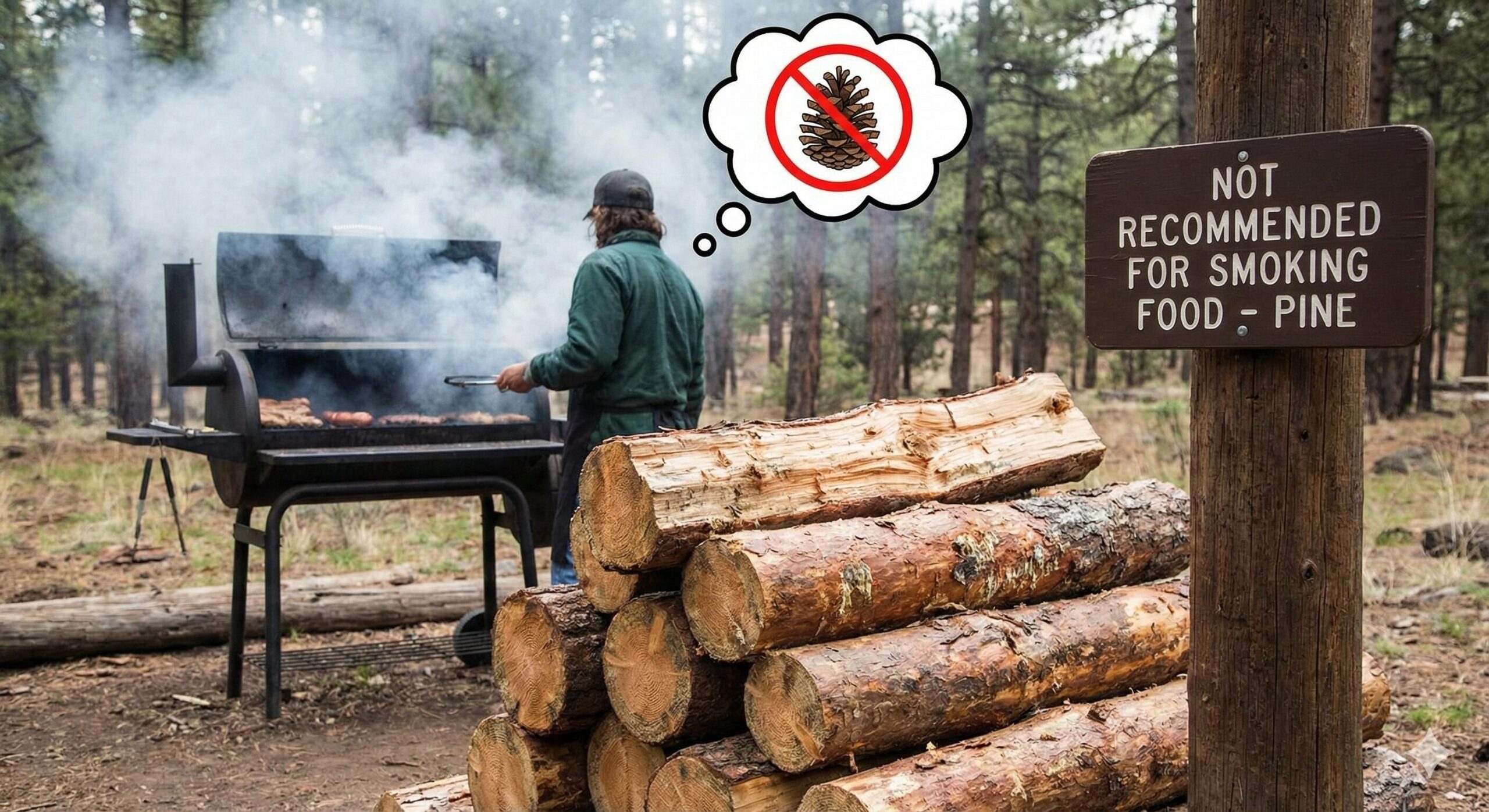
The answer is a resounding NO. You should never use pine, fir, spruce, or any other evergreen conifer for smoking meat.
While pine wood will technically burn and produce smoke, doing so can ruin your food, permanently damage your smoker with sticky residue, and most importantly, make you and your guests physically ill. Pine is a softwood loaded with resin and terpenes. When burned, these substances produce a thick, black, acrid smoke that coats everything in a bitter, oily soot known as creosote.
In this guide, we will dive deep into the chemistry of why pine is the enemy of BBQ, explain the difference between grilling planks and smoking wood, and point you toward the safe hardwoods that will make your food taste delicious.
2. The Science: Why Pine is Hazardous
To understand why pine is dangerous, we have to look at its cellular structure. Woods are generally categorized as hardwoods (deciduous trees that lose leaves, like Oak and Hickory) or softwoods (conifers that keep needles, like Pine and Spruce).
The Resin Problem
Pine trees are evolutionarily designed to resist freezing temperatures and pests. To do this, they are packed with sap and resin. This resin is rich in terpenes—volatile organic compounds that give pine trees their distinct scent. When you burn pine, you aren’t just burning cellulose; you are boiling and vaporizing this resin.
When pine resin burns, it produces excessive amounts of creosote. Creosote is a thick, black, tar-like substance. In small amounts from hardwoods, it creates color. In large amounts from softwoods, it creates a bitter, numbing coating on your meat. Furthermore, burning resin produces soot that is chemically similar to burning turpentine or oil.

Don’t risk your health with pine. This variety pack includes Hickory, Apple, and Mesquite—the holy trinity of safe, delicious BBQ smoking woods.
Check Price on Amazon3. The Flavor: Turpentine on Your Steak
Even if pine wasn’t potentially toxic (which it can be), you still wouldn’t want to use it because of the taste. Have you ever smelled Pine-Sol floor cleaner? Imagine that smell condensed into a flavor and injected into your chicken.
Meat smoked with pine takes on an incredibly bitter, chemical taste. Because pine burns fast and hot, it releases soot that settles on the surface of the meat. One bite will likely numb your tongue and leave an oily film in your mouth. It essentially destroys the natural flavor of the meat and replaces it with the taste of a campfire gone wrong.
4. Health Risks: Soot and Toxins
Burning softwoods releases higher levels of polycyclic aromatic hydrocarbons (PAHs) compared to hardwoods due to the incomplete combustion of the resins. While all smoke contains some carcinogens, the thick, black smoke from pine is significantly more hazardous to inhale and ingest.
Consuming meat heavily smoked with pine can lead to:
- Stomach Upset: The resinous oils are difficult to digest.
- Nausea: The chemical taste and smell can induce vomiting.
- Allergic Reactions: High concentrations of terpenes can trigger reactions in sensitive individuals.
Furthermore, the sticky creosote buildup inside your smoker can become a fire hazard. If you use pine, you will likely need to deep clean your rig. Learn how to clean mold and residue from a grill if you’ve made this mistake.
5. The “Black Forest” Exception
You may encounter a BBQ “expert” who claims, “But in Germany, they use pine for Black Forest Ham!”
This is technically true, but it requires massive context. Traditional Schwarzwälder Schinken (Black Forest Ham) is indeed cold-smoked over fir or pine. However, this is done in a highly controlled environment:
- Cold Smoking: The wood creates smoke without high heat, preventing the resin from boiling and igniting into bitter soot.
- Specific Species: They use local fir species with lower resin content than the standard Yellow Pine found in American lumber yards.
- Professional Curing: The meat is heavily cured to withstand the process.
For the average backyard pitmaster using a kettle grill, offset smoker, or pellet grill, attempting to replicate this will result in disaster. Do not try this at home.
6. Safe Alternatives (Hardwoods)
The golden rule of smoking is: Only use hardwoods, preferably nut or fruit-bearing trees.
Here are the safe, delicious woods you should be using instead of pine:
- Hickory: The king of BBQ. Strong, bacon-like flavor. Great for pork and ribs.
- Oak: The most versatile wood. Medium flavor, burns hot and clean. Perfect for brisket.
- Apple/Cherry: Mild, sweet, and fruity. Ideal for chicken and turkey.
- Mesquite: Very strong, earthy flavor. Best for beef, but use sparingly.

If you want Texas-style brisket, you need Oak. These chunks provide a long, clean burn without the bitterness of softwoods.
Check Price on Amazon7. How to Identify Pine vs. Hardwood
If you are scavenging wood or cutting down a tree, you need to be 100% sure of what you have. Here is how to spot the “Danger Wood”:
- Leaves vs. Needles: If it has needles or cones, it is a conifer (softwood). Do not smoke with it. If it has broad leaves, it is likely a hardwood.
- The Fingernail Test: Press your fingernail into the wood. If it dents easily and feels spongy, it is likely softwood. Hardwood (like Oak) is very difficult to dent.
- The Smell Test: Scratch the wood and smell it. If it smells like a Christmas tree, Pine-Sol, or sap, toss it.
- Resin: Look for sticky, amber-colored sap oozing from the bark. This is the flavor-killer.
8. What About Cedar Planks?
This is a common point of confusion. You can buy Cedar Planks for grilling salmon at any grocery store. Isn’t Cedar a softwood?
Yes, but Planking is NOT Smoking.
When you cook salmon on a soaked cedar plank, the wood is heated gently to release steam and aromatic oils into the fish. The wood is not supposed to burn or turn to ash. If the cedar catches fire, it produces the same acrid, black smoke as pine, ruining the fish. Plank cooking is a steaming process; smoking is a combustion process. Never put cedar chunks in your firebox.