Green Mountain Grills vs Traeger: Which Pellet Grill Reigns Supreme in 2025?
In the world of outdoor cooking, few debates are as heated as the battle of the wood pellet giants. On one side, you have Traeger, the original pioneer that invented the pellet grill and brought wood-fired flavor to the masses. On the other, you have Green Mountain Grills (GMG), the tech-savvy challenger known for aggressive innovation and better price-to-performance ratios.
If you are looking to invest in a smoker that allows you to “set it and forget it,” you have likely narrowed your search down to these two heavyweights. But does Traeger’s massive brand recognition justify the higher price tag? Or does GMG’s 12V direct power technology make it the smarter buy for the modern pitmaster?
In this comprehensive guide, we are stripping away the marketing fluff. We will compare build quality, temperature accuracy, WiFi technology, and cooking versatility to help you decide which grill deserves a spot on your patio.
At a Glance: The Tale of the Tape
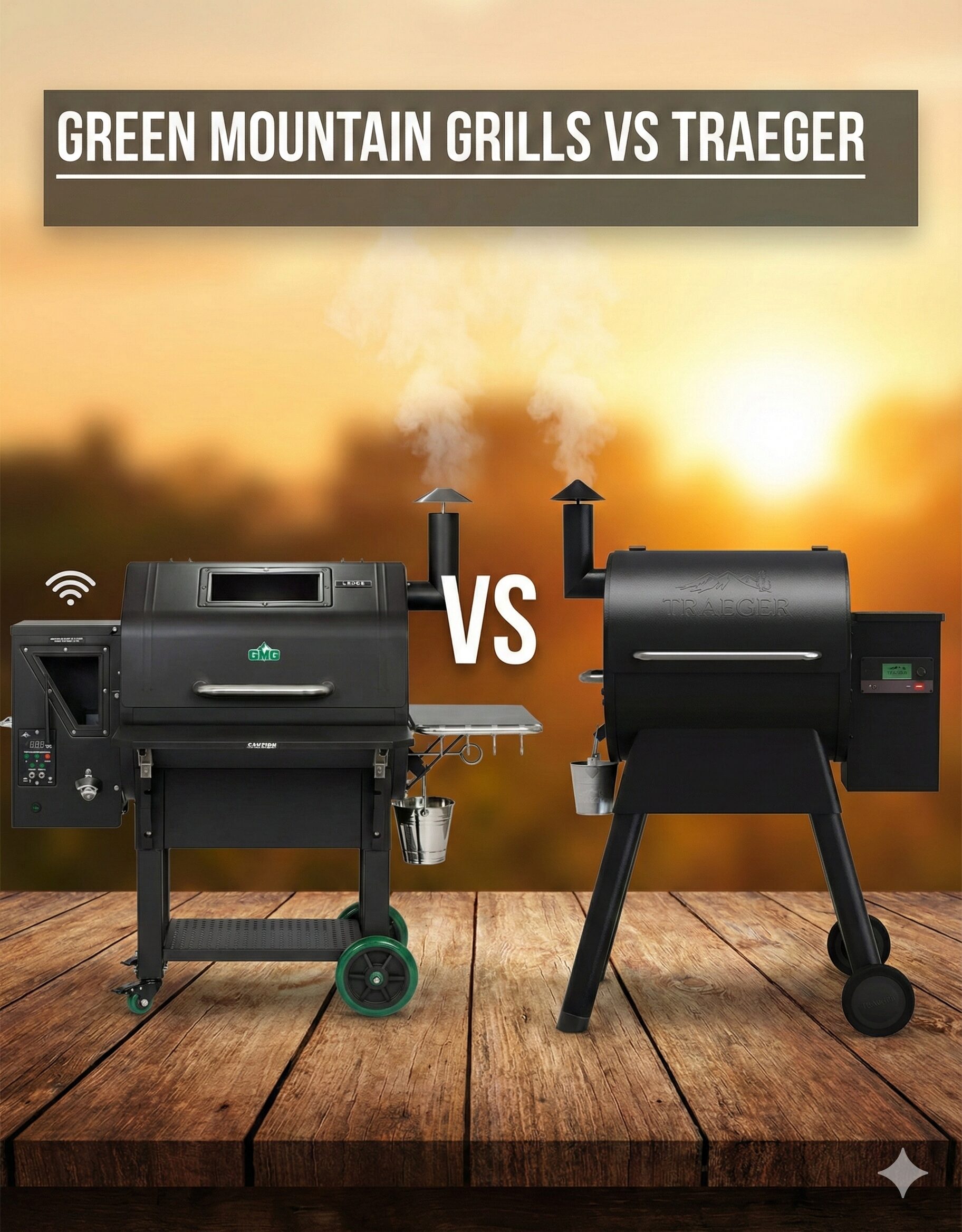
Before we dive into the nuts and bolts, here is a quick overview of how the popular mid-range models compare: The Traeger Pro 575 versus the GMG Ledge Prime 2.0.
| Feature | Traeger (Pro/Ironwood Series) | Green Mountain Grills (Prime 2.0 Series) |
|---|---|---|
| Price Range | $$$ – $$$$ (Premium pricing) | $$ – $$$ (Value focused) |
| Temperature Range | 165°F – 500°F (Model dependent) | 150°F – 550°F (Broader range) |
| Connectivity | WiFIRE® Technology | GMG Smart Control |
| Power Source | AC Current (Standard household) | 12V Direct Current (More efficient) |
| Accessories | Massive ecosystem (P.A.L. rail) | Included standard (Rotisserie ready) |
| Warranty | 3 to 10 Years (Model dependent) | 3 Years (Standard) |
The Contenders: History and Reputation
Traeger: The Original
Traeger is the Kleenex of the pellet grill world. Joe Traeger developed the original patent in 1985, and they held a monopoly on the technology for 20 years. When their patent expired in 2006, the market opened up, but Traeger remains the market leader.
They are known for polish, ease of use, and a massive community. Buying a Traeger is like buying an iPhone; it just works, it looks great, and there is an app for everything.
Green Mountain Grills: The Innovator
GMG entered the scene in 2008 with a specific mission: to improve upon the flaws of early pellet grills. They were one of the first to introduce WiFi control and, crucially, they pioneered the use of 12V Direct Power in residential grills. This allows for faster startups and more precise fan control.
GMG is often viewed as the “Android” to Traeger’s iPhone—more customizable, often more features for the money, but perhaps a slightly steeper learning curve.
If you are still deciding if a pellet grill is right for you compared to other fuel types, you might want to read our guide on pellet grills vs charcoal grills to understand the flavor differences.
Round 1: Technology and Connectivity
Both brands market their “Smart” capabilities heavily, but they approach it differently.
Traeger WiFIRE®
Traeger’s WiFIRE technology is incredibly polished. The app is intuitive, offering thousands of recipes that can literally “drive” the grill. You can select a brisket recipe on your phone, and the grill will automatically set the temp and timers. It connects to Alexa and Google Home seamlessly.
GMG Smart Control
GMG was arguably the first to really push WiFi. Their app allows for “Server Mode,” meaning you can control your grill from the grocery store via cellular data. A standout feature is the ability to create Custom Cooking Profiles. You can program the grill to: “Smoke at 225°F for 4 hours, then ramp up to 350°F until internal temp hits 203°F, then drop to 150°F to keep warm.” It offers granular control that power users love.
Round 2: Cooking Performance and Temperature Control
The 12V Advantage (GMG)
This is the biggest technical differentiator. Most pellet grills (including many Traegers) convert AC power to run the auger and fan. GMG runs on 12V Direct Current.
- Variable Speed Fan: Because it is 12V, the computer can run the fan at any speed, not just “High/Medium/Low.” This creates incredibly stable temperatures.
- Fuel Economy: The system is more efficient, using fewer pellets to maintain heat.
- Portability: You can run a GMG off your car battery or a portable jump starter easily, making even their large units tailgatable.
Traeger’s D2 Drivetrain
Traeger’s newer models utilize the D2 Direct Drive. This is a brushless motor that offers more torque and reverses if the auger jams. It is a significant upgrade from their old AC motors and provides fast startup times and good smoke production (Super Smoke mode), though this feature is locked behind their more expensive Ironwood and Timberline tiers.

Round 3: Build Quality and Design
When you are spending over $800 on a grill, you want it to last. Before using any new unit, ensure you know how to season a new BBQ grill to protect the metal internals.
Traeger
Traeger uses powder-coated steel. The barrel shape is iconic. On the higher-end Timberlines, you get double-walled insulation which is crucial for winter grilling. However, on the lower-end Pro series, the metal can feel somewhat thin compared to competitors. The legs on the Pro series are sturdy, but the wheels are often plastic casters that struggle on grass.
Green Mountain Grills
GMG grills often feel heavier. Their “Prime” series features windows to view your pellets and your food—a feature Traeger lacks on most models. However, GMG has historically battled issues with paint peeling on the firebox, though they claim to have rectified this in the Prime 2.0 models. Their cart design is generally robust with large, rubberized wheels that handle uneven terrain better than the standard Traeger casters.
Round 4: Price and Value
This is where GMG usually lands the knockout punch.
To get a rotisserie kit, a front shelf, and a viewing window on a Traeger, you are looking at the top-tier models or buying expensive add-ons. GMG includes a front shelf, a side shelf, grill windows, and often pre-drilled holes for accessories in their standard Prime pricing.
The Verdict on Value: If you have $900 to spend, a GMG Ledge will give you more features (rotisserie ready, 12V power, higher max temp) than a similarly priced Traeger Pro 575.
For those interested in exploring other brands in this price range, you might want to check out our comparison of Pit Boss vs Traeger as well.
Pros and Cons Breakdown
Traeger Pros
- Ecosystem: Massive support, recipe library, and accessory market.
- WiFIRE App: Best-in-class UI/UX.
- Availability: Easy to find parts at local hardware stores.
- Resale Value: Holds value well due to brand name.
Traeger Cons
- Price: You pay a “brand tax.”
- Max Temp: Many models max out at 500°F (searing is harder).
- Add-ons: Essential accessories are sold separately.
Green Mountain Grills Pros
- Temperature Range: Hits 550°F, better for grilling/searing.
- 12V Power: Efficient, car-battery compatible, better fan control.
- Value: More features (windows, shelves) included in the box.
- Customer Service: Often excellent direct support for parts.
Green Mountain Grills Cons
- Paint Issues: Historical complaints about paint durability.
- App Interface: Powerful, but looks dated compared to WiFIRE.
- Availability: Usually only sold through dealer networks, not big box stores.

Which One Should You Buy?
Buy a Traeger If:
- You want the most user-friendly experience possible.
- You value a polished app and access to thousands of guided recipes.
- You want a grill that looks sleek and modern on your patio.
- You are not worried about high-heat searing (or plan to use a separate grill for that).
Buy a Green Mountain Grill If:
- You want the best bang for your buck.
- You are a tech-head who wants to program custom cooking cycles.
- You plan to take the grill camping or tailgating (thanks to the 12V power).
- You want higher temperatures (550°F) for better versatility.
Regardless of which you choose, keeping your unit clean is vital for longevity. Be sure to check out the best barbecue grill cleaners to keep your investment running smoothly.
Final Verdict
Both Traeger and Green Mountain Grills produce excellent food. The “smoke flavor” difference between the two is negligible to the average palate. The choice comes down to philosophy.
Traeger is the safe, premium choice. It is the lifestyle brand that guarantees a good experience with minimal fuss. Green Mountain Grills is the enthusiast’s choice. It offers smarter power management, higher heat, and better inclusions for a lower price, provided you are willing to step outside the mainstream ecosystem.
For 2025, if budget is a concern, the GMG Ledge Prime 2.0 is the superior hardware. If ease of use and software integration is your priority, the Traeger Ironwood series remains the king of the hill.
Frequently Asked Questions
Can I use Traeger pellets in a Green Mountain Grill?
Yes, absolutely. Wood pellets are generally universal. As long as they are hardwood BBQ pellets (not heating pellets), you can use Traeger pellets in a GMG and vice versa. However, always ensure your pellets are dry; moisture is the enemy of all pellet grills.
Does GMG get hotter than Traeger?
Generally, yes. Most standard Green Mountain Grill units can reach 550°F, while standard Traeger models (like the Pro and Ironwood) usually top out at 500°F. That extra 50 degrees can make a difference when trying to crisp up chicken skin.
Which grill is better for searing?
Neither is perfect for searing compared to gas or charcoal, but GMG has a slight edge due to the 550°F max temp. For true searing on either machine, we highly recommend using a set of aluminum GrillGrates or a cast iron skillet to conduct heat directly into the meat.
Do I need electricity for these grills?
Yes, both brands require electricity to run the auger, fan, and digital control board. GMG runs on 12V DC (and comes with wall, car, and battery alligator clips), while Traeger runs on standard household AC.