Offset Smoker vs Pellet Smoker: Tradition vs Technology
Introduction: The Pitmaster’s Dilemma
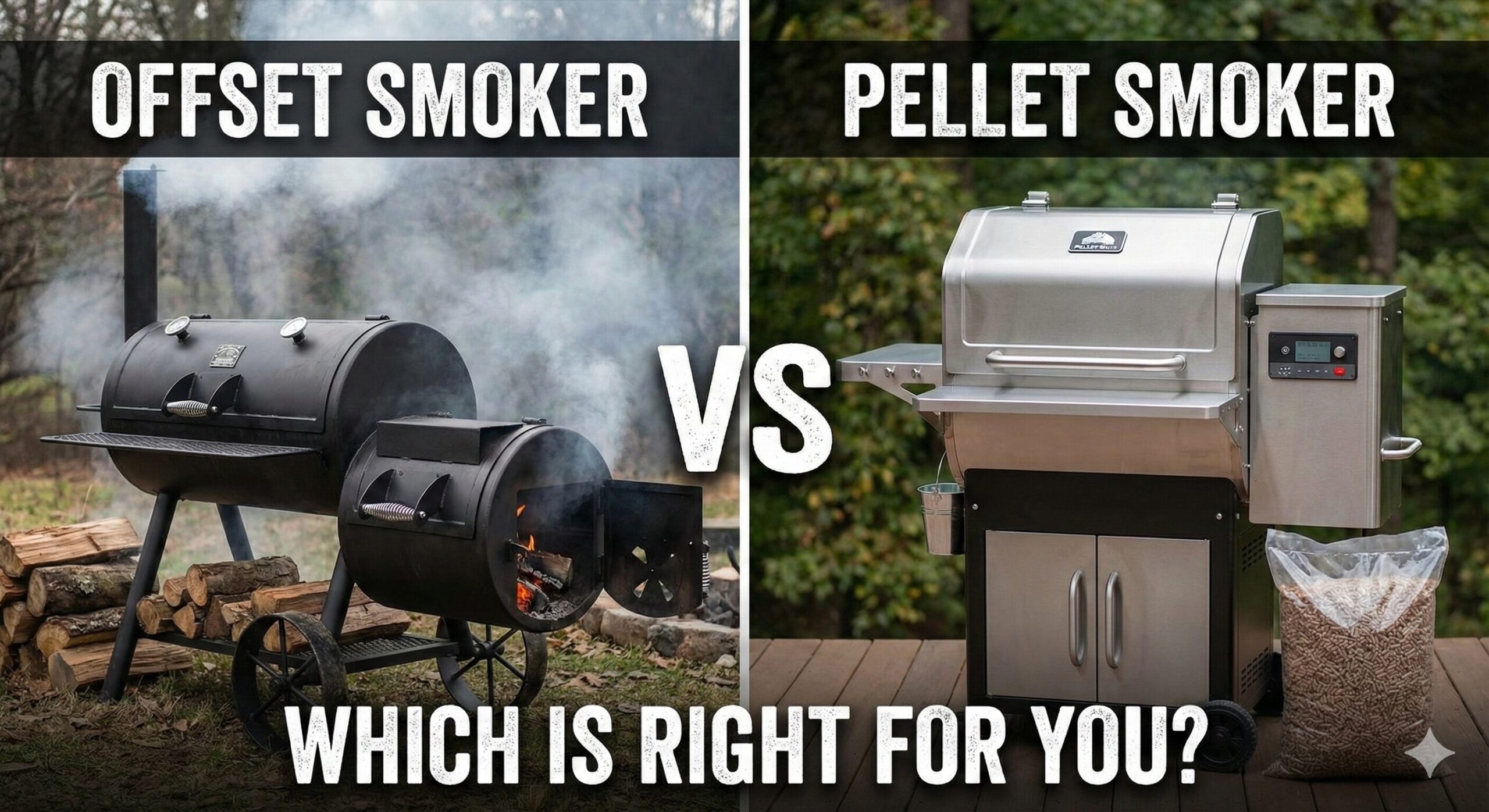
In the expansive universe of outdoor cooking, no debate is more heated or philosophically divided than the battle between the offset smoker and the pellet smoker. It is not just a comparison of appliances; it is a clash of cultures.
On one side stands the offset smoker: the rugged, heavy metal titan associated with Central Texas BBQ legends. It represents the “craft” of barbecue—tending a live fire, managing airflow, and earning every bite through patience and sleepless nights. It is the tool of the purist.
On the other side stands the pellet smoker: the technological marvel that democratized high-quality BBQ. With digital controllers, automated fuel delivery, and Wi-Fi connectivity, it offers “set it and forget it” convenience. It allows busy parents and novices to produce restaurant-quality ribs without spending 12 hours staring at a thermometer.
So, which is the best barbecue smoker for you? Are you looking for the deepest, most authentic flavor profile, or are you prioritizing consistency and ease of use? In this comprehensive offset smoker vs pellet smoker showdown, we analyze the mechanics, flavor, versatility, and cost to help you decide.
Quick Comparison: The Tale of the Tape
Before we break down the nuances, let’s look at the hard specs. Here is how these two heavyweights stack up at a glance.
| Feature | Offset Smoker (Stick Burner) | Pellet Smoker |
|---|---|---|
| Fuel Source | Wood Logs (splits) & Charcoal | Compressed Wood Pellets + Electricity |
| Flavor Intensity | High (Bold, complex smoke) | Mild to Medium (Clean smoke) |
| Ease of Use | Difficult (High learning curve) | Very Easy (Set and forget) |
| Temperature Control | Manual (Vents & Fire Management) | Automatic (Digital PID Controller) |
| Startup Time | 30–45 Minutes | 10–15 Minutes |
| Weather Resistance | Good (Thick steel holds heat) | Fair (Electronics dislike rain) |
| Running Cost | High (Wood/Charcoal adds up) | Moderate (Pellets are efficient) |
Round 1: Flavor Profile and The Smoke Ring
If flavor is king, the offset smoker wears the crown. But the pellet smoker is a very capable prince.
The Offset Flavor
Offset smokers burn real wood logs. This combustion produces a complex array of gases, including Nitrogen Dioxide (NO2) and Carbon Monoxide (CO). When these gases interact with the meat, they create a robust, heavy smoke flavor and a deep, vibrant pink “smoke ring.” The high airflow required to keep a wood fire burning also dries the surface of the meat faster, creating a thick, crunchy “bark” (crust) that is the hallmark of great brisket.
If you are curious about the science behind the color, read our article on why smoked meat turns pink.
The Pellet Flavor
Pellet smokers burn compressed sawdust pellets. While they are 100% wood, the combustion is assisted by a fan, making it incredibly efficient. Efficient fire produces less smoke. The flavor is cleaner, milder, and sweeter. You will still get a smoke ring, but it might not be as pronounced, and the bark tends to be softer due to the lower airflow. However, many people actually prefer this lighter smoke profile on poultry and pork.
Boost Your Flavor

For offset smokers, the quality of your wood dictates your flavor. Always use seasoned hardwood.
Pair with Best RubsRound 2: Ease of Use and “The Lifestyle”
This is where the divergence is most drastic. Buying an offset smoker is adopting a hobby; buying a pellet smoker is buying an appliance.
The Pellet Lifestyle
Imagine this: It’s 10 PM. You want brisket for lunch tomorrow. You season the meat, place it on the pellet grill, set the dial to 225°F, and go to bed. The smoker feeds pellets automatically to maintain temperature all night. You wake up, wrap the meat, and it’s done by noon. This is the reality of pellet smoking. It is stress-free.
Check out our comparison of Pit Boss vs Traeger grills to see which brands lead the pack in convenience.
The Offset Lifestyle
Now imagine this: It’s 4 AM. You are awake, lighting a chimney of charcoal. By 5 AM, you add your first log. Every 45 minutes for the next 12 hours, you must add another log. You are constantly adjusting vents to battle wind or temperature spikes. You smell like hickory smoke. You are exhausted, but when you slice that brisket, you feel a primal sense of accomplishment.
If you aren’t ready for this level of commitment, an offset will likely rust in your yard unused.
Round 3: Temperature Control and Consistency
Consistency is the secret to great BBQ. How do these units handle heat?
Pellet Precision
Modern pellet grills use PID (Proportional-Integral-Derivative) controllers—the same technology used in industrial ovens. They can hold a temperature within +/- 5 degrees Fahrenheit. This makes them the best smoker for ribs and brisket if your priority is repeatable results. You eliminate the variable of fire management.
Offset Variance
An offset smoker has a firebox on one side and a chimney on the other. This creates a natural temperature gradient; the side near the firebox is hotter than the chimney side. A skilled pitmaster uses this to their advantage (cooking chicken near the fire, ribs further away). However, maintaining a steady 225°F requires constant vigilance. A sudden gust of wind or a wet log can drop your temps instantly.
For those struggling with temperature management, check our guide on why your grill is not heating up properly.
Round 4: Versatility
Do you want a unit that only smokes, or one that can grill too?
Pellet Grills: The Jack of All Trades
Pellet grills act like outdoor convection ovens. You can smoke a brisket, but you can also bake a pie, roast vegetables, or braise a pot roast. However, they struggle with high-heat searing. Most max out around 450-500°F. While some have “sear slides” to expose the flame, they rarely match the searing power of a dedicated gas or charcoal grill.
Offset Smokers: The Specialist
Offsets are designed for low-and-slow smoking. The main chamber is not efficient for grilling burgers. However, many offsets come with a grill grate inside the firebox, allowing you to grill directly over the coals. This gives you a small but extremely high-heat searing area. But generally, an offset is a specialist tool.
Understanding the difference between grilling and smoking is crucial when choosing your weapon.
Versatile Cooking

Want the convenience of pellets but the sear of a flame? Look for models with direct-flame access.
Compare with CharcoalCheck Price on Amazon
Round 5: Maintenance and Durability
Offset Smokers: A high-quality offset is a heavy tank made of 1/4-inch steel. It has no moving parts. It can last a lifetime if you keep the rust away. Maintenance involves cleaning out ash and seasoning the steel with oil. Read up on key maintenance requirements to keep it running.
Pellet Smokers: These are appliances. They have auger motors, fans, hot rods, and circuit boards. In humid environments, pellets can swell and jam the auger. Electronics can fail. You must vacuum the fire pot regularly. While convenient, they have more points of failure than a steel pipe with a door.
Pros and Cons Breakdown
Offset Smoker
Pros
- Superior flavor and bark quality.
- Authentic BBQ experience.
- High capacity (large cooking area).
- Durable (no electronics to break).
- Looks impressive in the backyard.
Cons
- Steep learning curve.
- Requires constant attention (labor intensive).
- High fuel consumption.
- Takes up a lot of space.
Pellet Smoker
Pros
- Incredible ease of use (Set and Forget).
- Consistent temperatures.
- Versatile (Bake, Roast, Smoke).
- Quick startup and shutdown.
- Cleaner burning (less ash).
Cons
- Milder smoke flavor.
- Requires electricity (limits portability).
- Mechanical parts can fail.
- Poor high-heat searing performance.
The Verdict: Which is Better for Whom?
Buy an Offset Smoker If:
- You are chasing the “perfect” Texas-style BBQ and won’t settle for less.
- You enjoy the process of fire management and want a new hobby.
- You have plenty of yard space and tolerant neighbors (lots of smoke).
- You want a machine that will likely outlive you.
Buy a Pellet Smoker If:
- You love BBQ but have a busy schedule.
- You want consistent results every single time.
- You are intimidated by building fires and managing airflow.
- You want an outdoor cooker that can also bake cookies or roast a chicken.
- You live in an area where excessive smoke might annoy neighbors.
Expert Tips and Accessories
Regardless of your choice, you need the right tools to succeed.
- Thermometers: Essential. For offsets, you need a wireless probe to monitor ambient temp. See our best barbecue tools guide.
- Gloves: High-heat gloves are mandatory for handling logs or moving hot grates.
- Smoke Tubes: If you buy a pellet grill and find the flavor too mild, a smoke tube adds extra wood smoke. Read about smoke boxes and tubes here.
- Technique: Keep your meat moist! Learn how to keep meat moist in a smoker using water pans and spritzing.
Essential Gear

Never guess when your brisket is done. A quality thermometer is the best investment you can make.
See Accessories ListCheck Price on Amazon
FAQs
Yes, but it is often thinner than one from an offset. To enhance it, smoke at lower temperatures (around 180°F-200°F) for the first few hours, or use a “super smoke” mode if your grill has one.
Yes, it has a steep learning curve. Understanding how wind, vent openings, and wood size affect temperature takes practice. Expect a few bad cooks before you master it.
No. The igniter draws significant power for the first 5 minutes, but once running, the fan and auger use about as much power as a standard light bulb. You can even run them off a car battery inverter for camping.
Yes. Most pitmasters start with a bed of charcoal to establish a coal base, then switch to wood logs for flavor. Using only charcoal is possible but expensive given the airflow.
Generally, a thick-steel offset smoker retains heat better than a thin-walled pellet grill. However, many pellet smoker owners use thermal blankets to insulate their units in winter.
Pellet grills burn very clean. To get more smoke, try using stronger wood pellets (like Mesquite or Hickory), lower the cooking temperature, or add a smoke tube supplement.
While famous for brisket, they are excellent for pork shoulders, ribs, and whole chickens. Anything that benefits from long exposure to smoke excels on an offset.
Only if your firebox has a grill grate. Trying to grill in the main chamber usually doesn’t provide enough direct heat for a burger. See how to grill burgers properly.
Conclusion
The battle between offset smoker vs pellet smoker doesn’t have a single winner because they are designed for different people. If you want the destination (great food) without the journey (hard work), the pellet smoker is a miracle machine. If you believe the journey creates the value, the offset smoker is your instrument.
Ultimately, the best smoker is the one you will actually use. If 12-hour fire management sounds like a nightmare, don’t buy an offset just for the “street cred.” Buy a pellet grill and enjoy delicious BBQ every weekend. But if you have the itch to master fire, nothing satisfies like an offset.
Ready to make your choice? Check out our top-rated models for this year below.
Choose Your Weapon

Whether you choose technology or tradition, we have reviewed the best models on the market.
See Best Smokers ReviewCheck Price on Amazon