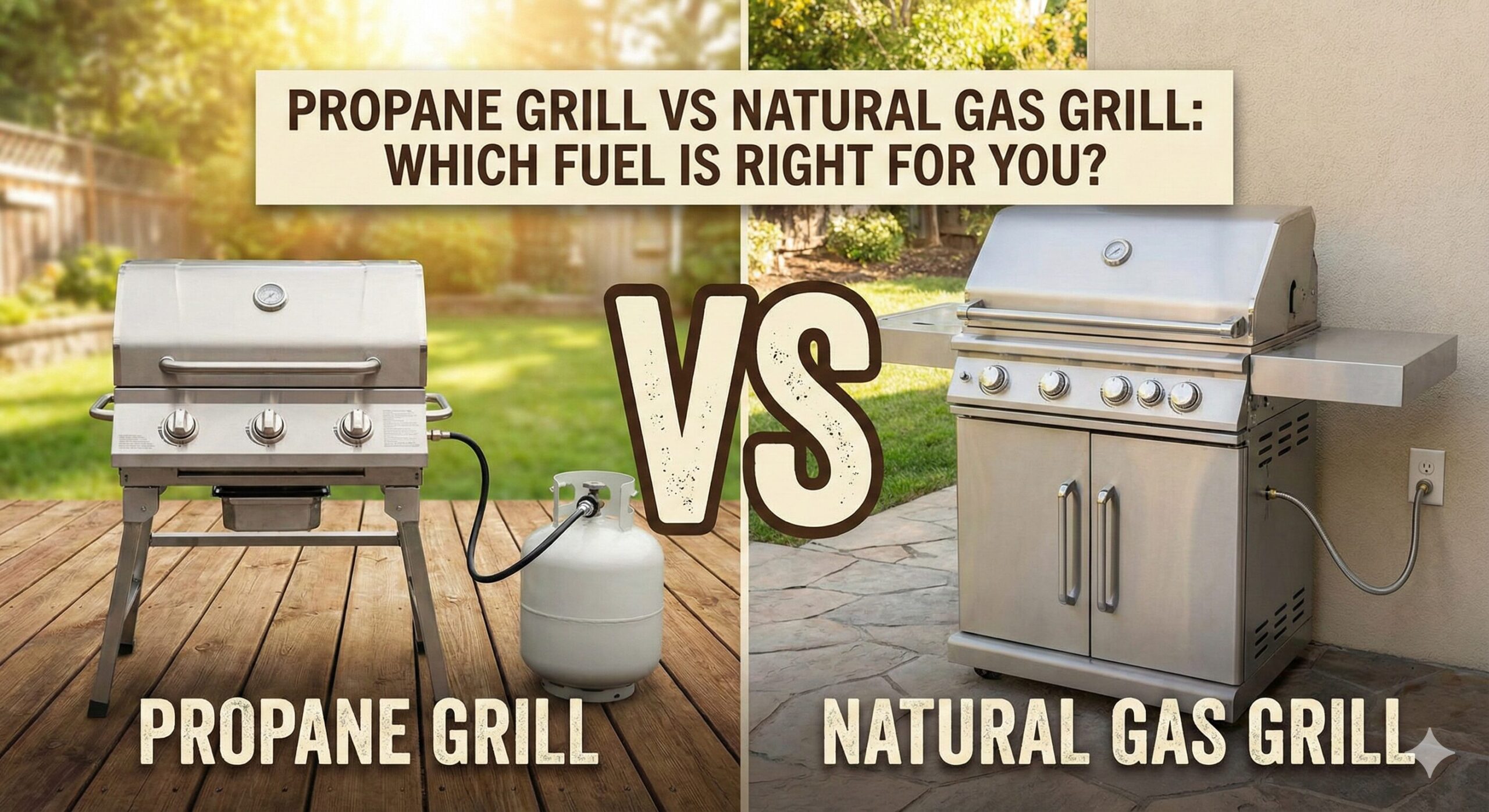
Propane Grill vs Natural Gas Grill: The Ultimate Backyard Fuel Debate
The sun is setting, the guests are arriving, and you are ready to fire up the barbecue. But as you reach for the ignition, you are faced with the defining choice of every modern griller: Propane or Natural Gas?
It is a debate that divides neighborhoods. On one side, you have the die-hard loyalists of Liquid Propane (LP), who value portability and the freedom to grill anywhere from the patio to the tailgate. On the other side, the Natural Gas (NG) aficionados sit back and relax, knowing their fuel source is hardwired to the house and will never run dry in the middle of a slow-cooked brisket.
But is one truly better than the other? Does one burn hotter? Is the cost of installing a natural gas line really worth it? In this comprehensive guide, we are stripping down the marketing jargon to give you the raw facts on cost, performance, flavor, and convenience. Whether you are building a permanent outdoor kitchen or just looking for the best barbecue grill for quick weeknight meals, this comparison will light the way.
At a Glance: The Tale of the Tape
Before we dive into the thermodynamics and installation logistics, let’s look at the high-level differences. Both fuel types will cook your food effectively, but the user experience is vastly different.
| Feature | Liquid Propane (LP) | Natural Gas (NG) |
|---|---|---|
| Fuel Source | Portable Tanks (usually 20 lbs) | Home Utility Line |
| Portability | Excellent (Move anywhere) | None (Tethered to house) |
| Initial Cost | Lower (Grill + Tank) | Higher (Grill + Plumbing Install) |
| Operating Cost | Higher per BTU | Very Low (Utility rates) |
| Convenience | Requires refilling/swapping | Endless supply |
| Heat Energy | ~2,500 BTU per cubic ft | ~1,000 BTU per cubic ft |
The Case for Liquid Propane (LP)
Liquid Propane is the reigning champion of the residential grilling market. If you walk into a hardware store today, 90% of the floor models will be set up for LP. It is a refined petroleum product that is compressed into liquid form and stored in portable cylinders.
Ultimate Portability
The biggest selling point for propane is freedom. Since the fuel source is attached directly to the grill cart, your barbecue is a mobile kitchen. You can wheel it to the far corner of the deck to keep smoke away from guests, store it in the garage during winter, or even load it into a truck for camping. For those who enjoy the flexibility of cooking anywhere, comparing pellet grills vs gas grills often leads back to propane due to this mobility factor.
Higher Energy Density
Scientifically speaking, propane packs a bigger punch. One cubic foot of propane contains roughly 2,500 BTUs (British Thermal Units) of energy, compared to about 1,000 BTUs for natural gas. While grill engineering (which we will discuss later) evens this playing field, propane is undeniably a potent fuel source that gets up to temperature quickly.

Weber Spirit II E-310 Liquid Propane Grill
The industry standard for reliable propane grilling. Features GS4 grilling system and infinity ignition.
Check Price on AmazonThe Case for Natural Gas (NG)
Natural gas is primarily methane and is the same fuel that likely powers your home’s furnace, water heater, and indoor stove. To use it for grilling, a professional plumber extends a gas line to your patio and installs a quick-disconnect valve.
The “Never-Empty” Luxury
Imagine you are two hours into slow-roasting a pork shoulder, or you have a dozen hungry guests waiting for burgers, and suddenly—the flame dies. The “propane walk of shame” to the gas station is a rite of passage we all hate. With natural gas, this scenario is impossible. You have a continuous, uninterrupted supply of fuel. This reliability makes NG grills a top contender for the best barbecue smoker setups that run on gas, where long cook times are required.
Cost Efficiency
While the upfront installation cost is higher, natural gas is significantly cheaper than propane in the long run. Depending on current energy prices, natural gas can be one-third to one-sixth the cost of propane for the same heat output. If you grill three or more times a week, the installation pays for itself surprisingly fast.

Napoleon Prestige 500 Natural Gas Grill
A premium choice for NG users, featuring infrared side and rear burners for ultimate versatility.
Check Price on AmazonHead-to-Head: Performance and Heat Output
One of the most persistent myths in the propane grill vs natural gas grill debate is that propane burns hotter and therefore sears better. While it is true that propane burns hotter by volume, grill manufacturers are well aware of this.
The Equalizer: Orifices and Regulators
A 40,000 BTU propane grill and a 40,000 BTU natural gas grill will produce the exact same amount of heat. How?
- Propane Grills: Have smaller orifice openings in the valves to limit the flow of the high-pressure, energy-dense gas.
- Natural Gas Grills: Have larger orifice openings to allow a greater volume of gas to flow through, compensating for the lower energy density.
If your grill is struggling to reach high temperatures, the issue is rarely the fuel type itself. It is more likely a clogged regulator or a ventilation issue. If you are experiencing this, check our guide on why is my grill not heating up before blaming the gas.
Verdict: It’s a tie. When properly calibrated, both fuels can sear a steak at 600°F+ without issue.
Head-to-Head: Flavor Differences
Let’s address the elephant in the room: Does the gas affect the taste of your food?
Both propane and natural gas are clean-burning fossil fuels. Unlike charcoal or wood pellets, they impart very little inherent flavor to the meat. The “grilled flavor” you associate with gas cooking actually comes from meat drippings hitting the hot flavorizer bars (or lava rocks) and vaporizing back up into the food.
Some purists argue that propane exhaust contains slightly more complex combustion byproducts that might leave a trace “bacon-like” flavor, while natural gas burns cleaner (producing mostly water vapor and CO2). However, for 99% of palates, the difference is indistinguishable. If you want real smoky flavor, you need to introduce wood.
Pro Tip: To elevate the flavor on either grill, consider using a smoke box. We have a detailed list of the best smoke boxes for gas grills that allow you to burn wood chips for that authentic BBQ taste. You can also read more about the taste difference between gas and charcoal.
Head-to-Head: Installation and Safety
Safety is paramount when dealing with combustible gases.
Propane Safety
Propane tanks are high-pressure vessels. They must be stored outdoors and upright. The biggest risk with propane is a leak at the connection point or a degraded hose. Always check for leaks using soapy water when swapping tanks. Furthermore, never store spare tanks in an enclosed garage or basement.
Natural Gas Safety
Natural gas is lighter than air, meaning if there is a leak, it tends to dissipate upwards rather than pooling low to the ground like propane. However, the installation involves tapping into your home’s main gas supply. This is not a DIY project. You need a licensed plumber to ensure everything meets local building codes.
Regardless of your choice, familiarize yourself with modern safety features to look for in a barbecue, such as thermocouple shut-offs and easy-access grease trays.
Pros and Cons Breakdown
🔥 Propane (LP)
Pros
- Portability: Grill anywhere, anytime.
- No Installation Cost: Plug and play.
- Higher Heat Density: Efficient combustion.
- Widely Available: Tanks available at most gas stations.
⚠️ Propane Cons
Cons
- Running Out: Inconvenient tank swaps mid-cook.
- Recurring Cost: More expensive fuel source.
- Tank Management: Heavy tanks are a hassle to transport.
- Waste: Disposable green camping cylinders are bad for the environment (if using portable versions).
🏠 Natural Gas (NG)
Pros
- Convenience: Never run out of fuel.
- Running Cost: Extremely cheap utility rates.
- Eco-Friendly: Burns cleaner with less waste.
- Home Value: Adds value to outdoor kitchen setups.
⚠️ Natural Gas Cons
Cons
- Installation: Expensive upfront plumber fees.
- Immobility: The grill is permanently tethered.
- Lower Pressure: More sensitive to wind in some models.
- Not for Renters: Requires modification to the property.
Can I Convert My Propane Grill to Natural Gas?
This is one of the most common questions we receive. The answer is: Maybe, but proceed with caution.
You cannot simply plug a natural gas hose into a propane grill. The orifices will be too small, resulting in a tiny flame that can barely melt cheese. Conversely, hooking propane up to a natural gas grill creates a dangerous flamethrower effect.
Some manufacturers, like Weber and Napoleon, sell specific conversion kits for certain models. However, many brands (including Weber in recent years) have stopped selling conversion kits to the public due to safety liability, voiding warranties if you attempt it. If you are torn between these top brands, check our Weber grill vs Napoleon grill comparison to see which models offer the best factory-built options for your preferred fuel.
Maintenance: Keeping Your Grill Alive
Fuel type affects maintenance slightly. Propane users need to regularly inspect the rubber hose for dry rot or cracks, as the constant movement and exposure to elements can degrade it. Natural gas hoses are often thicker and stationary, but the quick-disconnect fitting should be kept clean and capped when not in use to prevent spiders from nesting.
For both grills, internal cleanliness is key to preventing flare-ups. Grease fires don’t care about your fuel source. Read our tips on how to prevent flare-ups on a gas grill and ensure you have the best barbecue grill cleaner on hand for seasonal deep cleans.

Essential Maintenance Tools
Don’t let a dirty grill ruin your fuel efficiency. Keep your burners clean with this pro tool set.
Check Price on AmazonFinal Verdict: Which is Better for You?
The “better” grill depends entirely on your lifestyle and living situation.
Choose a Propane Grill If:
- You rent your home or move frequently.
- You want the flexibility to move the grill around your yard or take it tailgating.
- You don’t want to pay $300-$500 for a gas line installation.
- You are a casual griller who cooks once a week or less.
Choose a Natural Gas Grill If:
- You own your home and plan to stay there for a while.
- You grill frequently (3+ times a week) and want to save money on fuel.
- You are building a permanent outdoor kitchen or BBQ island.
- You value the convenience of never having to refill a tank again.
Still undecided? You might want to consider alternative fuel types entirely. Check out our Kamado grill vs gas grill comparison if you want more flavor versatility, or the best electric barbecue grill if open flames aren’t allowed in your area.
Frequently Asked Questions
1. Is natural gas cheaper than propane?
Yes, significantly. While the grill and installation cost more upfront, natural gas from your utility provider is much cheaper per BTU than pre-filled propane tanks.
2. Do natural gas grills cook differently than propane?
No. Once the burners are calibrated with the correct orifices, the heat output and cooking performance are virtually identical.
3. Can I use a propane tank on a natural gas grill?
No! The pressure and orifice sizes are different. Connecting the wrong fuel source is dangerous and can cause explosions or damage the grill.
4. Does food taste better on propane or natural gas?
There is almost no taste difference. Both are clean-burning fuels. Flavor comes from seasonings, smoke, and drippings. Check out our best barbecue rub recommendations to boost flavor.
5. Can I grill frozen meat on a gas grill?
Yes, gas grills are great for this because you can control the temperature precisely. Learn more about grilling frozen meat here.
6. How do I know if I have a natural gas line for a grill?
Look for a capped pipe or a quick-disconnect valve on your patio or exterior wall. If you don’t see one, you will need a plumber to install it.
7. Is it hard to convert a grill later?
It can be difficult. Many manufacturers are moving away from conversion kits due to safety concerns. It is always best to buy the grill that matches your fuel source from day one.
8. Which fuel is better for the environment?
Natural gas is generally considered the cleanest burning fossil fuel, releasing less carbon dioxide than propane. It also eliminates the waste of disposable tanks.
9. Why is my burger falling apart on the gas grill?
This is usually due to handling or fat content, not the fuel. See our guide on how to keep burgers from falling apart.
10. What happens if I use natural gas in a propane grill without converting?
The flame will be tiny and weak because the propane orifices are too small for the lower-pressure natural gas.
Conclusion
The battle of propane grill vs natural gas grill doesn’t have a single winner—it has a winner for you. If you crave the freedom of the open road (or just the open patio), propane is your trusty companion. If you desire the luxury of infinite fuel and lower operating costs for your permanent backyard oasis, natural gas is the smart investment.
Whichever fuel you choose, the most important factor is getting out there and cooking. Don’t forget to protect your deck with the best grill mats and stock up on the best barbecue sauce to finish your masterpiece.