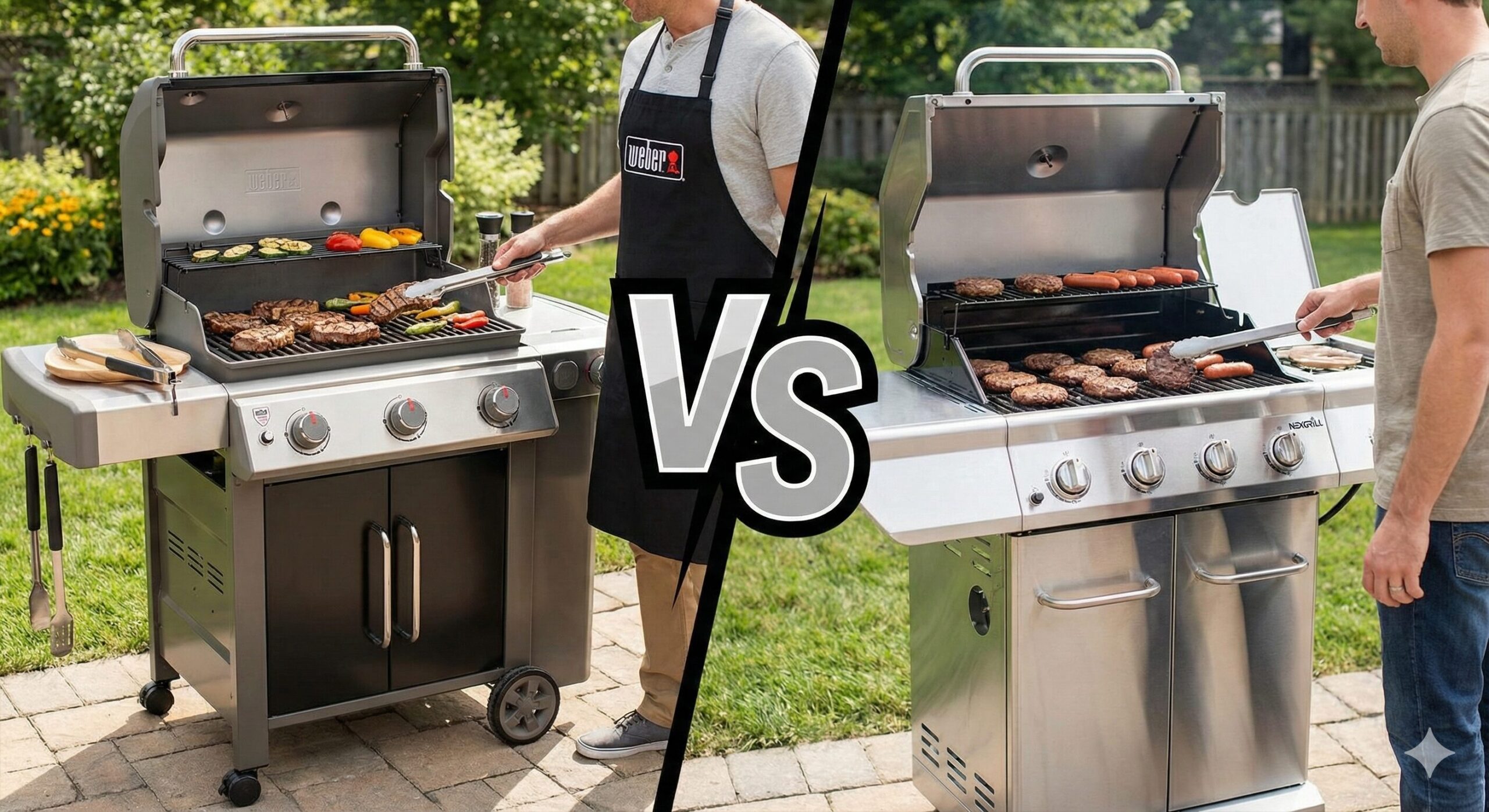
Weber Grill vs. Nexgrill: The Battle Between Legacy and Value
1. The Grilling Dilemma: Pay More or Save Now?
Walk into any Home Depot or Lowe’s, and you are immediately presented with a choice. On one side of the aisle sits Weber, the industry titan with its iconic black lids, rugged cast aluminum bodies, and price tags that can make your wallet wince. On the other side sits Nexgrill, gleaming in stainless steel, boasting infrared burners and side sear stations, often for half the price of the Weber sitting next to it.
It is the classic consumer battle: Legacy vs. Value. Do you pay the “Weber Tax” for a grill that might last 15 years, or do you save $400 today and get a feature-packed Nexgrill that looks great on your patio right now?
In this comprehensive guide, we are stripping away the marketing hype. We will analyze the metallurgy, the heat distribution engineering, and the real-world warranty support of both brands. Whether you are a weekend burger flipper or a serious pitmaster, this Weber vs. Nexgrill showdown will help you decide where to put your money in 2026.

The gold standard for mid-range gas grills. Features the GS4 grilling system, infinity ignition, and a 10-year warranty on all parts.
Check Price on Amazon2. At a Glance: Key Differences
If you are in a rush, here is the high-level breakdown of how these two brands approach outdoor cooking.
| Feature | Weber | Nexgrill |
|---|---|---|
| Primary Material | Cast Aluminum & Porcelain-Enameled Steel | 304 or 430 Grade Stainless Steel |
| Price Range | $450 – $2,000+ | $200 – $800 |
| Warranty | 10-12 Years (Comprehensive) | 1-5 Years (Limited) |
| Heat Distribution | Excellent (Flavorizer Bars) | Good to Average (Flame Tamers) |
| Tech Features | Minimalist (unless buying Smart series) | High (Infrared, Side Burners included) |
| Lifespan | 10-15 Years+ | 3-5 Years (typically) |
3. Weber: The King of Longevity
Weber didn’t become the most recognizable name in BBQ by accident. Their philosophy is engineering-first. A Weber grill is built like a tank. They prioritize cast aluminum fireboxes, which are virtually rust-proof and retain heat exceptionally well. This is a stark contrast to the thin sheet metal found on cheaper grills.
Weber’s claim to fame is their Flavorizer Bars. These angled metal bars cover the burner tubes, catching drippings and vaporizing them back into the food to create that distinct “grilled” flavor. They also protect the burners from clogging. When you buy a Weber, you are paying for consistency. You know that a burger on the top left corner will cook at the same speed as a burger in the center.
However, Weber is often criticized for being “feature-poor” at lower price points. A $500 Weber Spirit often lacks a side burner or sear station, features that are standard on a $300 Nexgrill.
4. Nexgrill: The Value Challenger
Nexgrill is the house brand for many big-box retailers (though it is a standalone manufacturer). Their strategy is maximizing “bang for your buck.” They build grills that look incredibly premium on the showroom floor. They use extensive amounts of stainless steel, giving them a shiny, commercial kitchen aesthetic.
Nexgrill innovates where Weber hesitates. Their Evolution series features “Infrared Plus” technology, allowing you to switch between traditional gas grilling and infrared searing. This helps prevent flare-ups and delivers intense heat for searing steaks. They almost always include side burners for heating sauces or sautéing vegetables.
The catch? The stainless steel used (often 430 grade) contains iron and is prone to rusting if not meticulously maintained. The internal components—flame tamers, burners, and carryover tubes—tend to corrode significantly faster than Weber’s components.

A powerhouse of value. Offers a massive cooking area, a side burner, and sleek stainless steel construction for a fraction of the cost of premium brands.
Check Price on Amazon5. Build Quality: Cast Aluminum vs. Stainless Steel
This is the single most important section of this review. The materials used determine how long your grill will live.
Weber’s Cookbox
Weber uses cast aluminum for the “tub” (cookbox) of the grill. Aluminum does not rust. Ever. It is thick, holds heat, and withstands thermal shock (going from cold to hot quickly). The lids are often porcelain-enameled steel, which is fused glass onto metal. It is incredibly resistant to peeling, scratching, and fading.
Nexgrill’s Construction
Nexgrill relies on stainless steel. However, there are different grades of stainless steel. High-end grills use 304 stainless (non-magnetic, very rust-resistant). Budget grills like Nexgrill often use 430 stainless. While it looks shiny initially, 430 stainless attracts magnets and will rust, especially near salt water or in humid climates. Furthermore, the firebox is often made of thin sheet metal rather than cast aluminum, which loses heat faster and burns out over time.
6. Cooking Performance & Heat
Weber excels at convection cooking. The shape of the lid and the placement of the Flavorizer bars create an airflow that circulates heat evenly around the food. This makes Webers exceptional for roasting chickens or cooking delicate items that require indirect heat. You rarely get “hot spots” or “cold spots” on a Spirit or Genesis.
Nexgrill is a brute force cooker. Their burners often have higher BTU ratings than Weber, meaning they can get hotter, faster. If your main goal is to sear steaks at 700°F quickly, a Nexgrill with infrared plates can actually outperform a standard Weber Spirit. However, users often report uneven heating (hot at the back, cool at the front) and more frequent flare-ups due to the design of the flame tamers compared to Weber’s Flavorizer system.
Flare-ups are the enemy of good BBQ. They char your food before it’s cooked. If you struggle with this, read our guide on how to prevent flare-ups on a gas grill.
7. Warranty Wars: 10 Years vs. 1 Year
Here is where the price difference justifies itself.
Weber offers a 10-year warranty (and sometimes 12 on high-end models) on the entire grill. That includes the burners, the ignition, the cookbox, and the lid. If a burner rusts out in year 9, Weber sends you a new one. Their customer service is legendary.
Nexgrill warranties are fragmented. You might get 1 year on the entire grill, 3-5 years on burners, and varying lengths on other parts. It is much more limited. When you buy a Nexgrill, you are accepting that in 4 or 5 years, you might be buying a replacement grill or hunting for generic parts.
8. Head-to-Head Model Comparisons
8.1 Weber Spirit II E-310 vs. Nexgrill Evolution 5-Burner
The Spirit II E-310 is Weber’s best-selling entry-level grill (3 burners). It costs roughly $550+. The Nexgrill Evolution 5-Burner costs roughly $350-$400.
The Nexgrill gives you 5 burners, a side burner, and infrared plates. It has way more cooking surface. The Weber has only 3 burners and no side burner. However, the Weber will likely be sitting on your patio in 2035 working perfectly, while the Nexgrill may have been replaced twice. Winner: Weber for longevity, Nexgrill for cooking space/budget.
8.2 Weber Q Series vs. Nexgrill Fortress
In the portable market, the battle is fierce. The Nexgrill Fortress is a cast-aluminum 2-burner tabletop grill that looks suspiciously like a Weber Q but costs half as much. Surprisingly, the Fortress gets excellent reviews for its durability because it actually uses cast aluminum (like Weber). It is one of the best values in Nexgrill’s lineup.
The Weber Q1200/Q2200 remains the king of camping, but the price gap is hard to ignore here. If you need a tailgating grill, the Nexgrill Fortress is a very strong contender.
The ultimate portable grill. Cast aluminum body, porcelain-enameled cast-iron grates, and electronic ignition. Perfect for camping and tailgating.
Check Price on Amazon9. Maintenance & Durability
Because Nexgrills use lower-grade stainless steel, you must cover them. Leaving a Nexgrill uncovered in the rain is a death sentence. You also need to clean the interior firebox regularly to prevent grease fires, which can warp the thinner metal.
Weber’s open-cart design (on the Spirit II) and advanced grease management system (a funnel into a drip pan) make it incredibly easy to clean. The grease doesn’t pool in the bottom of the cabinet; it flows away safely.
10. Final Verdict: Which is for You?
Buy a Weber If:
- You want a grill that lasts 10+ years.
- You hate rust and assembling complicated machines.
- You value even heat and predictable cooking results.
- You are willing to pay upfront for quality.
Buy a Nexgrill If:
- You are on a strict budget (under $350).
- You need a huge cooking area for parties but can’t afford a Genesis.
- You want specific features like Infrared or a Side Burner at a low cost.
- You don’t mind replacing the grill in 3-5 years.
The Bottom Line: If you view a grill as an investment, Weber wins. It costs less per year of ownership because it lasts three times as long. If you view a grill as a temporary appliance or need maximum features for a minimum price right now, Nexgrill is the undisputed value king.