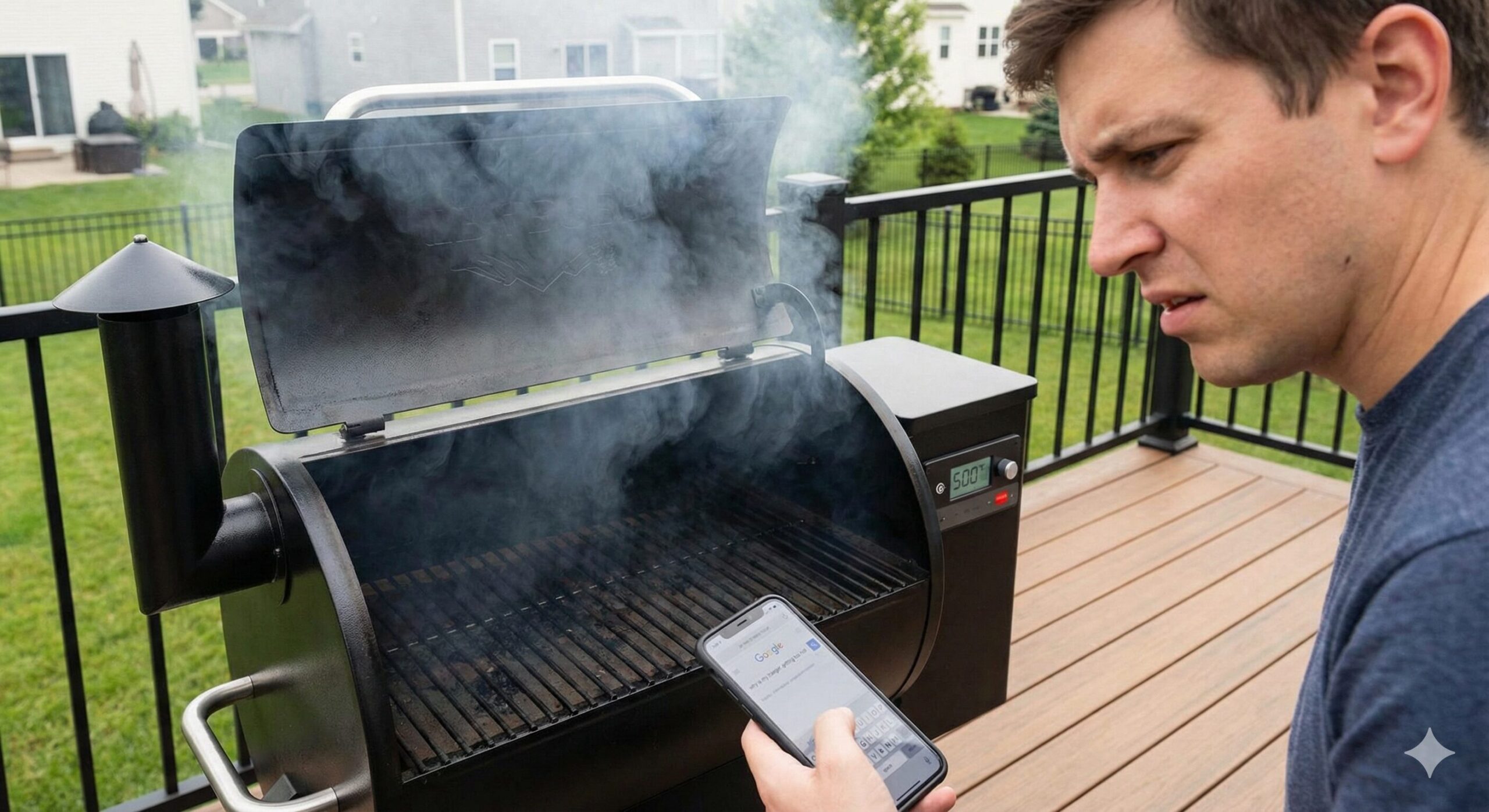
Why Is My Traeger Getting Too Hot? (And How to Fix It)
1. The Runaway Grill: Why 225°F Became 400°F
You set your Traeger to 225°F for a slow-smoked pork butt. You walk away for twenty minutes, only to return and find the digital display reading 450°F and rising. Your low-and-slow cook has turned into an incinerator. This phenomenon, often called a “runaway grill,” is one of the most frustrating issues for pellet grill owners.
A Traeger getting too hot isn’t just an annoyance; it can ruin expensive cuts of meat and, in extreme cases, damage the grill’s paint or internal components. The good news is that this is rarely a fatal flaw in the computer. In 90% of cases, it is caused by user error during startup, a dirty sensor, or airflow issues. This guide will walk you through diagnosing the heat spike and returning your grill to a steady smoke.

The first step to fixing temperature swings is a deep clean. This heavy-duty degreaser cuts through the carbon buildup that insulates your temperature probe.
Check Price on Amazon2. Cause #1: Improper Startup Procedure
This is the most common culprit, especially for new owners. If you start your Traeger with the lid closed, you are trapping a massive amount of initial ignition heat inside the barrel.
How it happens: When the firepot ignites a fresh pile of pellets, it creates a large initial burst of white smoke and heat. If the lid is closed, that heat builds up rapidly. The controller sees the temperature skyrocketing past the set point (e.g., shooting to 350°F when set to Smoke) and gets confused. It then shuts off the auger to compensate, causing the fire to die down, followed by a massive dump of pellets to restart it, leading to a rollercoaster of temperature swings.
The Golden Rule
Unless you have a newer WiFIRE model (which allows closed-lid startup), always start your Traeger with the lid OPEN. Turn it to “Smoke,” wait for the fire to establish (about 5-10 minutes) and the smoke to turn clear, then close the lid and set your temperature.
3. Cause #2: The Dirty RTD Probe
Your Traeger has a small vertical metal rod inside the cooking chamber (usually on the left side). This is the RTD (Resistance Temperature Detector) probe. It tells the computer how hot the grill is.
Over time, smoke and grease coat this probe in black soot. This soot acts as an insulator. The probe might be reading 200°F because it’s insulated, while the actual air temperature is 300°F. Because the computer thinks the grill is too cold, it keeps feeding more pellets into the fire pot, causing the grill to overheat significantly.
The Fix: Wait for the grill to cool completely. Use a damp cloth or a mild abrasive pad (like a Scotch-Brite) to gently wipe the probe until it is shiny silver again. Do this every 3-5 cooks.
4. Cause #3: The Hidden Grease Fire
If your temperature is reading “High” or exceeding 500°F uncontrollably, you might have a grease fire. This happens when grease accumulates on the drip tray (grease drain pan) or in the bottom of the barrel and ignites.
This is distinct from the fire pot flame. A grease fire burns outside the pot, fueling itself with old fat drippings. It creates intense, uncontrollable heat. If you see thick black smoke or flames licking up the sides of the drip tray, turn the grill off immediately and keep the lid closed to starve the fire of oxygen.

If cleaning your probe doesn’t fix the overheating, the sensor itself may be faulty. This replacement is compatible with most Traeger models.
Check Price on Amazon5. Cause #4: Incorrect P-Settings (Older Models)
If you have an older Traeger (non-WiFIRE) with a digital readout, you likely have a “P-Setting” (Pause Setting). This controls how long the auger pauses between feeding pellets when in “Smoke” mode.
If your P-Setting is too low (e.g., P-0 or P-1), the auger feeds pellets very frequently. On a hot summer day, this can cause the fire to grow too large, raising the ambient temperature above your target. Raising the P-Setting (to P-3 or P-4) increases the pause time, slowing down the fuel rate and lowering the temperature. Note: This only affects the “Smoke” setting, but an overheated “Smoke” cycle can throw off the temps for the rest of the cook.
6. Cause #5: Weather & Pellet Dust
Hot Weather: Traegers are insulated. On a 100°F day in direct sunlight, the grill is already hot. The minimum feed rate might produce more heat than necessary to maintain 180°F, causing it to creep up to 225°F or higher.
Pellet Dust: At the bottom of your pellet bag, there is often sawdust. If you dump this into the hopper, the dust can accumulate in the bottom of the auger. This dust burns much faster and hotter than compressed pellets, creating “flash” heat spikes. Always sift your pellets or avoid pouring the last cup of the bag into the hopper.
7. Step-by-Step Fix Guide
If your Traeger is currently running too hot:
- Open the Lid: Let the excess heat escape.
- Check for Fire: Ensure there isn’t a grease fire in the bottom.
- Check the Mode: Did you accidentally hit “High”?
- Shut Down: If it remains too hot, run the shutdown cycle. Let it cool completely.
- Vacuum: Vacuum out the fire pot. Excess ash can disrupt airflow, causing the controller to overcompensate with fuel.
- Clean Probe: Wipe the RTD probe.
- Restart Properly: Use the proper startup sequence (Lid Open) for your specific model.

A standard shop vac can be a fire hazard with warm ash. This dedicated ash vacuum is essential for keeping your fire pot clean and airflow optimized.
Check Price on Amazon