Yoder vs Traeger: The Heavyweight Title Fight of Pellet Grills
Is heavy-gauge steel worth the price, or does mass-market technology reign supreme?
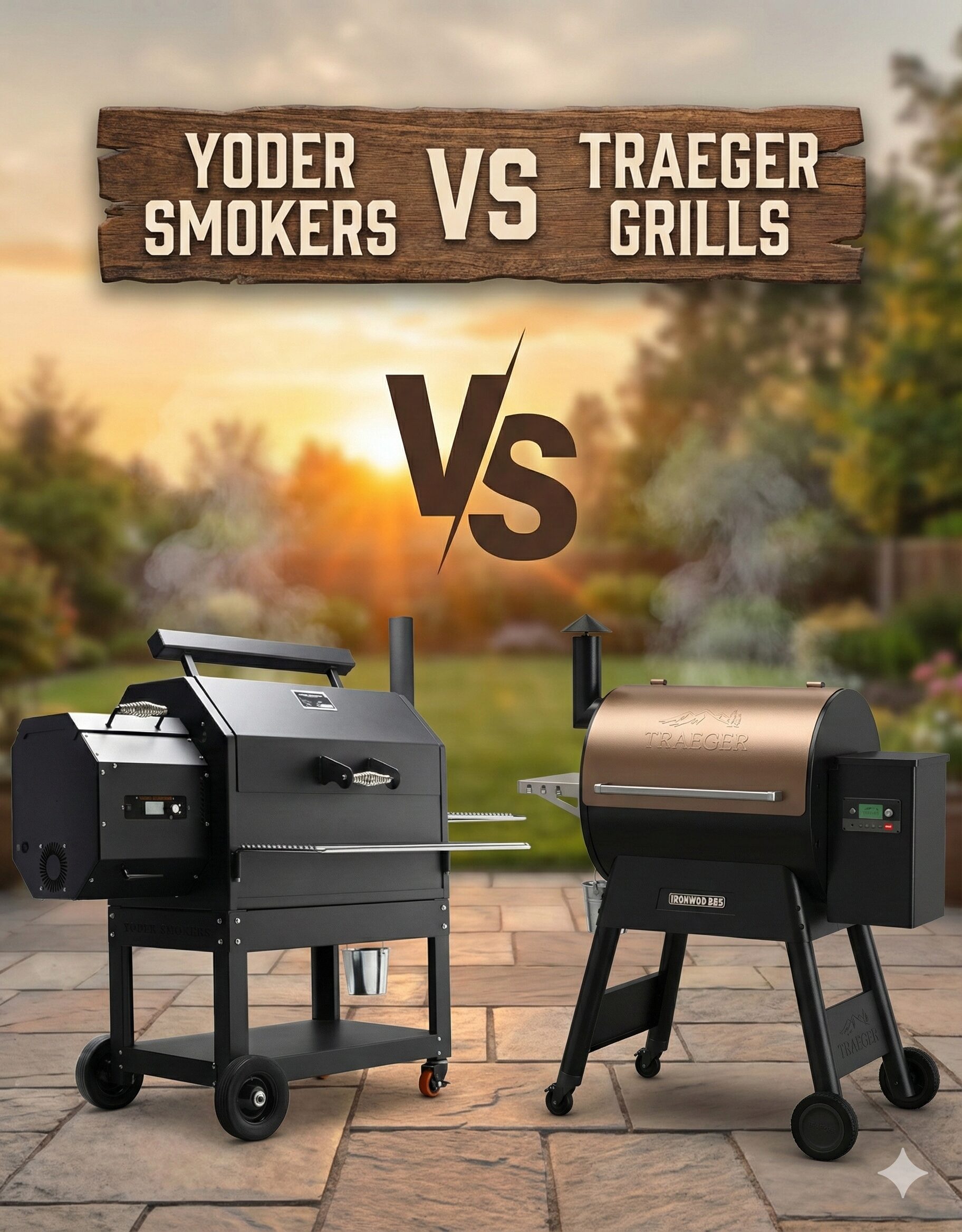
If you are looking to invest serious money into a pellet grill, your research has likely led you to a fork in the road. On one side, you have Traeger, the original inventor of the pellet grill and the biggest name in the game, known for slick apps and widespread availability. On the other side, you have Yoder Smokers, the cult-favorite from Kansas that builds grills weighing nearly three times as much as their competitors.
This isn’t just a comparison of two brands; it is a comparison of two different philosophies. Do you want a grill built like a tank that will last a lifetime (Yoder), or do you want the “iPhone of grills” with polished features and ease of use (Traeger)?
In this comprehensive Yoder vs Traeger guide, we are going deep. We are stripping away the marketing fluff to look at steel gauge, temperature consistency, searing capability, and software reliability to help you decide where to put your money.
At a Glance: The Tale of the Tape
For this comparison, we are pitting the industry standard Yoder YS640s against its closest price competitors, the Traeger Ironwood XL and the Traeger Timberline.
| Feature | Yoder Smokers (YS640s) | Traeger Grills (Ironwood/Timberline) |
|---|---|---|
| Build Quality | 10-Gauge American Steel (Heavy Duty) | Double-wall Powder Coated Steel (Standard) |
| Weight | ~335 lbs (Tank-like) | ~150 – 240 lbs (Mobile) |
| Max Temp | 700°F+ (Direct Flame) | 500°F (Mostly Indirect) |
| Controller | FireBoard ACS (Pro Grade) | WiFIRE (Consumer Friendly) |
| Origin | Made in USA (Kansas) | Made in China/Vietnam |
| Best For | Pitmasters who want to sear & smoke | Tech-lovers wanting “Set & Forget” |
Contender 1: Yoder Smokers (The Tank)
Based in Hutchinson, Kansas, Yoder Smokers built their reputation on the competition BBQ circuit. Their motto is “Competition Grade BBQ Products,” and they aren’t joking. When you touch a Yoder, it feels industrial. It doesn’t rattle.
The YS640s
The “s” stands for the ACS (Adaptive Control System) powered by FireBoard. This was a massive upgrade for Yoder, moving them from an “old school” manufacturer to a tech leader. The grill is constructed from 10-gauge steel, which provides immense thermal mass. Once this grill gets hot, it stays hot, regardless of the weather outside.
If you’re interested in how pellet grills stack up against other fuel types, check out our guide on Pellet Grill vs Charcoal Grill.

Contender 2: Traeger Grills (The Tech Giant)
Traeger is the brand that started it all. They have likely sold more pellet grills than all other manufacturers combined. Because of their size, they have a massive R&D budget, which shows in their user interface.
The Ironwood & Timberline Series
Traeger has completely revamped their lineup. The new Ironwood and Timberline models feature the “Pop-And-Lock” accessory rail (P.A.L.), a touchscreen interface, and a fully integrated grease management system. They are designed to be foolproof. The fit and finish are polished, looking more like a high-end appliance than a piece of farm equipment.
Comparing mainstream brands? See how they fare in our Pit Boss vs Traeger Grills showdown.

Round 1: Build Quality & Durability
This is the biggest differentiator. When you see a Yoder vs Traeger forum debate, this is usually the main argument.
Yoder: 10-Gauge Steel
The YS640s is prone to rusting if you don’t take care of the paint (it uses standard high-heat paint, not powder coat on the main chamber), but the metal itself is virtually indestructible. It is heavy. You do not want to move this grill up and down stairs. The thickness of the metal means excellent heat retention, which is crucial for winter grilling.
Traeger: Double-Walled Insulation
Traeger uses thinner metal but employs engineering tricks to compensate. The new Ironwood and Timberline series feature full double-wall insulation. This creates a “thermos” effect, keeping heat in without needing 300 lbs of steel. The exterior is powder-coated and generally holds up better to the elements visually, but it doesn’t have the “heirloom” durability of the Yoder.
Round 2: Cooking Performance & Searing
Can a pellet grill actually grill? That is the question.
Direct Flame Access (Yoder)
Yoder features a sliding damper that allows you to expose the firepot directly to the grates. When you install the optional “Grill Grates,” the YS640s transforms into a high-heat grilling machine capable of hitting 700°F+. You can legitimately sear a steak on a Yoder.
Convection Cooking (Traeger)
Traeger has historically struggled with searing. The Timberline uses an induction cooktop on the side for searing, admitting that the main chamber is really an oven. While the new models get hotter (500°F), they are designed primarily as convection ovens. They excel at baking, roasting, and smoking, but they lack the visceral direct-flame experience of the Yoder.
Looking for other options that can sear? Check out the Green Mountain Grills vs Traeger comparison.
Round 3: Technology & App Experience
We are living in the age of “smart” BBQ.
Traeger WiFIRE
Traeger’s app is beautiful. It comes loaded with thousands of recipes that you can “push” to the grill. You select “Brisket,” and the grill sets the temp and timers for you. It’s incredibly user-friendly and rarely crashes. The WiFIRE controller is intuitive and easy for beginners.
Yoder FireBoard
Yoder partnered with FireBoard, a company that makes high-end standalone thermometers. The data logging on the Yoder is superior. You get detailed graphs, cloud storage of your cooks, and extreme precision. However, the app is more utilitarian. It lacks the “recipe integration” of Traeger but offers more control for the pro.
Pros and Cons Breakdown
Yoder Smokers YS640s
- Built like a tank: 10-gauge steel construction.
- Direct Flame: True grilling capability over open fire.
- FireBoard Tech: Professional grade temperature tracking.
- Made in USA: Supporting American manufacturing.
- Capacity: Massive cooking area with slide-out shelves.
Yoder Negatives
- Paint Issues: Requires touch-up paint maintenance annually.
- Heavy: extremely difficult to move alone.
- Price: Accessories add up quickly.
- Pellet Consumption: Heavy steel takes longer to heat up and uses more fuel.
Traeger Ironwood/Timberline
- WiFIRE App: Best-in-class user interface and recipes.
- Clean Up: Excellent grease & ash management systems.
- Availability: Easy to find parts and dealers everywhere.
- Efficiency: Double-wall insulation saves pellets.
- Polished Look: Looks great on a modern patio.
Traeger Negatives
- Searing: Lacks true direct-flame capability.
- Build: Thinner metal compared to Yoder.
- Price: The new Timberline is extremely expensive for what you get.
Final Verdict: Which One Belongs on Your Patio?
The Yoder vs Traeger debate ultimately comes down to what kind of cook you are.
Buy the Yoder YS640s if:
You are a BBQ purist. You want a machine that feels industrial and capable. You plan on searing steaks just as often as you plan on smoking briskets. You are okay with doing a little maintenance (painting) to own a machine that will last 20 years. You prioritize build quality over fancy touchscreens.
Buy the Traeger (Ironwood/Timberline) if:
You value convenience above all else. You want the “set it and forget it” lifestyle with an app that guides you through every step. You want a grill that is easy to clean and looks sleek. You are mostly interested in smoking, baking, and roasting, and you have a separate gas grill for searing.
Before you make your purchase, don’t forget the essentials. Read our guide on Key Maintenance Requirements for Barbecues to keep your investment running like new.

Frequently Asked Questions
Does Yoder rust?
Yes, Yoder smokers can develop surface rust because they use high-heat paint rather than powder coat on the main chamber. However, this is easily fixed with a can of Yoder touch-up paint and does not affect structural integrity.
Is Traeger made in the USA?
No, Traeger grills are currently manufactured in China and Vietnam. Yoder Smokers are made in the USA (Kansas).
Can you grill burgers on a Traeger?
Yes, you can cook burgers on a Traeger, but because it relies on indirect heat, they will be more like oven-roasted burgers unless you use a cast-iron skillet inside the grill to get a sear.
Why is the Yoder YS640s so heavy?
The Yoder YS640s is constructed from 10-gauge steel, which is significantly thicker than standard grills. This weight provides thermal mass, helping the grill maintain temperature in cold weather.