What Is the Oklahoma Joe’s Highland Smoker?
There’s a reason BBQ enthusiasts whisper the Oklahoma Joe’s Highland’s name with a particular reverence. Since Joe Davidson hand-built his first 12 smokers for the 1987 Oklahoma State Fair — selling every single one before closing time — this brand has occupied a unique space in American outdoor cooking: serious, authentic performance at a price that doesn’t ask you to refinance your home.
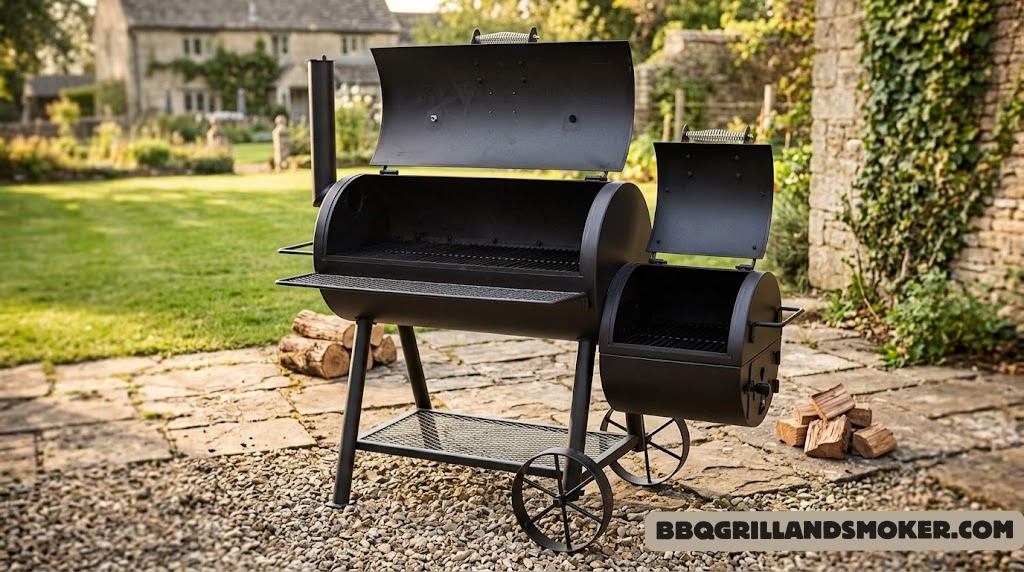
The Highland is a classic horizontal offset charcoal smoker in the traditional wagon-style format. A large horizontal cooking chamber sits on four sturdy steel legs, with a separate firebox bolted to the left side. You load charcoal and hardwood into the firebox, the combustion heat and smoke travel through the main cooking chamber, and the exhaust exits through the vertical smokestack on the right. It’s old-school, it’s proven, and in the right hands, it produces genuinely competition-caliber BBQ.
But the Highland isn’t a plug-and-play appliance. It rewards engagement, repays the investment of learning its behavior, and benefits enormously from a handful of inexpensive modifications that take it from good to great. This review covers absolutely everything: exact specifications, real-world performance across multiple proteins, the heat management craft required, the offset vs reverse-flow decision, which modifications matter most, and an honest verdict on whether this smoker deserves space in your backyard.
Bottom line up front: The Oklahoma Joe’s Highland is one of the best values in the entire offset smoker market. Its build quality, cooking capacity, and authentic smoke flavor exceed what the $330–$380 price tag should logically deliver. It demands active management and benefits from a few mods — but that’s precisely what makes it so satisfying for hands-on pitmasters who love the craft as much as the results.
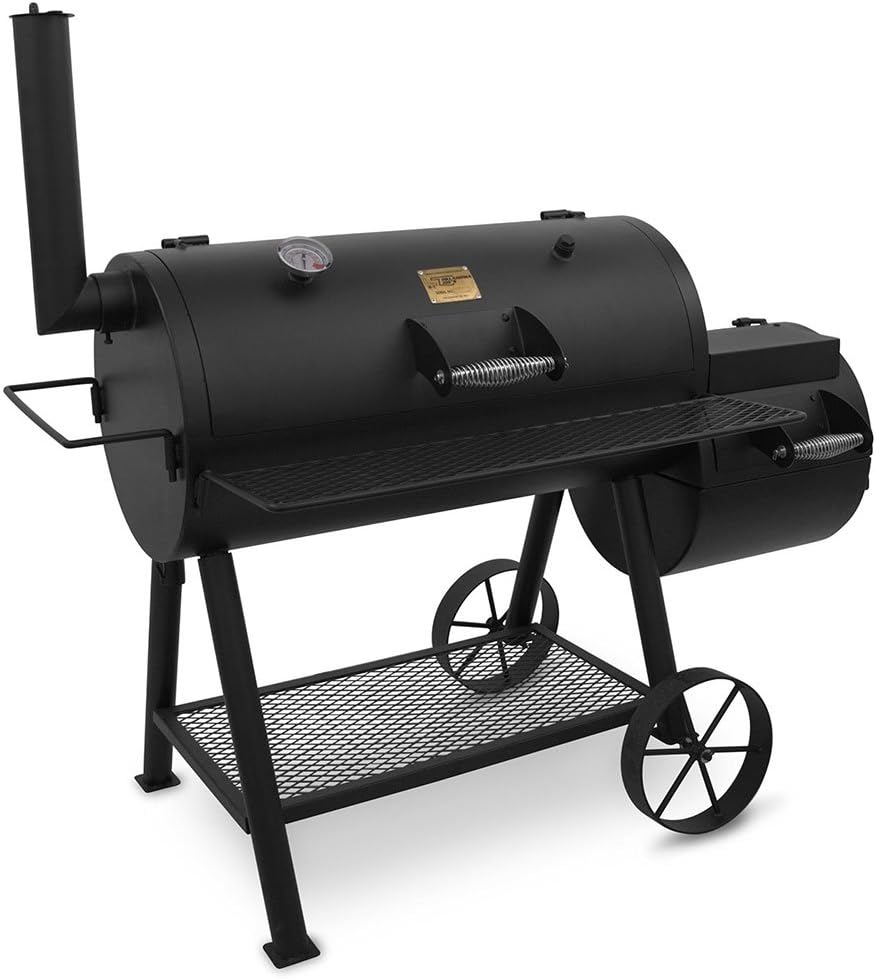
Oklahoma Joe’s Highland Offset Smoker
619 sq in primary + 281 sq in firebox · 2.5mm heavy-duty steel · Classic offset design · 2-year warranty included
🔥 Check Price on AmazonFull Specs & Key Features
Let’s start with the numbers. The Highland is bigger and heavier than most people expect when they first see the price — and that’s a pleasant surprise that reveals itself the moment it rolls off the truck pallet.
Dimensions & Cooking Surface
Materials & Construction
Key Features at a Glance
- Multiple dampers: The adjustable intake damper on the firebox and the chimney damper on the smokestack give you full airflow control — the primary mechanism for temperature management on an offset.
- Dual fuel flexibility: Designed from the ground up for a charcoal-plus-wood setup. You establish a charcoal base fire, then add hardwood splits or chunks to generate the flavored smoke.
- Side firebox access door: A large hinged door on the firebox makes loading fuel, clearing ash, and monitoring the fire convenient without ever opening the main chamber.
- Removable ash pan: Located under the firebox grate, the slide-out ash pan simplifies cleanup considerably — a thoughtful detail at this price point.
- Warming rack: A secondary steel rack inside the main chamber sits above the primary grates, useful for keeping finished meat warm or smoking smaller items at a slightly lower temperature zone.
- Bottle opener: Bolted to the side shelf. Because priorities.
Build Quality & Construction
At 178 pounds, the Highland announces its intentions before you’ve lit a single briquette. This is not one of the flimsy, thin-walled charcoal cookers that rust through after two seasons. The 2.5mm cold-rolled steel body is the single most important spec on this smoker — it’s thick enough to retain heat across long cooks, resist warping under high firebox temperatures, and stand up to years of weather exposure.
- Heavy 2.5mm steel resists warping and retains heat well
- Solid cast-iron charcoal grate in firebox won’t buckle
- Cool-touch wood handles don’t conduct heat
- Wagon wheels roll smoothly on patios and grass
- Powder coat finish holds up well to heat with proper seasoning
- Removable ash pan — thoughtful detail at this price
- Firebox door seals better than similarly priced competitors
- Lid gasket seal is loose from the factory — smoke leaks at edges
- Firebox-to-chamber seam can develop gaps after heavy use
- Porcelain grates chip over time and require replacement
- Built-in thermometer reads 50–75°F higher than grate level
- Some minor surface rust can appear at weld seams in wet climates
- Assembly hardware quality is merely adequate
The welds throughout the body are clean and consistent. The firebox attachment to the main chamber uses heavy bolts and a solid bracket system — you won’t see the flex or wiggle that plagues cheaper offset designs. The lid hinge is robust and holds its position when raised, which matters when you’re juggling tongs and a spray bottle during a long brisket cook.
The powder coat finish deserves a word of praise. Applied properly at the factory and properly seasoned before first use, it holds up remarkably well even through high-heat sear sessions in the firebox. Surface rust at exposed welds is occasionally reported in very wet climates, but a light coat of food-safe grapeseed oil on the exterior after each cook eliminates this risk entirely.
Overall, for a smoker in the $330–$400 bracket, the build quality is genuinely impressive. You’re getting materials and construction that would cost you considerably more on a lesser-known brand. The few weaknesses are all addressable with minor modifications outlined in the mods section below.
Smoking Performance & Heat
We ran the Highland through an extensive testing regimen: three full brisket cooks (12–14 hours each), four pork shoulder sessions, two rib days (baby backs and St. Louis spares), whole chickens, and multiple shorter cooks with salmon and pork belly. Here’s what we found.
Heat Distribution
This is where the Highland’s classic offset design shows its personality most clearly. The firebox end of the cooking chamber runs noticeably hotter — typically 25–50°F warmer than the smokestack end in stock configuration. This is entirely normal for a non-reverse-flow horizontal offset, and experienced pitmasters work with it rather than against it, rotating meats mid-cook and using the gradient to their advantage.
After applying the common baffle plate modification (detailed in the mods section), this gradient narrows to a more manageable 10–20°F differential, making consistent results significantly easier to achieve. Even without modification, the heat distribution is better than many comparable smokers in this price range, thanks to the Highland’s well-proportioned firebox-to-chamber ratio.
Heat Retention
The 2.5mm steel pays dividends here. Once the Highland reaches target temperature — typically a 45–60 minute process — it holds heat with real tenacity. On a calm day at 65°F, we observed temperature swings of just ±8°F over a 30-minute period with the dampers dialed in correctly. In cold weather (below 40°F) or windy conditions, swings widen to ±20°F and fuel consumption increases by roughly 30%, but this is true of virtually every offset in this price class.
Field observation: The Highland’s single greatest performance advantage is the thermal mass of that steel body. Budget competitors with thinner walls (1.5mm–2mm) struggle to hold heat in cool weather and swing wildly when you open the firebox door. The Highland barely flinches.
Fuel Efficiency
Plan for a full charcoal chimney to establish your fire, then hardwood splits or large chunks every 45–60 minutes to maintain temperature in the 225–250°F sweet spot. A 12-pound bag of charcoal plus 4–6 hardwood splits will carry you through a 6-hour cook comfortably. For a full 12-hour brisket, budget 18–22 pounds of charcoal and 8–12 pieces of wood. This is competitive consumption for an offset of this size and steel gauge.
Temperature Range
The Highland is comfortable from 200°F (cold smoking with a supplemental smoke generator) all the way to 350°F+ for direct-heat grilling in the firebox itself, which doubles as a capable direct-heat grill for steaks, burgers, and sausages. The primary chamber sweet spot for low-and-slow smoking is 225–275°F, easily achievable and maintainable by an experienced hand.
Smoke Flavor & Cook Results
This is ultimately why anyone buys an offset smoker, and the Highland delivers magnificently. The smoke flavor produced by a well-managed fire in this cooker is genuinely in a different league from what a pellet smoker, electric smoker, or kettle grill can produce. It’s the real thing — complex, layered, with that clean finish that only comes from properly combusted hardwood.
Brisket
Our best Highland brisket ran 13 hours at 235°F on post oak splits. The bark was mahogany-dark, papery dry on the outside with deep black at the fat cap — exactly what you’re aiming for. The smoke ring penetrated a full 8mm. Sliced flat and point were both moist, with that butter-yielding texture that means you’ve nailed the collagen-to-gelatin conversion. This is competition-grade output from a $350 smoker. Let that sink in.
Pork Shoulder (Boston Butt)
Pork shoulder is arguably the most forgiving protein for learning an offset, and the Highland excels here. A 9-pound bone-in butt at 250°F on apple wood and charcoal produced pulled pork with a beautiful smoke ring, a deeply caramelized bark, and the kind of smoky sweetness that makes sandwiches optional — you just eat it standing at the cutting board.
Ribs
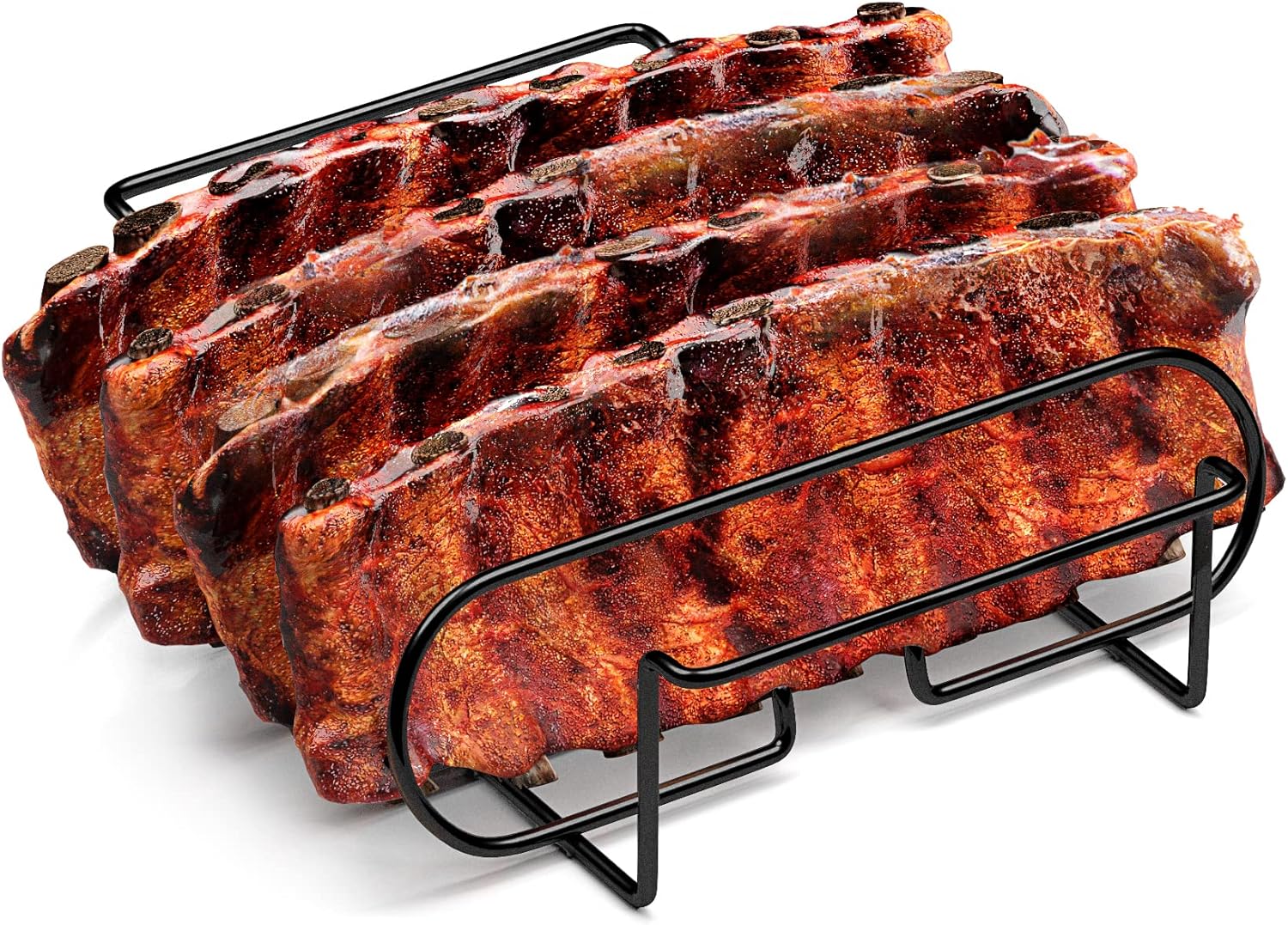
Baby backs ran 5.5 hours at 240°F using a 2-2-1 method (unwrapped–wrapped–unwrapped). The result: clean bone pull, great bite-through, visible smoke ring, and a surface glaze that set up perfectly. St. Louis spares at 6 hours, 3-2-1 method, were slightly better — more fat rendered, deeper flavor, more robust bark. The Highland handles both cuts superbly.
Whole Chicken
Whole chickens smoked at 275–300°F took approximately 2.5–3 hours and produced crispy-skinned, deeply flavored birds with no rubbery skin issues — a common failure mode on smokers that can’t hold higher temperatures. The Highland’s ability to run hot at this range is a real advantage for poultry.
Flavor Verdict
The smoke flavor the Highland produces is the primary reason this smoker earns its legendary reputation. No other smoker at this price point delivers this quality of authentic, wood-fired BBQ smoke. If you want to know what real Texas brisket or competition-style ribs taste like — not a pellet approximation, the actual thing — this is the cooker that gets you there.
Temperature Control Deep-Dive
Let’s be direct: temperature control on the Highland is the one area that requires the most investment of time and attention. It is not difficult to master, but it requires active engagement — this is not a set-and-forget cooker. For the right buyer, this is part of the appeal. For someone wanting minimal involvement in the cook process, it is a genuine limitation.
Understanding the Damper System
The Highland uses two dampers to control airflow, which controls combustion, which controls temperature:
- Intake damper (firebox): Controls how much oxygen feeds the fire. More open = hotter fire = higher temperature. This is your primary temperature control.
- Exhaust damper (smokestack): Controls how quickly combustion gases exit. Keep this 75–100% open during most cooks to maintain good smoke flow and avoid stale smoke buildup.
The Temperature Gradient
Stock, out of the box, expect a 25–50°F temperature differential between the firebox end (hotter) and the smokestack end (cooler) of the main cooking chamber. The built-in thermometer sits at lid level near the center — it will read 30–75°F higher than what your meat is actually experiencing at grate level. Buy a dual-probe wireless thermometer immediately. It’s not optional equipment for offset smoking.
Stabilizing Temperature: A Step-by-Step Approach
- Light a full chimney of charcoal, let it ash over completely (15–20 minutes).
- Pour into firebox, close the intake to roughly 25% open. Add your first hardwood split.
- Allow chamber to climb to 50°F below your target temperature, then close the intake further to slow the rise.
- At target temperature, make small damper adjustments (5–10% at a time) and wait 10 minutes before adjusting again. Patience is the skill.
- Add a new split before the fire gets too low — it’s easier to maintain temperature than to recover it after a dip.
Common Temperature Control Mistakes
- Chasing temperature too aggressively: Opening and closing dampers rapidly causes temperature swings. Small adjustments, long wait times.
- Letting the fire die too low: Adding fuel to a dying fire means a temperature dip and then overshoot. Stay ahead of the fire — add fuel while it’s still strong.
- Trusting the built-in thermometer: It lies. Buy a quality grate-level thermometer probe and use it every single cook.
- Closing the exhaust damper: See the Golden Rule above. Just don’t.
Best Modifications to Make It Elite
The Highland community is one of the most active and creative in the offset smoker world, and over decades of collective use, a handful of modifications have emerged as near-universal upgrades. None are expensive. All of them meaningfully improve the cooking experience. Here are the six most impactful:
High-Temp Gasket Tape (Lid Seal)
The single most impactful modification. Apply self-adhesive, high-temperature gasket rope or flat tape around the perimeter of the main chamber lid and firebox door. This eliminates smoke leakage, dramatically improves heat retention, and makes temperature management significantly easier. Available at hardware stores or on Amazon for $10–$15.
Cost: ~$12 · Impact: HighBaffle Plate / Tuning Plates
A steel baffle plate installed just inside the cooking chamber over the firebox opening forces hot air down and across the length of the chamber before rising, dramatically evening out the left-to-right temperature gradient. Steel tuning plates (flat strips laid across the bottom of the chamber) achieve a similar effect and are adjustable. Narrows the temperature differential from 50°F to as low as 10°F.
Cost: $20–$50 (DIY or aftermarket) · Impact: Very HighExtend the Smokestack to Grate Level
The factory smokestack exits at lid level, which means hot air and smoke rise toward the top of the chamber without fully bathing the meat at grate level. A simple extension (a short section of matching steel pipe) drops the exhaust point to grate level, pulling smoke horizontally across the meat and improving both smoke flavor and heat evenness. This is a beloved trick in the Highland community.
Cost: $10–$25 (pipe extension) · Impact: HighCharcoal Basket
An aftermarket charcoal basket for the firebox lifts the fuel off the bottom grate, improves airflow underneath the charcoal, reduces ash buildup, and makes fire management dramatically easier. Easier to add fuel without disturbing the existing fire bed. Available in expanded metal DIY builds or welded aftermarket versions.
Cost: $20–$45 · Impact: Medium-HighAftermarket Thermometers
Replace or supplement the factory lid thermometer with quality grate-level thermometers. Drill two small holes at grate level on each end of the main chamber and install Tel-Tru or Tel-Tru equivalent bi-metal thermometers. You’ll immediately understand your actual cooking environment — which is quite different from what the factory gauge suggests. A quality wireless dual-probe is also invaluable.
Cost: $20–$60 · Impact: Very HighCover & Surface Treatment
A fitted cover for outdoor storage prevents rust and extends the life of the powder coat. After each cook, while the smoker is still slightly warm, wipe the interior chamber with a thin layer of food-safe oil (flaxseed or grapeseed) to protect the steel. The exterior can be treated with a light coat of cooking spray or Crisco after cleaning. This isn’t glamorous, but it keeps your smoker looking good and prevents corrosion for years.
Cost: $30–$50 (cover) + negligible (oil) · Impact: Long-termAssembly & Initial Setup
Assembly is one of the Highland’s few genuinely frustrating elements, though it’s a one-time task. Budget 90–150 minutes for assembly depending on your mechanical aptitude and whether you have a helper. The instruction manual is functional but sparse — illustrated diagrams would help significantly but are largely absent.
Assembly Tips
- Do it with two people: The main chamber and firebox are heavy and awkward. Aligning bolt holes while holding components in position is a two-person job.
- Don’t fully tighten until everything is aligned: Run all bolts in finger-tight first, then check alignment, then tighten fully. Otherwise you’ll find components slightly skewed and gaskets unable to seat properly.
- Use Loctite on the hardware: The included hardware is adequate but can vibrate loose over time with the thermal expansion and contraction of repeated heating. A drop of medium-strength Loctite on each bolt keeps things tight.
- Have a rubber mallet handy: Some panel alignments require a gentle persuasive tap.
The Seasoning Cook: Do Not Skip This
Before smoking any food, you must season the Highland. This burns off the factory oils, protective coatings, and manufacturing residue from the steel interior, and begins building the protective patina of carbonized grease that will protect your cooker for years.
- Coat the interior of the main chamber and firebox with a thin layer of food-safe oil or cooking spray.
- Light a moderate fire in the firebox.
- Run the smoker at 250–300°F for 2–3 hours, feeding it small wood splits to generate smoke.
- During this process, apply your gasket tape and any other modifications you’ve planned.
- Allow to cool completely. The interior should now have a darkened, slightly glossy surface — that’s the seasoning layer taking hold.
Classic Offset vs Reverse Flow: Which Should You Choose?
Oklahoma Joe’s also makes a Reverse Flow version of the Highland (and the larger Longhorn model in reverse flow). This is one of the most common questions in the Highland buying journey — which design is better for your needs?
| Feature | Classic Offset (Highland) | Reverse Flow |
|---|---|---|
| Smoke path | Firebox → chamber → smokestack (direct) | Firebox → under baffle plate → back over food → smokestack |
| Temperature evenness | 25–50°F gradient (stock) | 10–20°F gradient (stock) |
| Smoke flavor intensity | Slightly higher — more direct smoke contact | Slightly lower — more even but less intense |
| Learning curve | Steeper — requires more active heat management | Gentler — more forgiving for beginners |
| Modifiability | Extremely — huge community of mods | Less — baffle plate is fixed |
| Price (approx.) | $330–$400 | $380–$450 |
| Best for | Enthusiasts who love the craft | Those wanting more consistent results, beginners |
Our recommendation: if you’re genuinely interested in learning offset smoking as a craft and want the maximum ceiling for what the smoker can become with modifications, choose the Classic Highland. If you want slightly more reliable, forgiving results out of the box and have less appetite for the tinkering side of BBQ, the Reverse Flow is worth the modest price premium.
Comparison vs Competitors
The Highland doesn’t exist in a vacuum. Here’s how it compares against the key alternatives you’re likely considering at similar or nearby price points:
| Model | Price | Cook Area | Steel | Heat Control | Verdict |
|---|---|---|---|---|---|
| OKJ Highland (Classic) | $330–$400 | 900 sq in | 2.5mm | Manual / Active | Best value overall |
| OKJ Highland Reverse Flow | $380–$450 | 900 sq in | 2.5mm | Easier (even heat) | Better for beginners |
| Char-Griller Smokin’ Pro | $200–$260 | 830 sq in | ~1.5mm | Difficult (thin walls) | Budget option, lower quality |
| Dyna-Glo Signature Series | $350–$430 | 1,382 sq in | ~1.8mm | Moderate | More space, thinner steel |
| Pit Boss Austin XL (Pellet) | $500–$600 | 1,000 sq in | N/A | Automatic / Easy | Set-and-forget, less smoke flavor |
| Weber Smokey Mountain 22″ | $480–$530 | 726 sq in | Heavy porcelain-enamel | Easier than offset | Excellent smoker, different style |
| Lang 36″ Patio Model | $1,500+ | 864 sq in | ~6mm (3/16″) | Excellent | Superior build, much higher cost |
The competitive picture is clear: the Highland occupies a genuinely unique position. The smokers below it in price use thinner steel and sacrifice heat retention. The smokers above it in the $500–$800 range offer incremental improvements in convenience but rarely in the smoke flavor that matters most. The Highland beats most of them on pure BBQ output per dollar spent.
Who Should Buy It?
✅ Buy the Highland If You Are…
- A passionate backyard pitmaster who views a 12-hour brisket cook as a great Saturday, not a chore.
- Budget-conscious but quality-focused — you want the best possible BBQ output without spending $1,500+ on a premium offset.
- A tinkerer and modifier who enjoys improving and personalizing your equipment. This smoker rewards investment.
- Someone who values authentic smoke flavor above all other considerations — the flavor this cooker produces is the primary reason for its existence.
- Cooking for groups regularly — 900 square inches feeds a crowd comfortably.
- Willing to learn — even if you’re new to offset smoking, the Highland’s forgiving steel gauge means you’ll learn quickly without the constant frustration of temperature instability that cheaper smokers deliver.
❌ Look Elsewhere If You…
- Want a set-and-forget experience — consider a pellet smoker instead.
- Have very limited outdoor space — the Highland needs room; it’s nearly 5 feet wide with the firebox.
- Are not willing to spend the first few cooks learning the smoker’s behavior. This rewards patience.
- Need precise, repeatable temperature control for competitive cooking at the highest levels — step up to a quality reverse-flow or custom offset above $1,000.
- Live somewhere with strict fire regulations that prohibit wood-burning charcoal cookers.
Pro Tips for Best Results
These tips come from years of Highland-specific experience and represent the most impactful lessons for getting the most out of this smoker, whether you’re on your first cook or your fiftieth.
- Use a charcoal chimney, never lighter fluid. Lighter fluid residue imparts off-flavors to everything you smoke. A chimney starter gets charcoal fully lit in 15–20 minutes with zero chemical contamination.
- Let the charcoal fully ash over before adding wood. White-ashed charcoal burns clean. Grey or black charcoal still producing startup smoke introduces acrid flavors. Patience during the fire-building stage pays dividends in flavor.
- Use split hardwood, not chips. Wood chips burn too fast and produce quantity of smoke rather than quality. Use fist-sized hardwood chunks or small splits for a slow, even burn that produces the thin blue smoke you’re looking for.
- Aim for thin blue smoke, never thick white. Thin blue smoke (barely visible) is what you want at the stack — it deposits flavor without bitterness. Thick white smoke from smoldering wood or insufficient airflow coats meat in bitter creosote. If you see white smoke, open the intake, stoke the fire, and wait for it to clear before putting meat on.
- Place meat fat-side toward the firebox. The fat acts as a thermal buffer, protecting the side of the meat closest to the heat source from drying out. Rotate mid-cook if you’re doing a very long session.
- Don’t open the lid constantly. Every lid opening loses 15–25°F and adds time to your cook. Resist the urge to peek. Trust your thermometer probes — that’s what they’re there for.
- The Texas Crutch is your friend. When a brisket or pork shoulder hits the stall (typically 155–165°F internal temp, where evaporative cooling plateaus), wrap it tightly in butcher paper or aluminum foil. This pushes through the stall and retains moisture without sacrificing bark quality.
- Rest your meat properly. A brisket pulled at 200–205°F internal temperature should rest in a cooler (wrapped in butcher paper, then towels) for at least 1 hour and up to 4 hours. This allows juices to redistribute and collagen to fully set. It makes a profound difference in moisture and sliceability.
- Keep a fire log. Record damper settings, fuel quantities, weather conditions, and temperatures for each cook. After 5–10 cooks, you’ll have a personal reference that makes hitting your target temperature reliably a near-automatic process.
- Season and protect after every cook. While still warm, wipe the interior with a thin coat of cooking oil. Cover when stored. This keeps rust away and maintains the seasoning layer.
FAQs — 12 Questions Answered
How long does it take to assemble the Oklahoma Joe’s Highland? ▶
Most people report 90 to 150 minutes for full assembly, with a helper making the process significantly faster and easier. The main challenge is aligning and holding heavy components in position while threading bolts — a two-person job. Read all instructions before starting and don’t fully tighten any hardware until all components are loosely assembled and aligned.
Is the Highland good for beginners? ▶
Yes, with the right expectations. The Highland is more beginner-friendly than many offset smokers at its price point, primarily because of its thick steel construction — the thermal mass helps buffer against temperature mistakes. That said, offset smoking genuinely requires learning. If you want truly set-and-forget simplicity, a pellet smoker is a better fit. If you’re willing to invest 2–3 cooks learning the fire management process, the Highland is an excellent entry point into the craft.
What wood is best to use in the Highland? ▶
The choice of wood depends on the protein you’re smoking. Post oak is the classic choice for beef brisket — it produces a medium-intensity, slightly earthy smoke that complements beef beautifully. Hickory delivers a stronger, more assertive smoke and works well with pork shoulder and ribs. Apple and cherry wood produce a milder, sweeter smoke that pairs beautifully with chicken, pork, and fish. Pecan is a versatile middle ground that works with virtually everything. Avoid resinous softwoods (pine, cedar) entirely — they produce toxic, bitter smoke.
How do I prevent rust on my Highland? ▶
Three practices prevent virtually all rust issues: (1) Season the interior steel before first use and after any extended periods of non-use. (2) Apply a thin coat of food-safe oil to the interior chamber while still warm after each cook. (3) Use a fitted cover to protect the exterior from rain and moisture when stored outdoors. Addressing any small rust spots with a wire brush and a coat of high-temp paint immediately prevents them from spreading.
Can I cook on the firebox of the Highland? ▶
Yes, and this is one of the Highland’s underappreciated features. The firebox lid can be opened to reveal a direct-heat grilling surface running at very high temperature, ideal for searing steaks, cooking burgers, or finishing sausages. It essentially functions as a small charcoal grill when used this way. Many pitmasters smoke their brisket or ribs in the main chamber, then sear chicken or sausages directly over the firebox simultaneously.
Does the Highland work in cold or windy weather? ▶
Yes, but with increased fuel consumption and more active fire management required. In cold weather (below 40°F), budget approximately 30% more charcoal than you’d use in moderate conditions. Wind is the bigger challenge — position the smoker with its firebox intake facing away from the prevailing wind direction, and consider using a wind break (a piece of plywood propped beside the smoker works well). In windy conditions, temperature swings will be wider and fuel burn will be faster.
How many briskets can I fit in the Highland? ▶
Comfortably two full packer briskets (12–15 lbs each) on the primary grate, potentially three if they’re trimmed and positioned efficiently. The 619 square inch primary cooking surface gives you real capacity for a backyard smoker. Add the firebox cooking surface and secondary warming rack, and you can run a genuinely substantial cook for a large gathering.
What is the warranty on the Oklahoma Joe’s Highland? ▶
Oklahoma Joe’s provides a 2-year limited warranty on the Highland, which covers manufacturing defects in materials and workmanship. The warranty does not cover damage from improper use, rust from lack of maintenance, or normal wear items. Oklahoma Joe’s customer service is generally well-regarded for handling warranty claims. Keep your receipt and register the product on the Oklahoma Joe’s website after purchase.
Should I buy the Classic or Reverse Flow version? ▶
If you’re a craft-focused pitmaster who enjoys the process of fire management and plans to modify the smoker over time, the Classic is the better choice — it has a massive community, more modification options, and produces exceptional smoke flavor in experienced hands. If you want slightly more consistent, forgiving results out of the box and have less interest in the tinkering side of BBQ, the Reverse Flow is worth the modest extra cost. Both produce outstanding BBQ; the difference is in the experience of using them, not the ceiling of what they can achieve.
What’s the best way to clean the Highland after cooking? ▶
After the smoker has cooled: (1) Scrape the grates with a wire brush and wipe clean. (2) Empty the ash pan and dispose of cooled ash. (3) Scrape any heavy grease buildup from the bottom of the main chamber. (4) Wipe the interior with a dry cloth or paper towel — do not wash with soap and water, as this strips the seasoning. (5) While still slightly warm, apply a thin coat of food-safe oil to the interior. The goal is to maintain the seasoning layer, not sterilize the steel.
Can I use the Highland as a regular grill? ▶
Yes. The main cooking chamber can be used as a very large indirect-heat grill, and the firebox can be used as a direct-heat charcoal grill. The main chamber isn’t ideal for direct searing — the grates are too far from the firebox — but it excels for indirect grilling and roasting. Many users run a hybrid setup: direct heat over the firebox for high-heat items and indirect heat in the main chamber for larger cuts simultaneously.
Are replacement parts available for the Highland? ▶
Yes. Oklahoma Joe’s maintains a good supply of replacement parts through their website and through major retailers. Replacement grates, thermometers, handles, and hardware are all readily available. The broad popularity of the Highland means third-party aftermarket parts (upgraded grates, baffle plates, charcoal baskets) are also widely available from multiple vendors on Amazon and specialty BBQ retailers.
Final Verdict: Should You Buy the Oklahoma Joe’s Highland?
After extensive testing, years of community feedback, and honest assessment of what the Highland does well and where it falls short, our conclusion is unambiguous: yes, absolutely, buy it — with one important caveat about who “you” needs to be.
The Oklahoma Joe’s Highland is the finest offset smoker available below $500. Its heavy-gauge steel construction, generous cooking capacity, classic offset design, and the quality of smoke flavor it produces are simply not matched at this price point. It is a genuine pitmaster’s tool that rewards skill development and produces results that would cost you three to five times more from a restaurant.
The caveat: this smoker rewards engagement. It’s not for someone who wants to load it up and walk away for 12 hours. It wants attention, fire management, and the willingness to learn its specific behavior across several cooks. That learning process — for the right person — is half the joy. There is deep satisfaction in understanding a fire well enough to hold 250°F for 12 hours through changing weather, to read the smoke color and know what the fire needs, to pull a brisket at the exact right moment and have it yield like silk under the knife.
- Exceptional smoke flavor — the best at this price
- Heavy 2.5mm steel outperforms competitors
- 900 sq in total capacity handles large crowds
- Outstanding value for the construction quality
- Massive mod community — easily upgradeable
- Doubles as a direct-heat grill via firebox
- 2-year warranty, widely available parts
- Requires active fire management — not set-and-forget
- Lid seal needs gasket tape modification
- Built-in thermometer is inaccurate at grate level
- Temperature gradient needs baffle plate fix
- Assembly is time-consuming and best done with help
- Heavier fuel consumption than pellet alternatives
If authentic wood-fire BBQ is what you’re after, and you’re ready to embrace the craft behind it, the Oklahoma Joe’s Highland is your smoker. It has earned its legendary status in American backyard cooking, and it earns it again with every brisket that comes off the grate.
Oklahoma Joe’s Highland Offset Smoker
The best value offset smoker on the market. 900 sq in total cooking area · 2.5mm cold-rolled steel · 2-year warranty · Classic American BBQ results.
🔥 Check Current Price on Amazon