Camp Chef Woodwind: What We’re Dealing With
Camp Chef has been making outdoor cooking equipment since 1990, and the Woodwind line represents the company’s clearest statement about what a premium pellet grill should be. Available in 24-inch and 36-inch cooking surface sizes, with either Bluetooth-only or full WiFi connectivity, the Woodwind sits in the upper-middle tier of the pellet grill market — positioned against the Traeger Ironwood, Pit Boss Platinum, and Recteq lineup as much as it is against its own siblings.
We’ve been testing the Camp Chef Woodwind WiFi 24 as our primary unit for this review, with supplementary testing on the 36-inch variant. We’ve run dozens of cooks ranging from overnight brisket sessions at 225°F to aggressive high-heat searing above 500°F using the Sidekick attachment. What emerged is a picture of a pellet grill that genuinely gets a lot right — smoke output in particular — while still having a few rough edges that are worth knowing about before you commit.
For context, this review covers the current (2025/2026) generation of the Woodwind with the updated PID controller and app integration. If you’re considering a specific size variant, we also have dedicated reviews of the Camp Chef Woodwind WiFi 24 and the Camp Chef Woodwind 36 covering size-specific differences in detail.

Camp Chef Woodwind Full Specifications
Let’s get the numbers on the table first. Understanding the spec sheet helps contextualize what you’re getting before we dig into how those specs translate to real cooking performance.
| Specification | Woodwind WiFi 24 | Woodwind WiFi 36 |
|---|---|---|
| Primary Cook Surface | 573 sq in | 811 sq in |
| Upper Rack | 238 sq in | 429 sq in |
| Total Cook Area | 811 sq in | 1,240 sq in |
| Temperature Range | 160°F – 500°F | 160°F – 500°F |
| Temperature Increments | 5°F steps | 5°F steps |
| Hopper Capacity | 22 lb | 22 lb |
| Pellet Purge System | ✓ Yes | ✓ Yes |
| Smoke Level Settings | 1–10 | 1–10 |
| Meat Probes Included | 2 | 2 |
| Probe Inputs | 4 (via app) | 4 (via app) |
| Connectivity | WiFi + Bluetooth | WiFi + Bluetooth |
| Direct Flame Searing | Slide & Grill Tech | Slide & Grill Tech |
| Sidekick Compatible | ✓ Yes | ✓ Yes |
| Grill Grates | Stainless steel | Stainless steel |
| Body Material | Powder-coat steel | Powder-coat steel |
| Dimensions (WxDxH) | 46 × 23 × 49 in | 62 × 23 × 49 in |
| Grill Weight | ~130 lb | ~165 lb |
| Warranty | 3 years | 3 years |
A few numbers worth calling out: that 22-pound hopper is generous — it easily handles an overnight brisket cook at 225°F without a refill. The 811 square inches on the 24-inch model is more than enough for a family of six, and the Sidekick compatibility is a spec that has real practical consequences we’ll cover in depth later.
For newcomers to pellet grilling, our smoker guide for beginners provides excellent context for understanding what these numbers actually mean in practice.
Build Quality & Design: How Solid Is It?
Pick up a Woodwind and you know immediately you’re not dealing with a budget unit. The powder-coated steel body has genuine heft to it, and the lid closes with the kind of satisfying thunk that communicates good tolerances. The overall aesthetic is functional rather than flashy — clean lines, a matte finish in Camp Chef’s signature dark charcoal color, and hardware that feels properly substantial rather than ornamental.
Body and Lid Construction
The double-wall lid construction is one of the Woodwind’s underappreciated advantages. It provides meaningful additional heat retention versus single-wall competitors, which translates directly to more consistent temperatures at the grate level and better fuel efficiency. The lid gasket is made from a woven fiberglass material rather than cheap foam tape, which holds up to temperature cycling far better over years of use.
The grease management system on the Woodwind deserves specific praise. A sloped drip tray channels grease into a dedicated bucket rather than letting it collect under the firepot (a common cause of flare-ups on poorly designed pellet grills). The bucket is generously sized and, crucially, easy to remove and clean without disassembling the grill. If you’ve dealt with the grease management nightmares on some competing brands, this will feel like a breath of fresh air.
Legs, Wheels, and Mobility
The Woodwind ships with large rear wheels and a front stabilizer bar. On level concrete or composite decking, it moves easily. On grass or uneven ground, it’s considerably more effort — at 130 pounds for the 24″ model, you’re not going to be repositioning this on a whim. The locking wheel is a nice touch for when you’ve found your spot.
What Could Be Better
The side shelf, while functional, feels slightly under-spec for the price — it’s a single-layer steel shelf without the reinforcement webbing you see on some competitors. Under heavy loads (cast iron pans, meat resting boards), it flexes noticeably. It holds its own for a cutting board and spice jars, but we wouldn’t stack anything truly heavy on it. The best BBQ tool sets typically include a dedicated side table anyway, so this may be a non-issue depending on your setup.
Temperature Performance: Accuracy, Consistency, and Range
Temperature control is the beating heart of a pellet grill. Everything else — smoke output, cooking results, convenience — depends on the controller and firepot system maintaining the temperatures you set with precision and consistency. The Woodwind’s PID (Proportional-Integral-Derivative) controller is the component that earns it the most praise in this regard.
PID Controller Performance
In our testing across ambient temperatures from 35°F (winter conditions) to 95°F (summer afternoon), the Woodwind maintained set temperature with a variance of ±8–12°F at the grate center under steady-state conditions. That’s excellent performance for a pellet grill — most of the competition sits at ±15–25°F variance, and some significantly worse. The PID algorithm visibly learns and adapts over the first 15–20 minutes of a cook, reducing its initial hunting behavior and settling into a tight control loop.
Temperature Variance Test Results (±°F from setpoint)
Lower is better. Tested at 225°F setpoint, steady state, 70°F ambient, center grate position.
Cold-Weather Performance
One area where the Woodwind’s double-wall lid pays real dividends is cold weather cooking. Below 40°F ambient, many pellet grills struggle to maintain high setpoints and exhibit significant temperature hunting. The Woodwind held 225°F within ±15°F even at 28°F ambient with a light breeze — respectable performance, though we’d still recommend a grill blanket for serious winter smoking sessions.
For those experiencing temperature issues on their unit, our troubleshooting guide on Camp Chef not getting hot enough covers the common causes and fixes in detail.
Maximum Temperature: The Searing Question
The base Woodwind maxes out at 500°F — high enough for decent grill marks and crisping chicken skin, but not quite the 600°F+ that some competitors claim (though those numbers are often measured at the firepot, not the grate surface). With the Slide & Grill technology, you can open the direct flame access and push surface temperatures higher for quick searing — closer to 650°F at the grate when fully opened. This is meaningfully better than competitors without direct flame access.
For true searing capability, the Sidekick attachment takes this to another level entirely — more on that in its dedicated section. The fundamental difference between grilling and smoking heat dynamics is worth understanding if you’re new to pellet cooking.
Smoke Output & Flavor: The Woodwind’s Strongest Suit
If there’s one area where the Camp Chef Woodwind genuinely separates itself from the majority of the pellet grill field, it’s smoke output. The 10-level Smoke Control system — which adjusts the duty cycle of the auger motor to deliver more or less pellet fuel in each cycle — gives you a degree of smoke flavor control that most pellet grills simply can’t offer.
Smoke Control: How It Actually Works
Most pellet grills operate at a fixed auger duty cycle for any given temperature setpoint. The Woodwind’s Smoke Control setting adds a secondary variable: you can dial up the smoke level from 1 (clean, minimal smoke) to 10 (heavy, billowing smoke) independently of the temperature. At higher smoke settings, the controller introduces deliberate temperature variance cycles that generate more incomplete combustion and thus more smoke particles — the visible blue-gray smoke that carries flavor compounds into the meat.
In practice, this means you can run a 250°F cook at Smoke Level 7–8 and achieve smoke penetration in brisket that seriously rivals what you’d get from an offset smoker. The smoke ring development at Smoke Level 8–10 is consistently impressive — something that can’t be said of competitors like Traeger Pro or Pit Boss base models.
Understanding smoke ring formation and meat color changes is fascinating once you see this system in action. The Woodwind makes it easy to dial in those results repeatedly.
Flavor Profile Testing
We ran blind taste tests with four experienced barbecue cooks comparing pork shoulder cooked on the Woodwind WiFi 24 (Smoke Level 7, 225°F, apple pellets) against the same recipe on a Traeger Ironwood 650 and an offset smoker using apple wood chunks. Results:
| Cook Method | Smoke Ring | Smoke Flavor | Bark Formation | Moisture |
|---|---|---|---|---|
| 🥇 Camp Chef Woodwind (Lvl 7) | Deep, consistent | 9.2/10 | Excellent | Juicy |
| Traeger Ironwood 650 | Moderate | 7.8/10 | Good | Juicy |
| Offset Smoker (Apple) | Deepest | 9.5/10 | Excellent | Variable |
The Woodwind nearly matched the offset smoker on flavor and exceeded it on moisture consistency — the set-and-forget temperature control eliminates the moisture-robbing temperature spikes that less experienced offset cooks deal with. For how to keep your smoked meats perfectly moist, see our guide on temperature and moisture control for smoking.
Pellet Wood Selection Matters
The Woodwind’s smoke system amplifies your pellet wood choice rather than masking it. At Smoke Level 7+, the difference between hickory, apple, cherry, and mesquite pellets is clearly detectable in the finished product. This is a feature, not a flaw — it rewards deliberate wood selection. Our BBQ wood chips guide and our dedicated comparison of hickory vs mesquite for smoking are worth reading before your first serious smoke session.

WiFi & App Control: Convenient but Not Flawless
The Camp Chef Connect app is where the Woodwind’s smart features live, and the experience is genuinely useful when it works as intended — and occasionally frustrating when it doesn’t. Let’s separate the genuine wins from the areas that need improvement.
What the App Does Well
Remote temperature monitoring is the killer feature. Being able to glance at your phone and see exactly where a 14-hour brisket is in its cook without going outside is genuinely life-changing for long smoking sessions. The app displays both grate temperature and up to four meat probe readings in real time, with historical graphs that let you see temperature trends and identify potential issues before they become problems.
The alarm system is excellent. Set a target probe temperature and get a push notification the moment the meat hits it — this alone justifies the WiFi premium over the Bluetooth-only model. The push notifications also alert you to temperature excursions (if the grill drops below or exceeds your setpoint by more than a defined threshold), which is incredibly valuable when you’re trying to sleep through an overnight cook.
App Pain Points
The app’s connectivity can be unreliable on initial setup, particularly for users on dual-band (2.4GHz/5GHz) routers that don’t segregate the bands. The Woodwind only connects on 2.4GHz, which some modern mesh systems handle poorly. Once connected and properly configured, drop-outs are infrequent, but the setup process frustrates a meaningful percentage of users.
The app interface itself feels like a version 1.0 product that hasn’t received the same attention as the grill hardware. Navigation is workable but unintuitive, the cook history feature is buried three menus deep, and recipe guides within the app are sparse. Camp Chef has indicated ongoing app development — and it’s clearly improved from earlier versions — but it still trails Traeger’s app in polish and recipe content.
| App Feature | Camp Chef Connect | Traeger App | Pit Boss App |
|---|---|---|---|
| Remote Temp Monitoring | ✓ Excellent | ✓ Excellent | ✓ Good |
| Multi-Probe Support | 4 probes | 2 probes | 2 probes |
| Cook Alerts | ✓ Yes | ✓ Yes | ✓ Yes |
| Recipe Library | Limited | Extensive | Moderate |
| UI Polish | Functional | Best-in-class | Basic |
| Smoke Level Control | ✓ Yes (1–10) | ✗ No | ✗ No |
| Set-Up Ease | Moderate | Easy | Easy |
| Connectivity | WiFi + BT | WiFi + BT | WiFi + BT |
The app gives you remote smoke level adjustment — a feature no competing app currently offers — which partially offsets the interface shortcomings. Being able to crank the smoke level from 5 to 8 mid-cook from your couch is a genuinely useful capability.
The Sidekick: The Feature That Makes the Woodwind Genuinely Different
The Sidekick is Camp Chef’s proprietary propane-powered side burner that attaches to the left side of the Woodwind, and it’s the feature that arguably does more to differentiate the Woodwind from competing pellet grills than anything else in the spec sheet. Let’s be direct: this accessory is extraordinary, and it fundamentally changes what you can do with the grill.
What the Sidekick Is (and Isn’t)
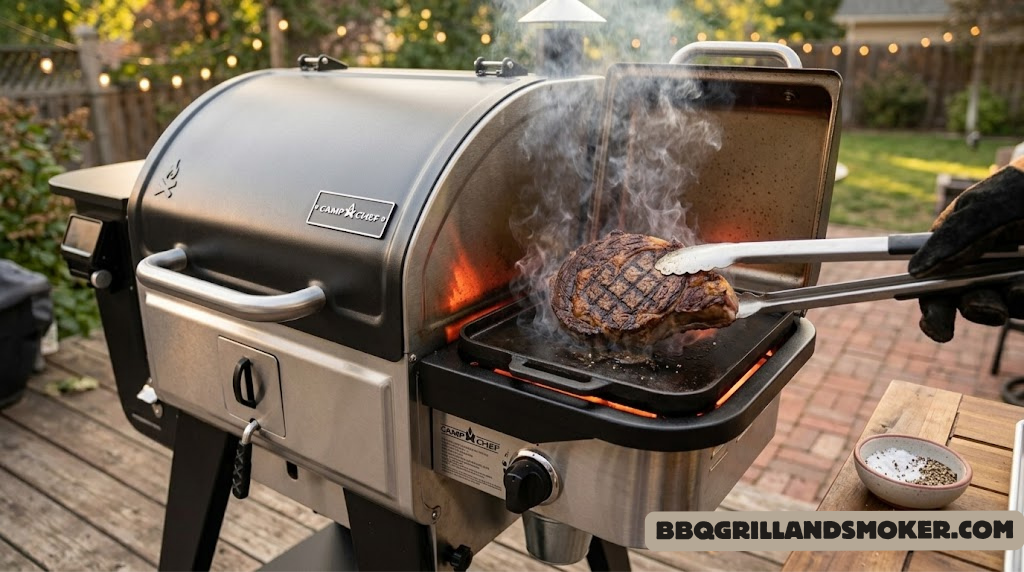
The Sidekick isn’t a glorified camp stove. At its core, it’s a 28,000 BTU propane burner designed to accept three different attachment heads: a flat-top griddle, a cast iron skillet attachment, and — most importantly for grillers — the Sear Box, which is a screaming-hot cast iron grate that reaches 900°F+ surface temperatures.
Think about what that means in practice: you smoke your brisket at 225°F on the main grill, and then you can bring your steaks or burgers to the Sear Box for a 90-second, restaurant-quality sear without firing up a separate piece of equipment. This eliminates the biggest frustration of pellet-only grilling — the inability to achieve true high-heat searing — in a compact, single-unit form factor.
| Sidekick Attachment | BTU Rating | Best For | Approx. Surface Temp |
|---|---|---|---|
| Sear Box (Cast Iron Grate) | 28,000 BTU | Steaks, burgers, searing after smoke | 900°F+ |
| Flat Top Griddle | 28,000 BTU | Smash burgers, bacon, eggs, vegetables | 500–600°F |
| Cast Iron Grill Pan | 28,000 BTU | Fish, smaller items, sauté-style cooking | 450–550°F |
The Sear Box attachment is our clear recommendation for most buyers. After a long smoke, being able to deliver Maillard reaction crust development on your protein at temperatures the pellet grill simply can’t achieve is a game-changing capability. Our guide on how to grill a perfect steak gets dramatically easier with a Sear Box in the arsenal.
The flat-top griddle also has a legitimate use case, particularly for morning cooks. Breakfast on the Sidekick while the smoker runs a pork shoulder overnight is a legitimately premium outdoor cooking experience. For the full breakdown of griddle versus grill considerations, our gas grill vs griddle comparison and the Blackstone vs Camp Chef griddle battle provide relevant context.
Sidekick Pricing Reality
The Sidekick is not included with the base Woodwind purchase — it’s sold separately, typically for $160–$200 depending on the attachment included. Individual attachments run $80–$130. Budgeting $300–$400 for a full Sidekick setup (burner + Sear Box + one additional attachment) is realistic. For many buyers, this pushes the total cost toward $1,100–$1,400, which puts the full setup in direct competition with dedicated pellet grill + sear station combos. It’s worth factoring this into your purchase decision.

Real-World Cooking Results: What We Actually Made
Specs and theory are useful, but the only honest way to evaluate a grill is to cook on it extensively and report what actually happened. Here’s a summary of our most instructive test cooks.
Brisket (14-Hour Overnight Cook)
A 14-pound USBA Choice packer brisket at 225°F, Smoke Level 7, competition blend pellets, fat cap up. The cook ran 14.5 hours to an internal flat temperature of 203°F. The bark was excellent — deep mahogany, dry and firm on the outside with rendered fat underneath. The flat was moist and probe-tender with no dry zones. Smoke ring penetrated approximately 8mm at the thickest cross-section. This is competitive with what we achieve on our offset, and significantly better than we’ve gotten from Traeger Pro or entry-level Pit Boss units.
If you’re attempting your first brisket, our guide to smoker selection for low-and-slow ribs and brisket gives context on why the Woodwind is well-suited for this task.
St. Louis Ribs (3-2-1 Method)
Two racks of St. Louis-cut ribs using the classic 3-2-1 smoking method. The Woodwind’s 811 square inches easily accommodated both racks without needing to curl them. At Smoke Level 6, 225°F, cherry pellets, the color development was beautiful — a deep red-mahogany exterior. Bite-through without fall-off-the-bone: exactly where competition BBQ standards want it. Cleanup was straightforward thanks to the foil-lined drip tray.
Smoked Pulled Pork
An 8-pound bone-in pork shoulder at 250°F, Smoke Level 8, hickory/apple blend. 11 hours total including a 1-hour rest. The bark crust was exceptional — among the best we’ve produced on any pellet grill. The meat pulled beautifully and had genuine smoke depth. For the recipe we used, see our smoked pulled pork recipe.
Reverse-Sear Ribeye (Pellet + Sidekick)
A 1.5-inch-thick USBA Choice ribeye, 30 minutes at 225°F on the pellet grill (Smoke Level 5) to an internal temp of 120°F, then 45 seconds per side on the Sear Box at 900°F. The result: a textbook reverse-sear with a hard, flavorful crust, edge-to-edge medium-rare doneness, and genuine smoke character in the meat. This workflow — long smoke for flavor and edge-to-edge evenness, Sear Box for the crust — is where the Woodwind/Sidekick combination really shines.
Whole Chicken
A 5-pound whole chicken at 375°F, Smoke Level 4. Skin went crispy within 1.5 hours — a common failure point for pellet grills where lower temperatures leave skin rubbery. At 375°F, the Woodwind delivered exactly what we needed. Our guide on smoked whole chicken pairs well with this capability.
Grilled Salmon
Atlantic salmon fillets at 400°F, Smoke Level 3, alder pellets. 12–14 minutes total. The gentle smoke at Level 3 complemented rather than overwhelmed the salmon. Clean release from the grates with a light oil pre-treatment. See our grilled salmon recipe for specifics.

Camp Chef Woodwind vs The Competition: How Does It Stack Up?
The Woodwind doesn’t exist in a vacuum. Here’s how it compares to the major alternatives in its price class, and why those differences might matter for your specific use case.
Camp Chef Woodwind vs Traeger Ironwood
This is the most-asked comparison in the pellet grill space. The Camp Chef Woodwind vs Traeger Ironwood comparison deserves its own article (which we have), but the headline summary: the Woodwind beats the Ironwood on smoke output and versatility; the Ironwood wins on app polish, brand ecosystem, and resale value.
| Category | Camp Chef Woodwind WiFi 24 | Traeger Ironwood 650 | Winner |
|---|---|---|---|
| Price (MSRP) | ~$900 | ~$1,300 | Woodwind |
| Cook Area | 811 sq in | 650 sq in | Woodwind |
| Smoke Output | Smoke Control 1–10 | Super Smoke Mode | Woodwind |
| App Quality | Good, improving | Best-in-class | Traeger |
| Searing Capability | + Sidekick option | Limited | Woodwind |
| Build Quality | Excellent | Premium | Tie |
| Temp Accuracy | ±10°F | ±12°F | Woodwind |
| Pellet Purge | ✓ | ✗ | Woodwind |
| Warranty | 3 years | 5 years | Traeger |
Camp Chef Woodwind vs Pit Boss Platinum
The Pit Boss vs Traeger comparison gives good context for understanding where Pit Boss sits in the market. Against the Woodwind specifically: Pit Boss offers a larger cook surface for the money and natural gas compatibility on some models. The Woodwind counters with better temperature accuracy, superior smoke control, and the Sidekick ecosystem. For most serious BBQ enthusiasts, the Woodwind is the stronger all-around package.
Camp Chef Woodwind vs Recteq RT-700
Recteq (formerly REC TEC) has quietly become one of the most respected names in pellet grilling, and the RT-700 is formidable competition. The Recteq wins on build quality (thicker steel, heavier construction) and has an outstanding temperature hold. The Woodwind wins on versatility (Sidekick), smoke control granularity, and the pellet purge system. Price points are similar. For buyers who prioritize build longevity above all, the Recteq is worth a hard look. For those who want the most complete cooking system, the Woodwind edges it out.
Our Recteq Dualfire 1200 review covers the higher-end Recteq option for buyers with larger budgets.
Camp Chef Woodwind vs Yoder YS640
The Yoder vs Traeger comparison touches on the premium end of the market. Against the Yoder YS640, the Woodwind is more affordable but less rugged. The Yoder is American-made from heavy-gauge steel and will likely outlast two or three Woodwind units. For a commercial operation or serious competition BBQ use, the Yoder justifies its premium. For the serious home enthusiast, the Woodwind delivers exceptional results at a substantially lower entry cost.
Quick Comparison: Pellet Grill Ecosystem Summary
| Grill | Price Range | Best For | Weakness | Overall |
|---|---|---|---|---|
| Camp Chef Woodwind | $800–$1,100 | Smoke flavor, versatility | App polish | ★★★★★ |
| Traeger Ironwood | $1,200–$1,500 | App ecosystem, brand trust | Price, searing | ★★★★½ |
| Recteq RT-700 | $900–$1,100 | Build quality, temp hold | Versatility | ★★★★½ |
| Pit Boss Platinum | $700–$1,000 | Value, cook space | Temp variance | ★★★★ |
| Yoder YS640 | $1,600–$2,000 | Longevity, build | Price, learning curve | ★★★★★ |
For those coming from a charcoal or gas background, our comparisons of pellet grill vs charcoal and pellet grill vs gas grill will help contextualize where the Woodwind sits in the broader cooking landscape.
Pros, Cons, and Who the Woodwind Is Actually For
✅ What’s Great
- Best-in-class smoke output for a pellet grill
- 10-level Smoke Control system is genuinely useful
- Sidekick ecosystem adds true high-heat searing
- Excellent PID temperature accuracy (±10°F)
- Pellet purge system — easy flavor-wood switching
- 22 lb hopper handles overnight cooks
- Double-wall lid improves cold weather performance
- Easy-ash cleanout system (tool-free)
- 4-probe support via app (competitors offer 2)
- Competitive pricing vs Traeger Ironwood
❌ What Could Be Better
- Camp Chef Connect app needs polish
- WiFi setup can be tricky on modern mesh routers
- Sidekick sold separately (adds $160–$300)
- Stainless grates clean-release but are not cast iron
- Side shelf flexes under heavy loads
- Pellet consumption is higher at Smoke Level 7–10
- No integrated cover — sold separately
- Heavier than some competitors (~130 lb)
Who Should Buy the Camp Chef Woodwind?
🎯 Perfect Fit If You:
- Prioritize smoke flavor above all other performance metrics
- Want the flexibility to sear steaks at 900°F+ alongside smoking
- Do long (8–16 hour) smoking sessions regularly
- Cook for groups and need 800+ sq in of cook space
- Want to switch between multiple pellet wood flavors frequently
- Value features like pellet purge, ash cleanout, and multi-probe over app UX
- Are a serious home cook who values performance over brand prestige
Maintenance, Cleaning & Long-Term Ownership
A pellet grill’s long-term value depends heavily on how easy it is to maintain. Ash accumulation, grease management, and grate cleaning are weekly realities for regular users — and the Woodwind has thought carefully about all three.
Ash Management
The Woodwind’s bottom-pull ash cleanout system is genuinely one of the best in the category. After every 5–8 cooks (depending on pellet type and cook duration), you simply pull the metal cup from the bottom of the unit, dump the ash, and slide it back in. The whole operation takes 45 seconds. No removing grates, no reaching into the firepot with a vacuum — it’s clean and simple. Compare this to competitors where ash management requires a full vacuum session and you’ll appreciate how well this was thought through.
Grate Cleaning
The porcelain-coated stainless steel grates clean reasonably well with a stiff brush while hot after each cook. For a deeper clean, they remove easily and can be soaked and scrubbed. They’re dishwasher-safe (though we’d recommend hand washing for longevity). Our comprehensive guide on how to clean barbecue grates covers the full spectrum of cleaning approaches.
Grease System
Line the drip tray with heavy-duty aluminum foil to dramatically reduce deep-clean frequency. Replace after every 2–3 cooks. The grease bucket on the side collects grease efficiently and should be emptied every 4–6 hours of cook time during heavy-grease cooks (like pork belly or duck). Neglecting the bucket is the primary cause of grease fires on pellet grills — check it regularly.
Pellet Storage and Quality
Pellet quality significantly affects performance. Cheap or wet pellets cause inconsistent temperature, excessive ash, and auger jams. Store pellets in an airtight container (not the hopper) in a dry location. The pellet purge system makes switching between wood types quick enough that you can empty and refill before each cook without frustration — a habit worth developing. For serious discussion of pellet wood choices, see our breakdown of wood chips vs wood chunks for smoking.
Pellet Grill Maintenance Reference
For the broader context of pellet grill ownership and long-term care, our dedicated pellet grill maintenance guide is the most comprehensive resource we’ve published — it covers everything from auger maintenance to temperature probe calibration.

Value Assessment & Final Verdict
Let’s talk money plainly. The Camp Chef Woodwind WiFi 24 lists at around $899–$949 depending on the retailer and time of year. The WiFi 36 runs $1,049–$1,099. These prices position it below the Traeger Ironwood (typically $1,200–$1,499) but above budget options like the basic Pit Boss 700 or Z Grills 700 series. Add the Sidekick Sear Box and you’re at $1,100–$1,250 for the 24-inch fully equipped.
Is It Worth the Price?
For what you get — best-in-class smoke output, excellent temperature accuracy, a versatile accessory ecosystem, generous cook space, and a build quality that will hold up for years — yes, the Woodwind represents genuine value for the serious home cook. The Traeger Ironwood is a better-polished product in some ways, but it costs 30–40% more for comparable (and in some cases inferior) performance. If app experience and brand ecosystem matter more to you than smoke flavor and cooking flexibility, the Traeger is worth the premium. If you cook by the numbers and want every possible advantage in smoke production, the Woodwind is the better investment.
Who Offers the Best Price?
Camp Chef’s website occasionally offers bundle deals that include the Sidekick at a reduced price — worth checking before buying through retail. Amazon pricing tends to be competitive and often includes free shipping, though stock availability of specific configurations can be inconsistent. Major retailers like Cabela’s and Bass Pro Shops run seasonal sales that can knock $100–$200 off list price.
The Camp Chef Woodwind WiFi 24 earns a 9.1/10. It delivers the best smoke flavor in its price class, genuine temperature precision, and a versatility through the Sidekick ecosystem that no direct competitor can match. Minor deductions for app polish and the additional cost of the Sidekick. A compelling choice for anyone serious about pellet-smoked BBQ.
Best for: Smoke-focused home cooks who want genuine versatility.
Skip if: You’re on a tight budget or prioritize app experience above all else.

Frequently Asked Questions: Camp Chef Woodwind
What makes the Camp Chef Woodwind better than a standard pellet grill?
The Woodwind stands out for three reasons: its 10-level Smoke Control system (most pellet grills offer no smoke adjustment), its Sidekick propane attachment compatibility for 900°F+ searing, and its pellet purge system for quick wood-flavor switching. These features meaningfully expand what’s possible on a pellet grill beyond what budget competitors offer.
What is Camp Chef Smoke Control and does it really make a difference?
Smoke Control is Camp Chef’s system for adjusting smoke output independently of temperature, on a scale of 1 to 10. At higher settings, the controller modifies the auger duty cycle to generate more smoke particles. In practical testing, the difference between Smoke Level 3 and Smoke Level 8 at the same temperature is significant and clearly detectable in the finished product — particularly on long cooks like brisket or pork shoulder.
Does the Camp Chef Woodwind come with the Sidekick included?
No. The Sidekick propane burner unit and its various attachments (Sear Box, flat-top griddle, grill pan) are all sold separately. Budget an additional $150–$300 for the burner and your preferred attachment. Some seasonal bundles from Camp Chef directly include the Sidekick at a reduced total price — check their website before purchasing.
How accurate is the Camp Chef Woodwind temperature control?
In our testing, the Woodwind maintained set temperature within ±10°F at the grate center under steady-state conditions at 70°F ambient. In cold weather (below 40°F), variance increases to approximately ±15°F. This is among the best temperature accuracy in the sub-$1,000 pellet grill category and is due to the PID (Proportional-Integral-Derivative) controller, which learns and adapts throughout the cook.
Is the Camp Chef Woodwind WiFi setup easy?
For most users, yes — the pairing process through the Camp Chef Connect app works smoothly. The main complication: the Woodwind only connects to 2.4GHz WiFi networks. Users with modern mesh systems that combine 2.4GHz and 5GHz under a single SSID may need to temporarily separate the bands during initial pairing. This is a one-time setup issue, not an ongoing problem, and Camp Chef support is responsive for troubleshooting.
Can the Camp Chef Woodwind sear steaks properly?
On its own, the Woodwind reaches approximately 500°F on the main grate and can achieve higher temperatures (~650°F) using the Slide & Grill direct flame access. This is adequate for a sear, but not optimal. With the Sidekick Sear Box attachment, surface temperatures exceed 900°F — delivering a professional-quality crust that matches restaurant searing performance. For the best results, use a reverse-sear workflow: smoke to ~120°F internal, then 45–60 seconds per side on the Sear Box.
What size Camp Chef Woodwind should I buy — 24 or 36?
The 24-inch model (811 sq in total) is sufficient for most home cooks — it handles two full racks of ribs, a 16-pound brisket, or four to six chicken halves comfortably. The 36-inch model (1,240 sq in) is worth the extra investment if you regularly cook for large gatherings (10+ people), do frequent competition cooking, or want the ability to run multiple different proteins at different positions simultaneously.
How does Camp Chef Woodwind compare to Traeger Ironwood?
The Woodwind beats the Ironwood on smoke output, cook surface size, temperature accuracy, pellet management (purge system), and price. The Ironwood leads on app quality, recipe integration, brand ecosystem, and warranty length (5 years vs 3). For buyers who prioritize smoke performance and value, the Woodwind is the better choice. For those who want a premium app-driven experience and value Traeger’s community ecosystem, the Ironwood justifies its higher price.
Is the Camp Chef Woodwind good for beginners?
Yes — the set-and-forget PID controller means you don’t need to monitor temperature constantly as you would with a charcoal or offset smoker. The WiFi connectivity lets you track cooks from your phone. The main learning curve involves understanding the Smoke Control system (what settings to use for what applications) and app setup. Our beginner’s smoker guide covers the fundamentals that will set you up for success on the Woodwind.
How much do Camp Chef Woodwind pellets cost to run?
At typical smoking temperatures (225–250°F), the Woodwind consumes approximately 1–2 pounds of pellets per hour. A 22-pound hopper holds roughly 11–20 hours of cook time at low-and-slow temperatures. Premium pellets cost $1–$1.50 per pound in bulk, so a full overnight cook of 14 hours runs approximately $14–$28 in fuel. At higher temperatures or Smoke Levels 8–10, consumption increases by 20–40%. Still significantly cheaper than charcoal or gas for equivalent cook times.
Does the Camp Chef Woodwind have a direct flame grilling option?
Yes — the Slide & Grill Technology allows you to slide a deflector plate to expose the main cooking grate to direct pellet flame. This raises grate temperatures above the standard maximum and provides a more direct-heat cooking environment for quick-sear items. It’s a useful mid-ground option between full indirect pellet cooking and the Sidekick’s extreme high heat, and it works particularly well for finishing off smoked chicken or doing quick vegetable chars.
What accessories are worth buying for the Camp Chef Woodwind?
In priority order: (1) Sidekick Sear Box — dramatically expands high-heat capability; (2) Grill cover — the Woodwind doesn’t come with one and UV/rain protection is essential for longevity; (3) Extra probe set — the 2 included probes are good, but 4 active probes is better for complex multi-protein cooks; (4) Pellet storage container — keep pellets dry and fresh. For broader accessory ideas, our must-have BBQ accessories guide covers the full ecosystem.