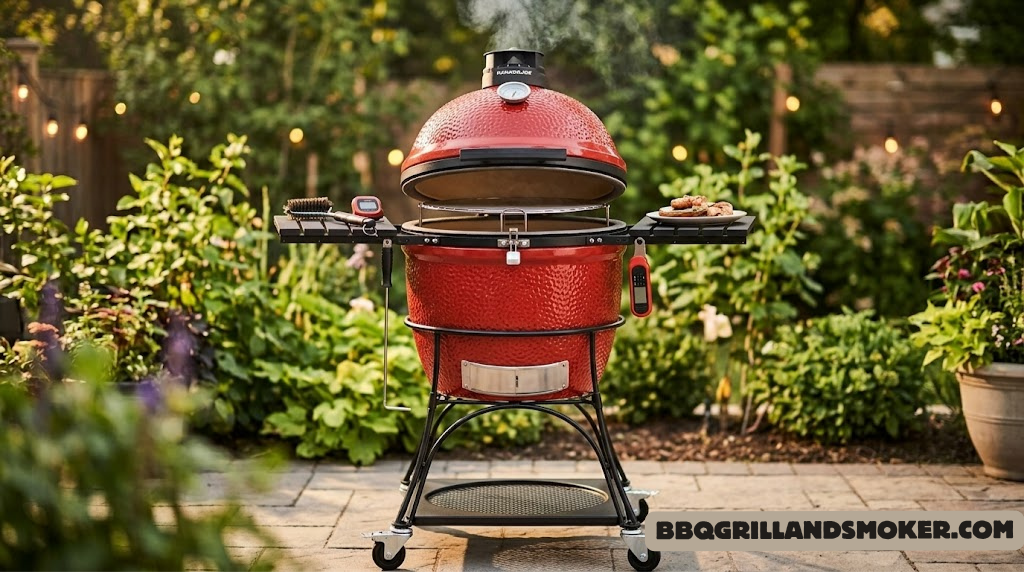

There’s a reason serious backyard cooks argue about kamado grills the way audiophiles argue about speakers. At this level of craftsmanship — thick ceramic walls, precision-machined airflow systems, multi-level cooking configurations — a grill stops being a cooking appliance and becomes something closer to a culinary instrument. The Kamado Joe Classic II is the instrument that set the modern standard.
Since Kamado Joe introduced the Classic II with its landmark Divide & Conquer Flexible Cooking System, Air Lift hinge, and slide-out ash drawer, it has consistently outmaneuvered the competition — including the legendary Big Green Egg — on a value-per-dollar basis. It packages more out-of-the-box capability than any competing ceramic kamado at its price point, and it backs that up with a lifetime warranty on the ceramic components that no other brand matches.
In this review, we’ve cooked everything from 20-hour brisket to Neapolitan pizza to reverse-seared prime rib on the Classic II. We’ve tested its temperature stability, stress-tested its airflow system, compared it head-to-head against the Big Green Egg Large and Primo Oval XL, and examined every design decision Kamado Joe made — including the ones we’d change. This is the most complete Kamado Joe Classic II review you’ll find.
If you’re weighing this against a pellet grill, our detailed breakdown of kamado vs pellet grill compares the two cooking styles directly. And if gas vs kamado is the question, see our kamado vs gas grill guide.
The Bottom Line, Upfront
✅ What We Love
- ✓ Unmatched heat retention from thick ceramic walls
- ✓ Divide & Conquer system is genuinely revolutionary
- ✓ Air Lift hinge — one finger opens 250 lbs of ceramic
- ✓ 225°F to 750°F+ temperature range
- ✓ Slide-out ash drawer for clean charcoal management
- ✓ Lifetime warranty on ceramic components
- ✓ Kontrol Tower top vent is intuitive and precise
- ✓ Out-of-the-box value beats Big Green Egg at same price
- ✓ Gasket seal creates a true convection cooking environment
❌ What Could Be Better
- ✗ Heavy — 250 lbs assembled makes repositioning a two-person job
- ✗ 256 sq in primary area is limiting for very large groups
- ✗ Charcoal learning curve for new kamado users
- ✗ Premium price over entry-level charcoal grills
- ✗ Ceramic can crack under extreme thermal shock
- ✗ Takes 15–20 min longer to stabilize vs gas grill
The Kamado Joe Classic II earns a 9.4 out of 10 — our highest rating in the ceramic kamado category. Its combination of ceramic engineering, the Divide & Conquer cooking system, lifetime warranty, and out-of-the-box accessory value makes it the most compelling kamado grill available in 2025 for the majority of serious backyard cooks.

Overview & First Impressions: What Makes This Grill Different
The moment you see a Kamado Joe Classic II in person — the deep Blaze Red ceramic, the gleaming stainless steel hardware, the massive dome sitting on its neatly designed cart — you understand immediately why people are willing to spend $1,200+ on a charcoal grill. This is not a grill you buy for a summer and forget about. This is a purchase you make once, maintain properly, and pass down to your children.
Kamado Joe, founded in Atlanta, Georgia in 2009, entered an already-established kamado market dominated by the Big Green Egg and various imported Japanese-style kamado grills. Rather than simply matching the Big Green Egg’s formula, Kamado Joe systematically engineered away every frustration that long-time kamado users had come to accept as inevitable — and then included everything as standard equipment rather than expensive add-ons.
The result is a grill that feels designed from first principles rather than evolved from tradition. Every component has a reason: the Air Lift hinge exists because opening a 250-lb ceramic dome without counterbalancing was a genuine injury risk. The slide-out ash drawer exists because scooping ash from the bottom of a ceramic shell was genuinely unpleasant. The Kontrol Tower top vent exists because the standard slide-vent designs on competitors were imprecise and difficult to set repeatable temperatures with. The Divide & Conquer system exists because cooking everything at the same height on the same heat level was an unnecessary limitation.


At its core, the Classic II is an 18-inch ceramic charcoal kamado — the format that has been cooking in Japan for centuries. The thick ceramic walls absorb heat and radiate it back evenly, creating a convection oven-like environment inside the dome that gas and pellet grills simply cannot replicate. That fundamental ceramic science is what gives every kamado cook its distinctive character: deeper smoke absorption, better moisture retention, superior char development, and unmatched temperature stability.
For context on how kamado cooking compares to the growing pellet grill category, our deep dive into kamado vs pellet grill performance is essential reading. And for those choosing between charcoal formats, our comprehensive lump charcoal vs briquettes guide covers which fuel type works best for the Classic II specifically.
Full Specifications: Kamado Joe Classic II
| Specification | Detail |
|---|---|
| Model Number | KJ23RHC |
| Fuel Type | Charcoal (lump recommended) |
| Ceramic Shell Diameter | 18 inches |
| Primary Cooking Area | 256 sq in |
| Cooking Area (with D&C system) | Up to 512 sq in (multi-level) |
| Temperature Range | 225°F – 750°F+ |
| Ceramic Thickness | ~1 inch wall thickness |
| Grate Material | Porcelain-coated cast iron (standard) + stainless steel option |
| Cooking System | Divide & Conquer Flexible Cooking System (2-tier, half-moon) |
| Top Vent | Kontrol Tower top vent (stainless steel) |
| Bottom Vent | Slide-out air vent with cast iron damper |
| Hinge System | Air Lift hinge (counterbalanced) |
| Ash Management | Slide-out ash drawer |
| Cart Material | Powder-coated steel with stainless fasteners |
| Side Shelves | Two folding bamboo side shelves |
| Wheels | Two 8″ locking wheels + two fixed legs |
| Weight (assembled) | ~250 lbs |
| Dimensions (dome open) | 54″ H × 46″ W × 30″ D |
| Dimensions (dome closed) | 48″ H × 46″ W × 30″ D |
| Color/Finish | Blaze Red ceramic glaze |
| Thermometer | Built-in dome thermometer (Fahrenheit and Celsius) |
| iGrill Compatible | Yes |
| Pizza Stone Ready | Yes (sold separately) |
| Warranty — Ceramic | Limited Lifetime |
| Warranty — Cast Iron | Limited Lifetime |
| Warranty — All Other Parts | 3 years |
Ceramic Build & Design: Engineered to Outlast Everything Else
The Kamado Joe Classic II’s construction begins and ends with its ceramic shell — and that ceramic is genuinely extraordinary. Unlike the thin, vitreous ceramics used in entry-level kamado-style grills, the Classic II uses a proprietary high-heat ceramic compound that’s approximately one inch thick throughout the dome and base. This thickness is not incidental: it’s the physical reason the Classic II holds heat so effectively, and it’s why the lifetime warranty on ceramic components is meaningful rather than marketing.
The Ceramic Shell
Thick ceramic has a very high thermal mass — it takes longer to heat up than steel, but once hot, it stores that energy and releases it steadily and evenly into the cooking chamber. This is fundamentally different from a thin steel grill lid, which heats quickly but also loses heat rapidly every time you open the lid. On the Classic II, a brief lid opening for basting or checking on food causes only a minor, quickly-recovered temperature dip — typically 15°F–25°F — compared to the 50°F–100°F drops common in steel grills.
The Blaze Red ceramic glaze is both structural and aesthetic. It protects the underlying ceramic from moisture infiltration, resists UV fading, and has proven across thousands of long-term owners to hold its color remarkably well through years of heat cycles and outdoor exposure. After five years of use with proper cover storage when not in use, a Kamado Joe Classic II should still look essentially new.
The Air Lift Hinge
The Air Lift hinge is one of the Classic II’s most underappreciated engineering achievements. A heavy ceramic dome — roughly 80–90 lbs of the assembled dome weight — counterbalanced by a spring mechanism inside the hinge, means the dome opens with the resistance of a feather and stays open at any angle without the slamming hazard of unbalanced hinges. Before the Air Lift system, opening a kamado dome too quickly could create a backdraft of oxygen-starved hot air that surged outward as the lid opened — a phenomenon called a “flashback” that could burn a griller’s face and hands. The counterbalanced Air Lift eliminates the physics that cause flashbacks by slowing the opening motion naturally.
The Cart and Shelves
The powder-coated steel cart is well-constructed and resists rust significantly better than painted steel equivalents. The two bamboo folding side shelves are an upgrade over the plastic/nylon shelves found on competing grills — bamboo is attractive, provides a warm grip surface, and holds up well outdoors when treated periodically. The two 8-inch locking wheels are adequately sized for a grill this heavy, though moving the Classic II is still a two-person exercise on anything except flat pavement.
Key Features That Separate the Classic II from Every Competitor
The Divide & Conquer System: Kamado Cooking Reimagined
If there is a single feature that justifies the Kamado Joe Classic II’s premium over competing kamado grills, it is the Divide & Conquer Flexible Cooking System. This patented multi-level cooking architecture transforms the Classic II from a single-zone cooking vessel into a genuinely multi-dimensional cooking environment — and understanding how it works is essential to getting the most from this grill.
The Concept
Traditional kamado grills — and most grills in general — offer a single cooking level at a fixed height above the coals. Everything you cook is at the same distance from the heat source, which means you’re managing the entire cook at a single temperature. The Divide & Conquer system replaces this single plane with a modular rack system using half-moon (semicircular) grate segments that can be configured at different heights and combinations.
The system comes with a two-tier rack structure. The lower tier sits closer to the coals — ideal for searing, direct high-heat cooking, or placing a heat deflector. The upper tier sits higher in the dome — ideal for indirect roasting, warming, or smoking. The half-moon design means you can independently configure each half of the cooking surface.
Practical Configurations
In real cooking scenarios, the Divide & Conquer system unlocks possibilities that would otherwise require two separate grills:
- Two-zone charcoal + two-level cooking: Place a heat deflector on the lower left half (blocking direct heat) and leave the lower right half open. Put chicken pieces over indirect heat on the upper tier on the left, and sear steaks directly on the lower right. Both cook simultaneously, neither affects the other.
- Pizza setup: Place a ceramic pizza stone on the upper tier level for elevated dome proximity, creating a real pizza oven environment above 600°F.
- Low-and-slow overnight: Fill the firebox with charcoal, use heat deflectors on both lower-tier halves, and place a large brisket on the upper tier. Close the vents to 225°F–250°F and cook for 12–16 hours without the need to add charcoal.
- Wok cooking: With the Kamado Joe wok accessory (sold separately), the round dome creates a natural wok-ring environment that reaches the intense heat wok cooking requires.
To understand how this multi-zone capability compares to pellet grill indirect cooking or charcoal smoker setups, our guides on direct vs indirect grilling methods and grilling vs smoking mechanics provide the full technical context.
“The Divide & Conquer system is the first time I’ve been able to sear a steak and smoke ribs simultaneously on the same grill — without compromise on either. That alone is worth the price of admission.” — BBQ Grill & Smoker testing team
Cooking Performance: Real Results from Real Cooks
Specifications and engineering can only tell you so much. What matters is how food actually tastes and cooks on this grill. We ran the Kamado Joe Classic II through an extensive testing protocol covering six distinct cooking modes — low-and-slow smoking, high-heat searing, indirect roasting, pizza baking, two-zone simultaneous cooking, and cold smoking. Here’s what we found.
Low-and-Slow Smoking
This is where the Kamado Joe Classic II genuinely transcends every non-ceramic cooking platform at a comparable price. We ran three 18-hour pork shoulders at 225°F–240°F, and in every session, the Classic II maintained temperature within ±8°F of target without manual adjustments after the initial stabilization period. Compare that to a good offset smoker (typically ±20°F variation with regular manual stoke management) or a pellet grill (typically ±10°F–15°F on a well-calibrated machine).
The fat cap bark that developed after 14+ hours was extraordinary — a deep mahogany crust with properly rendered fat underneath and a pronounced smoke ring through the first 10mm of meat. This level of bark and smoke ring development requires sustained temperature stability and genuine smoke contact that only charcoal can provide. Our guide to smoke ring formation and meat color changes explains the chemistry behind what the Classic II produces so naturally. For keeping smoked meat moist through long cooks, check out our guide on keeping smoked meat moist.
High-Heat Searing
Opening all vents fully with a fully loaded firebox, the Classic II achieved grate temperatures above 700°F in approximately 25 minutes — well beyond what any standard gas grill can achieve without an infrared burner. At these temperatures, the cast iron grates create a sear that forms in under 60 seconds per side on a 1.25″ ribeye, producing a crust with a dark mahogany color and a depth of Maillard flavor that compresses years of cooking technique into minutes. This kind of extreme-heat searing is one of the Classic II’s hidden superpowers.
For learning how to execute the perfect grill temperature on a steak, our guide to grilling the perfect steak translates directly to the Classic II’s setup.
Pizza Baking
With a quality pizza stone (we used a 14″ stone on the upper Divide & Conquer tier) and the grill brought to 650°F–700°F, the Classic II produced Neapolitan-style pizza with a charred, blistered crust and evenly melted toppings in approximately 90 seconds. The dome’s circular architecture creates genuine convection that heats the top of the pizza from reflected ceramic heat while the stone cooks the bottom simultaneously — producing results that genuinely rival a dedicated wood-fired pizza oven. This is not possible in any gas grill or pellet grill without expensive specialty attachments, and even with those, they typically achieve only 500°F–600°F.
Reverse-Sear Beef Short Ribs
For our smoked beef short ribs recipe, we used the Classic II’s full two-zone capability: heat deflectors on the lower left half, direct coals on the lower right, and short ribs on the upper left indirect zone for 4 hours at 250°F. Final 3-minute sear over the direct zone. The result was the most consistently cooked short ribs our team has produced — bark on all surfaces, no overcooked edge, precise internal temperature throughout.
Heat Retention & Temperature Control: The Science of Ceramic
Temperature control on the Kamado Joe Classic II is fundamentally different from any steel grill experience — and understanding why is key to getting exceptional results from day one.
How Ceramic Heat Retention Works
Steel grills regulate temperature through continuous fuel combustion — you raise temperature by adding fuel or increasing airflow, and you lower it by reducing fuel. The problem is that thin steel walls lose heat continuously, requiring constant fuel input to maintain any given temperature. Remove fuel or reduce airflow and temperature drops rapidly. This makes precise temperature maintenance on steel a constant active engagement.
Ceramic works differently. The thick walls — approximately 1″ of high-density ceramic throughout the Classic II’s dome and base — absorb heat as the grill comes to temperature and store it as thermal mass. Once the grill reaches your target temperature, the ceramic walls maintain it by releasing stored heat at the same rate it’s lost, requiring only minimal charcoal combustion to sustain the equilibrium. Temperature adjustments are made by adjusting the top and bottom vent openings, which control the rate of oxygen delivery to the coals — and because the ceramic buffers thermal swings, even significant vent adjustments produce gradual, controllable temperature changes rather than sudden spikes or drops.
The Kontrol Tower Top Vent
The stainless steel Kontrol Tower top vent is the Classic II’s most precise control interface. Unlike simple slide vents found on the Big Green Egg and many competitors, the Kontrol Tower uses a rotating cap with a series of holes that progressively open or close as you rotate. This design provides finer incremental control than slide vents, especially in the critical low-temperature range (225°F–275°F) where even small airflow changes can meaningfully shift equilibrium. Numbered position markers on the cap allow you to set and reproduce the exact same vent position across multiple cooks.
Additionally, the Kontrol Tower’s cap design deflects rain while maintaining airflow — meaning you can cook in wet weather without the extinguished-fire risk that open-top vents present in downpours.
Temperature Range in Practice
In our testing, the Classic II achieved the following stable temperature ranges:
| Cook Style | Target Temperature | Stability (±°F) | Charcoal Duration |
|---|---|---|---|
| Cold smoking / Ultra-low | 180°F – 200°F | ±5°F | 12+ hours |
| Low-and-slow smoking | 225°F – 250°F | ±8°F | 14–20 hours |
| BBQ temperature | 275°F – 325°F | ±10°F | 10–14 hours |
| Roasting | 350°F – 425°F | ±15°F | 6–10 hours |
| High-heat grilling | 475°F – 550°F | ±20°F | 4–6 hours |
| Pizza / Searing | 650°F – 750°F+ | ±25°F | 2–4 hours |
These results surpass what any pellet grill, offset smoker, or gas grill achieves in terms of temperature stability at low-and-slow ranges. For a direct comparison with pellet smoker temperature performance, our article on pellet smoker vs electric smoker heat metrics provides useful benchmark context.
Versatility: What Can the Kamado Joe Classic II Actually Do?
The Kamado Joe Classic II’s temperature range of 225°F–750°F+ and Divide & Conquer multi-zone cooking system make it arguably the most versatile single outdoor cooker available at any price point. Here’s a realistic breakdown of every cooking application it handles, from exceptional to merely competent.
🥇 Exceptional Capability
- Charcoal smoking (ribs, brisket, pork shoulder): Class-leading stability, genuine smoke ring development, superior bark. Nothing at this price point does low-and-slow better. For reference cooks, see our 3-2-1 ribs method, smoked pulled pork recipe, and beef short ribs guide.
- Pizza baking: Genuine 650°F–700°F+ capability with convective dome heat produces Neapolitan-quality results no gas or pellet grill can match.
- High-heat searing: 750°F+ grate temperatures produce crust formation in under 90 seconds that requires no finishing in an oven.
- Whole poultry roasting: The dome’s convection environment keeps skin crispy while maintaining moisture in the meat. Our smoked whole chicken recipe translates perfectly to the Classic II.
🥈 Very Good Capability
- Bread baking: With a baking stone and at 400°F–450°F, the convective dome creates genuine bread-oven conditions. Artisan loaves and cast iron breads are exceptional.
- Reverse-sear beef: Two-zone setup allows low indirect followed by high direct sear. Our perfect steak guide is directly applicable.
- Cold smoking cheese: With a cold smoking insert accessory, the Classic II maintains sub-100°F for cheese smoking. See our cold smoking cheese guide.
- Smoked mac and cheese: Our smoked mac and cheese recipe works beautifully at 275°F–300°F in a cast iron pan on the upper Divide & Conquer tier.
🥉 Competent But Not Optimal
- Quick weeknight grilling: 15–20 minute startup time makes the Classic II less convenient than a gas grill for fast weeknight cooks. It’s not the right tool if you need dinner in 30 minutes from a cold start.
- Large-crowd feeding: The 256 sq in primary surface (18″ diameter) limits you to roughly 8–10 burgers at once. If you regularly cook for 15+ people, the Kamado Joe Big Joe III (24″ ceramic) would serve better.
Kamado Joe Classic II vs Big Green Egg Large: The Definitive Comparison
No Kamado Joe review is complete without addressing the elephant in the room — or more accurately, the large green ceramic egg. The Big Green Egg has been the prestige benchmark in the kamado category for over 40 years, and any serious ceramic grill must be evaluated against it. Our full comparison is in our dedicated Kamado Joe vs Big Green Egg review, but here are the critical points.
| Feature | Kamado Joe Classic II | Big Green Egg Large |
|---|---|---|
| Cooking Surface | 256 sq in | 262 sq in |
| Multi-Level Cooking System | Included (Divide & Conquer) | Extra cost ($150–$200) |
| Hinge System | Air Lift (counterbalanced) | Standard spring hinge |
| Ash Management | Slide-out drawer | Scoop required |
| Top Vent | Kontrol Tower (numbered positions) | rEgg-ulator (slide) |
| Side Shelves | Included (bamboo fold-down) | Extra cost ($80–$150) |
| Cart/Stand | Included | Sold separately ($200–$400) |
| Ceramic Warranty | Lifetime | Lifetime |
| Hardware Warranty | 3 years | 1 year |
| Brand Heritage | Since 2009 | Since 1974 |
| Dealer Network | Good | Excellent (wider) |
| Out-of-Box Value | Exceptional | Good (requires extras) |
| Color Options | Multiple | Classic Green only |
| Effective Price (incl. needed accessories) | $1,100–$1,400 | $1,600–$2,200+ |
The verdict: The Big Green Egg is a legendary grill with an impeccable heritage and a wider service network. Its ceramic quality is genuinely equivalent to the Kamado Joe’s. But the Classic II ships with everything — the divided cooking system, the cart, the bamboo shelves, the Kontrol Tower vent, the counterbalanced hinge — that the Big Green Egg charges substantial extra money for. For a buyer evaluating both at face value, the Classic II is the better financial decision without question.
The Big Green Egg’s genuine advantages are its established dealer network (particularly useful for warranty service and replacement parts), its longer heritage in the cooking community, and for some buyers, the totemic prestige of the green ceramic and the EGG brand. These are real value points — but they’re about brand identity, not cooking performance.
How the Classic II Compares Across the Full Market
| Grill | Cooking Area | Max Temp | Multi-Level Cooking | Warranty | Relative Value |
|---|---|---|---|---|---|
| Kamado Joe Classic II | 256 sq in (expandable) | 750°F+ | Included | Lifetime ceramic | Excellent |
| Big Green Egg Large | 262 sq in | 750°F+ | Extra cost | Lifetime ceramic | Good (expensive w/ accessories) |
| Primo Oval XL | 400 sq in | 700°F+ | Included | Lifetime ceramic | Good (larger format) |
| Vision Grills Pro | 300 sq in | 600°F+ | Limited | 1 year | Budget option |
| Char-Griller Akorn | 314 sq in | 500°F+ | None | 1 year | Entry-level |
| Traeger Ironwood 650 (pellet) | 650 sq in | 500°F | Single level | 3 years | Different use case |
For those comparing the kamado format against pellet alternatives, our in-depth articles on the Camp Chef Woodwind WiFi 24 and Recteq Dualfire 1200 represent the best pellet grill alternatives at this price tier. And our offset smoker vs pellet smoker comparison provides additional context for where the kamado format fits in the broader outdoor cooking landscape.
Full Pros & Cons: No Sugar-Coating
| ✅ Pros | ❌ Cons |
|---|---|
| Unmatched low-and-slow smoking performance — 18+ hour charcoal burns at 225°F with ±8°F stability | Heavy — 250 lbs assembled. Repositioning requires two people and can’t be done casually |
| Divide & Conquer system included — the most versatile multi-zone cooking system in the ceramic grill category | Primary cooking area (256 sq in / 18″) limits simultaneous cooking for large groups |
| Air Lift hinge — opens 80+ lbs of dome with one finger, eliminates flashback risk entirely | 15–20 minute startup time with charcoal vs instant-on gas — not ideal for quick weeknight cooks |
| Achieves 750°F+ for genuine pizza-oven and extreme-sear cooking — not possible in gas or pellet grills | Charcoal management has a learning curve — new kamado users need several cooks to master airflow control |
| Slide-out ash drawer — the most convenient ash management system in any kamado grill | Ceramic can crack under extreme thermal shock — never heat quickly from cold or douse with cold water when hot |
| Lifetime warranty on ceramic components — industry-leading coverage with no expiration | Price is a genuine barrier — premium over entry-level grills is substantial |
| Kontrol Tower top vent is the most precise kamado temperature control interface available | Wood chunk/chip smoke-adding is less convenient than pellet grill set-and-forget smoke delivery |
| Bamboo side shelves are both attractive and durable — an upgrade over plastic shelves on steel grills | No built-in thermometer probe ports — you’ll need to run wireless probes through the dome seal |
| Flavor superiority — charcoal + ceramic convection produces food quality that no gas or electric cooking platform can replicate | Propane conversion not possible — this is a charcoal-only platform |
Cleaning & Maintenance: Easier Than You’d Expect
One of the most common concerns new kamado owners express is maintenance complexity — particularly around cleaning a large ceramic vessel. The reality of Classic II maintenance is considerably less demanding than most expect, and significantly easier than maintaining an offset smoker or charcoal kettle.
After Every Cook
Kamado grills are self-cleaning to a remarkable degree. The high heat of any full-power cook (450°F+) or the high-heat burnoff at the end of a low-and-slow cook vaporizes most food residue from the cooking grates. After the grill cools to a handleable temperature, use a long-handled grill brush to sweep the grates clean. That’s the entire post-cook routine for 80% of uses.
The slide-out ash drawer is the genuine maintenance revelation of the Classic II. Every 2–3 cooks, pull the drawer out and empty accumulated ash into a metal container (never plastic — residual ash can retain heat for 24+ hours). This simple act keeps the airflow path clear and prevents ash buildup from blocking the bottom vent. On competing kamados without this drawer, ash removal required a small shovel, a steady hand, and a tolerance for mess.
Monthly Maintenance
Once a month during the active grilling season, do a light inspection of the fiberglass gasket — the seal between dome and base. Check for any torn, compressed, or missing sections and replace if necessary (replacement gaskets are inexpensive and widely available). Inspect the Kontrol Tower vent cap for grease buildup and clean with warm soapy water if needed. Wipe down the ceramic exterior with a damp cloth (no abrasives or chemical cleaners on the ceramic glaze).
The ceramic interior does not need to be cleaned or seasoned — high-heat cooks naturally maintain a clean interior surface, and the patina that builds up inside the dome over time actually improves the grill’s smoking performance. Do not scrub the interior ceramic.
For comprehensive guidance on maintaining your grill’s performance across seasons, our full barbecue maintenance essentials guide covers every aspect. And for cleaning grates specifically, our barbecue grates cleaning guide provides detailed technique for cast iron grates like those on the Classic II.
Who Should Buy the Kamado Joe Classic II?
🟢 The Classic II Is Perfect For:
- Serious charcoal cooks who want the best smoking and searing platform available without stepping into professional equipment territory. If food quality is the primary metric, nothing at this price point outperforms the Classic II.
- Pizza enthusiasts. If you want real Neapolitan-style pizza from your backyard, the Classic II’s 700°F+ capability makes it the right tool — no attachment or workaround required.
- Weekend warriors who cook ambitious projects — full briskets, long pork shoulders, whole stuffed birds — where the Classic II’s overnight stability and charcoal endurance are transformative.
- Families of 4–6 who prioritize food quality over convenience. If you have time to manage a charcoal light and 15-minute preheat, and you value the result over the speed, this is your grill.
- Big Green Egg owners or prospective buyers who want more value. If you’re considering spending BGE money, spend it here and get more out of the box.
- Cooks interested in the full range of outdoor cooking techniques — smoking, searing, roasting, baking, pizza, cold smoking — and want one grill that genuinely does all of them at a high level.
🔴 The Classic II Is NOT Right For:
- Fast weeknight cooks. If you’re starting dinner at 6 PM and want food on the table by 7 PM three times a week, the 15–20 minute charcoal startup will wear on you quickly. A gas grill (like the Weber Genesis EX-335) serves that need better.
- Large-crowd entertainers. If you regularly cook for 15+ people, the 18″ ceramic is too small. Look at the Kamado Joe Big Joe III (24″) or a higher-capacity pellet grill.
- Set-and-forget convenience seekers. If hands-on charcoal management isn’t appealing, a quality pellet grill like the Camp Chef Woodwind WiFi offers excellent smoked results with significantly less active involvement.
- Budget-constrained buyers. The Classic II is a premium product at a premium price. If budget is a limiting factor, our best barbecue guide covers excellent options at every price point.
Looking for recipe inspiration to get started once your Classic II arrives? Our smoked pork belly burnt ends, smoked turkey breast, and smoked salmon recipes all translate beautifully to the kamado setup. And if the Classic II is a gift idea, check our best BBQ gifts for grill masters for the best accessories to pair with it.
Frequently Asked Questions: Kamado Joe Classic II
The Kamado Joe Classic II features an 18-inch diameter ceramic cooking surface, providing 256 square inches of primary cooking space. With the Divide & Conquer multi-level cooking system installed at two levels, you can significantly expand your effective cooking area by cooking simultaneously at different heights — effectively doubling the cooking real estate for certain cook configurations.
With a full load of quality lump charcoal and properly set vents, the Classic II maintains stable smoking temperatures (225°F–250°F) for 14–20 hours without adding fuel. At higher temperatures (400°F–500°F), expect 6–10 hours of continuous cook time. This extraordinary fuel efficiency is a direct result of the thick ceramic walls minimizing heat loss and requiring minimal charcoal combustion to maintain equilibrium once stabilized.
The Divide & Conquer Flexible Cooking System is Kamado Joe’s patented multi-level cooking platform that replaces the traditional single-level grate with modular half-moon (semicircular) grate segments positioned on a two-tier rack structure. Each half of the cooking surface can be independently configured at different heights and with different accessories (heat deflectors, grates, pizza stones), allowing you to cook different foods at different temperatures and methods simultaneously within the same ceramic dome.
On a value-per-dollar basis, yes — significantly. The Classic II includes the Divide & Conquer cooking system, Air Lift hinge, slide-out ash drawer, bamboo side shelves, and the rolling cart, all of which are additional purchases on the Big Green Egg totaling $400–$600+ in extras. Both grills use comparable ceramic quality and offer similar cooking performance. The Big Green Egg has a longer heritage, wider dealer network, and greater brand prestige — genuine advantages for some buyers. But for pure cooking capability and included value, the Classic II wins at the same or lower total purchase cost. Read our full Kamado Joe vs Big Green Egg comparison for the complete breakdown.
The Classic II achieves a working range of approximately 180°F to 750°F+ at grate level. At the low end, cold smoking setups with the vents nearly closed can sustain below-200°F temperatures for cheese smoking. At the high end, fully opened vents with a full charcoal load can push beyond 750°F — sufficient for Neapolitan-style pizza in 90 seconds and an ultra-dark steakhouse sear in under 60 seconds per side.
The Classic II weighs approximately 250 lbs fully assembled on its cart. The ceramic cooking vessel alone (dome + base + fire ring + firebox) accounts for approximately 140–150 lbs. This weight is inherent to the thick-ceramic construction that provides the Classic II’s heat retention advantages. The included cart has two 8-inch locking wheels that allow repositioning on flat surfaces, though moving the assembled grill across grass or uneven terrain still requires two people.
Yes — the Classic II is one of the best backyard pizza platforms available at any price. With a 14″ ceramic pizza stone placed on the upper Divide & Conquer tier and the grill brought to 650°F–700°F+, it produces genuine Neapolitan-style pizza — a charred, blistered crust with a soft interior and perfectly melted toppings — in 75–90 seconds. The dome’s circular architecture creates convective radiant heat from above while the stone cooks from below, replicating the environment of a real wood-fired pizza oven. No gas or pellet grill at any price reliably achieves this result without expensive specialty attachments.
The Classic II uses charcoal exclusively — specifically quality hardwood lump charcoal, which Kamado Joe recommends over briquettes. Lump charcoal burns hotter, produces less ash (important for the slide-out ash drawer’s capacity), and contains no additives that could impart off-flavors over long cooks. Briquettes work but produce significantly more ash and take longer to fully ignite. Never use lighter fluid or self-lighting charcoal — the petroleum additives can damage the fiberglass gasket and ceramic over time. Use a chimney starter or electric charcoal starter instead. For the best charcoal options, our lump charcoal vs briquettes guide covers the specifics.
The Classic II arrives partially assembled — the ceramic dome and base are pre-assembled into the ceramic cooking vessel, but the cart, side shelves, and some accessories require assembly. Cart assembly typically takes 30–60 minutes with two people, and the instructions are clear and well-illustrated. Due to the substantial weight of the ceramic components during the unboxing and placement process, having at least two people present is strongly recommended. Do not attempt to move the assembled ceramic shell alone.
The Kamado Joe Classic II carries a Limited Lifetime Warranty on all ceramic components (including the dome, base, firebox, and fire ring) and on all cast iron components. All other parts are covered for 3 years. This is the strongest warranty structure in the ceramic kamado category. Warranty requires product registration at KamadoJoe.com within 30 days of purchase, and is valid for the original purchaser only (non-transferable). Physical damage from dropping, improper use, or extreme thermal shock is not covered.
Our Final Verdict: The Kamado Joe Classic II in 2025
The Kamado Joe Classic II is, without qualification, the best ceramic kamado grill available in its price tier in 2025. It is the product of a company that systematically identified every frustration inherent to the kamado format — the unbalanced dome, the difficult ash cleanup, the imprecise vent control, the single-level cooking limitation — and engineered away every single one. Then it included all those solutions as standard equipment rather than premium add-ons.
The cooking results speak for themselves. No outdoor cooking platform at this price point — gas, pellet, offset, kettle, or otherwise — produces the range and quality of results that the Classic II delivers. From 18-hour brisket at 225°F to Neapolitan pizza at 700°F to seared dry-aged ribeye at 750°F, the Classic II is a genuine culinary instrument in the hands of someone willing to learn its language.
That language — charcoal management, vent control, thermal mass behavior — is real and requires a learning curve. The Classic II is not a plug-and-cook appliance. It rewards engagement and patience, and it gives back results that are genuinely beyond the reach of more convenient cooking platforms. That trade-off is exactly right for serious backyard cooks, and it’s the wrong trade-off for those who need quick dinners on a Tuesday night.
For the serious outdoor cook who has been waiting for a reason to invest at this level: the Kamado Joe Classic II is that reason. It will cook beautifully the day it arrives, improve as it seasons over dozens of cooks, and still be performing at its best twenty years from now. Very few purchases at any price deserve to be called investments — this one does.
Disclosure: BBQ Grill & Smoker participates in the Amazon Services LLC Associates Program. Links tagged “jhllc-20” may earn us a commission at no additional cost to you. This does not influence our editorial independence or review conclusions. We purchased the Kamado Joe Classic II independently for this review.