Quick Verdict: What You Need to Know in 60 Seconds
✅ What We Love
- Exceptional porcelain-enamel durability
- Precise airflow control via top/bottom vents
- One-Touch ash cleaning system is genuinely brilliant
- Hinged cooking grate for easy charcoal access
- Handles grilling, smoking, roasting, and baking
- 10-year lid and bowl warranty
- Massive ecosystem of compatible accessories
- Iconic, proven design refined over decades
❌ Room for Improvement
- No built-in thermometer on base model
- Limited ash catcher capacity on long cooks
- Single bottom shelf offers little prep space
- Legs feel slightly thin at this price
- Lid hook could be more secure
- No side table (Premium version adds one)

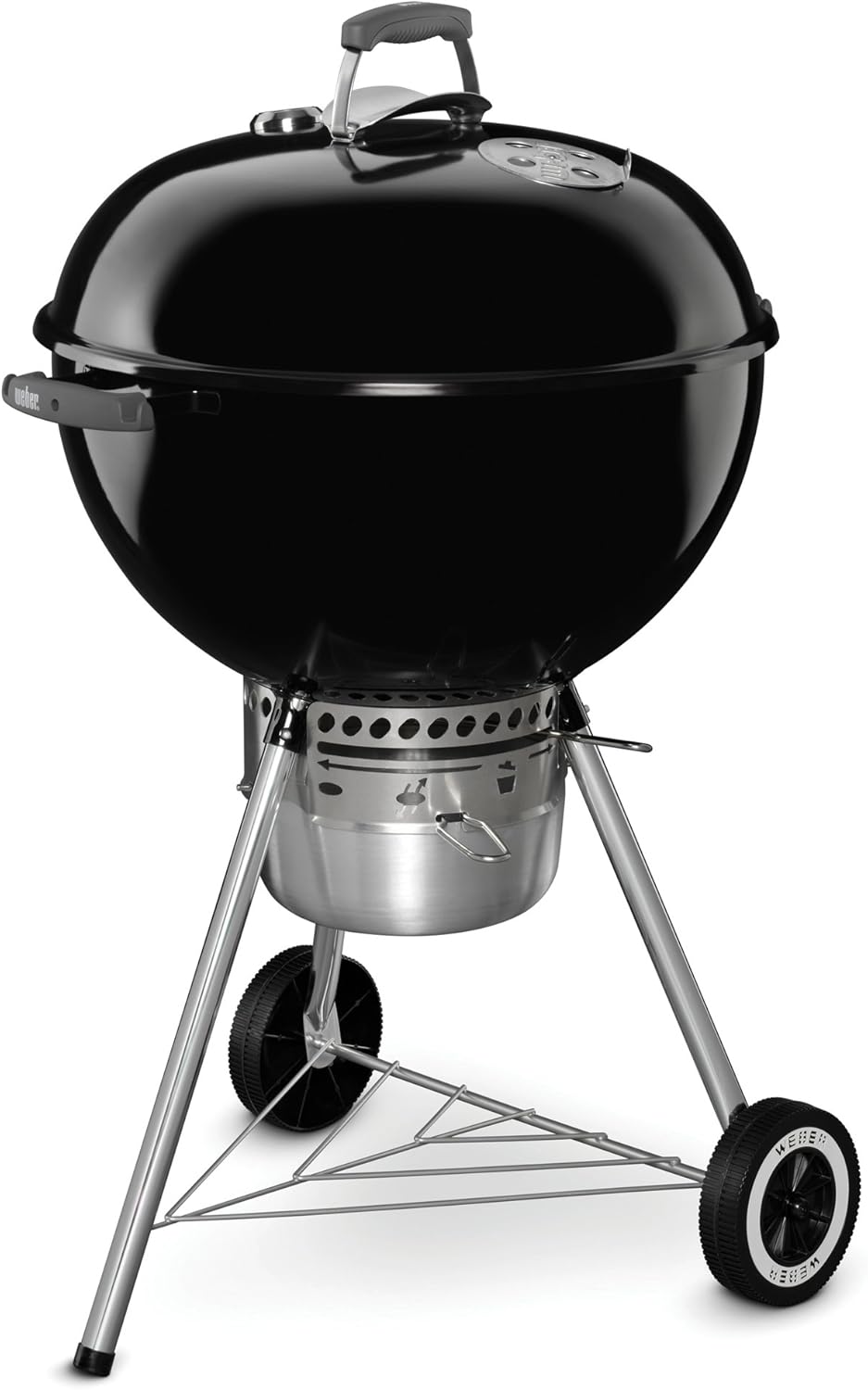
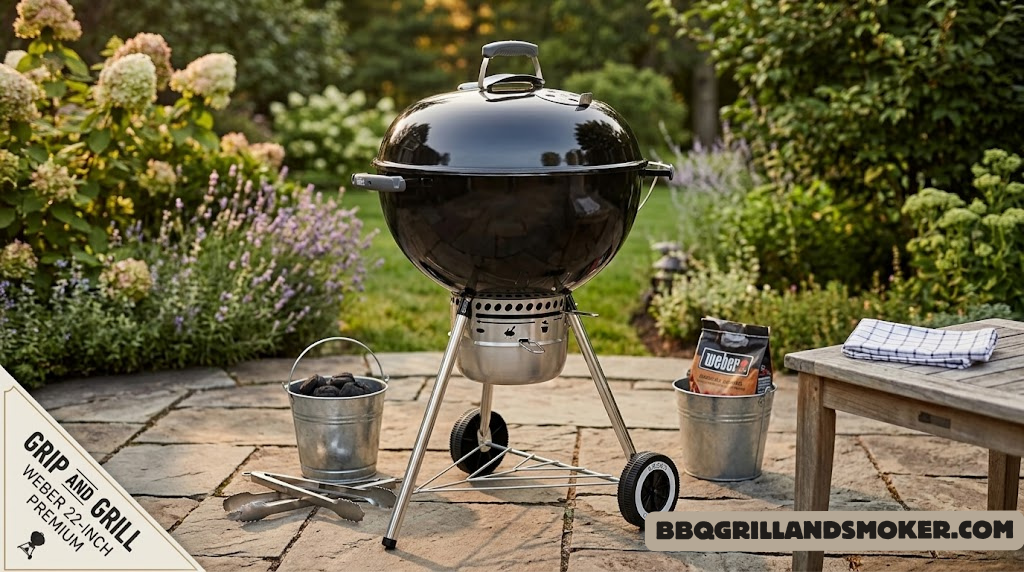
Weber Original Kettle Premium 22″ — Our Top Pick
The best-selling charcoal grill in America. Built to last decades. Backed by a 10-year warranty on lid and bowl. Check the current price and available colors on Amazon.
Check Price on Amazon →Why the Weber Kettle Grill Is Still the Standard Everything Else Is Measured Against
In 1952, a Weber employee named George Stephen Sr. took a metal buoy, cut it in half, welded on legs and a lid, and created what would become the most recognizable grill shape in the world. The round kettle design wasn’t accidental genius — it was deliberate engineering. The dome lid deflects heat and smoke back down onto the food, promoting convection cooking. The round shape eliminates hot corners. The dampers let you dial airflow with precision. And the porcelain enamel coating prevents rust while retaining and reflecting heat with remarkable efficiency.
More than seven decades later, the Weber 22-inch Original Kettle Premium sits at the center of a heated market crowded with pellet grills, smart smokers, and gas grills with Bluetooth connectivity. And yet — it outsells nearly all of them. Not because of inertia or brand nostalgia, though both exist, but because the design genuinely delivers. Every generation of backyard cooks rediscovers the same truth: there’s nothing the Weber kettle can’t handle, and very few grills that do any single thing dramatically better.
This review tests the Weber 22″ across every relevant dimension — from raw searing performance to slow-smoke capability, from assembly experience to long-term build durability. We’ll compare it against its direct competitors, tell you who should buy it and who shouldn’t, and give you an honest, unvarnished assessment of whether it deserves its legendary reputation in 2025.
If you’re also weighing the charcoal-vs-gas debate before committing, our detailed comparison of flavor outcomes between gas and charcoal grills is required reading — it’ll crystallize exactly what you gain and give up with each fuel type.
Weber 22″ Original Kettle Premium — Full Specifications
Weber Kettle Model Lineup: Which Version Is Right for You?
Weber offers several configurations of the 22-inch kettle. Understanding the differences helps you avoid paying for features you don’t need — or skimping on ones that matter.
| Model | Thermometer | Side Table | Ash System | Charcoal Access | Best For |
|---|---|---|---|---|---|
| Original Kettle (Base) | No | No | One-Touch | No hinged grate | Budget buyers |
| Original Kettle Premium | Yes (lid) | Yes (folding) | One-Touch | Hinged grate | Most buyers ✅ |
| Master-Touch | Yes | Yes | Gourmet system | Hinged grate | Enthusiasts |
| Performer Deluxe | Yes | Large table | Gourmet system | Charcoal ignition | Serious cooks |
| Summit Charcoal | Digital | Full station | Advanced | Full access | Premium buyers |
Build Quality and Design: Where Weber Earns Its Reputation
The first thing you notice when handling a Weber kettle is the weight of the lid. Lift it — really handle it — and you immediately feel something that’s absent from most budget charcoal grills: genuine material substance. The porcelain-enameled steel used for both the lid and bowl isn’t thin sheet metal that flexes under pressure; it’s a properly thick gauge that feels solid and behaves like it’s going to be around for decades. Because it typically is.
The Porcelain Enamel Advantage
Weber’s porcelain enamel coating deserves specific attention because it’s genuinely one of the best material choices in this product category. The coating is applied over steel and fired at high temperature, creating a glassy, impermeable surface that resists rust, doesn’t absorb flavors or odors, cleans easily, and retains heat more effectively than bare steel. It’s the same coating used on cast-iron cookware, and it delivers the same benefits at a fraction of the weight.
Competitors at the same price point frequently use painted steel — which looks similar but chips, rusts, and degrades far more rapidly under thermal cycling. Weber’s porcelain surface, by contrast, handles temperature swings from 0°F to 700°F+ without cracking, peeling, or discoloring in any meaningful way. After years of use, a well-maintained Weber kettle bowl looks almost new. This is not an accident of design — it’s the reason Weber offers a 10-year warranty on the lid and bowl while most competitors offer one.
For a deeper look at how different grill surface materials hold up over time and across temperature ranges, our charcoal grill surface and durability comparison breaks down the trade-offs across different material choices.
Grate Construction
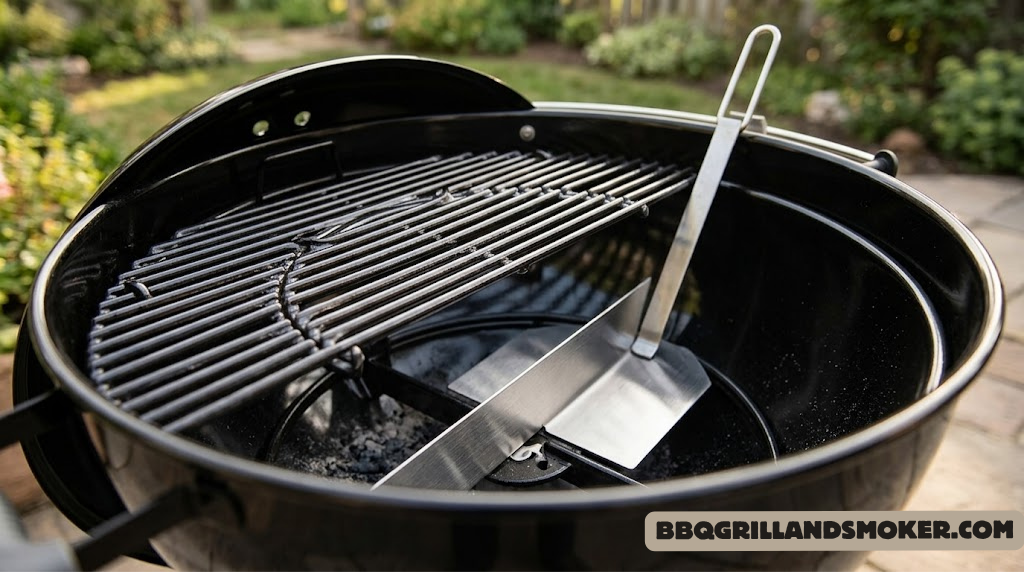
The cooking grate on the Premium model is a porcelain-enameled steel hinged design — the hinge on one end lifts to allow you to add charcoal mid-cook without removing food. This sounds like a minor detail until you’re 90 minutes into a low-and-slow cook and need to add fuel. It’s a thoughtful addition that makes a real-world difference.
One legitimate debate in the charcoal grill community is whether the porcelain-coated steel grates are preferable to cast iron. Weber offers cast iron grates as an upgrade through their accessories system. Cast iron holds heat longer and produces more aggressive sear marks; porcelain-coated steel is easier to clean and doesn’t require seasoning. We explore this trade-off in detail in our cast iron vs. stainless steel grill grates comparison.
The One-Touch Ash Management System
Weber’s One-Touch cleaning system is — and this isn’t hyperbole — one of the cleverest pieces of design in backyard cooking. Three aluminum sweep blades sit beneath the charcoal grate, controlled by a single handle that extends through the bottom of the bowl. After a cook, you simply rotate the handle a few times. The sweeper blades push all ash through the vents and into the removable aluminum ash catcher below. No scooping, no mess, no digging.
The ash catcher itself is adequately sized for most cooks, but on extended 6+ hour smokes where you’re burning through significant charcoal volume, it may fill before the cook is complete. This is the one area where the Performer’s larger ash management system offers a practical advantage for frequent long-cook users.

Essential Companion: Weber Rapidfire Chimney Starter
No lighter fluid, no hot spots, no waiting. The chimney starter is the right way to light your Weber kettle and produces a clean, even coal bed in 15 minutes. Every kettle owner needs one.
Check Price on Amazon →Heat Performance: Temperature Range, Consistency, and Searing Ability
A charcoal grill’s heat performance is determined by three things: the maximum temperature it can achieve, how consistently it holds a target temperature, and how precisely you can manipulate that temperature. The Weber 22″ excels at all three — though the last point requires some understanding of damper mechanics and a modest learning curve for first-time charcoal cooks.
Temperature Range
With a full chimney of lit lump charcoal — approximately 100 briquettes or a proportional volume of lump — the Weber 22″ lid thermometer reads 550–600°F at the grate level, with hotspot zones directly above the coal bed reaching 650°F or higher. This is more than sufficient for hard searing: steaks, chops, and burgers develop excellent Maillard reaction crust at these temperatures, and the results are significantly better than what most gas grills achieve at their maximum output.
At the low end, with both vents barely cracked and only a partial chimney load in a two-zone arrangement, you can hold 225–250°F in the indirect zone for extended periods. We’ve maintained 230°F for 5+ hours on a single full load of charcoal briquettes using the snake method (more on this in the Cooking Versatility section). This is the temperature range for serious low-and-slow cooking — ribs, pulled pork, whole chicken — and the Weber handles it with more reliability than most buyers expect from a grill at this price.
The Damper System: Your Primary Temperature Control
Unlike gas grills where you simply turn a knob, charcoal temperature management requires understanding airflow. The Weber kettle uses a beautifully simple two-damper system: a bottom vent that controls the volume of oxygen feeding the coals, and a top vent in the lid that controls exhaust. More airflow = hotter fire. Less airflow = cooler, slower burn.
The general rule of thumb: the bottom vent is your primary temperature control (how much oxygen feeds the coals), and the top vent should always be at least partially open so moisture and smoke can exhaust properly without creating creosote. Keeping the top vent closed to reduce temperature is a common beginner mistake that leads to bitter, sooty food — adjust from the bottom, not the top.
400–450°F (direct grilling): Bottom 75% open, top fully open.
325–375°F (roasting): Bottom 50% open, top fully open.
225–250°F (low & slow): Bottom 10–15% open, top 50% open.
All settings require adjustment time of 10–15 minutes to stabilize.
Heat Consistency and Hot Spots
In direct-heat mode with a full coal bed, the center of the grate runs approximately 50–75°F hotter than the outer ring, which sits closer to the kettle walls. This is predictable and consistent — once you know it, you use it. Proteins get placed in the center for aggressive sear, then moved to the outer ring to finish more gently. This is very different from gas grill hot spots, which are random and inconsistent.
In two-zone indirect mode, temperature consistency is excellent. With proper damper management, you’ll see less than a 15°F swing across the indirect side, which is impressive for a grill with no digital temperature controller. Our testing found that the dome lid plays a critical role here — its shape promotes natural convection that distributes heat more evenly than flat-lid competitors at the same price.
For a thorough understanding of airflow’s role in temperature management, our resource on why grills fail to heat properly due to fuel and airflow issues is highly relevant — it applies directly to charcoal management on the kettle.
Charcoal Type: Briquettes vs. Lump
The Weber 22″ performs well with both, but each has trade-offs. Briquettes burn longer, more consistently, and at more predictable temperatures — ideal for low-and-slow cooks where you need 4–6+ hours of sustained heat. Lump charcoal burns hotter, lights faster, and produces less ash, but burns through more quickly and can create temperature spikes if overloaded. For everyday grilling, briquettes are the more reliable choice; for high-heat searing sessions, lump’s higher ceiling is an asset.
We break down the complete lump vs. briquettes debate — including chemical additives, ash production, and temperature characteristics — in our guide on lump charcoal vs. briquettes.

Reliable Fuel: Kingsford Original Briquettes (2×8 lb)
The most predictable charcoal for long cooks on the Weber kettle. Consistent burn temperature, manageable ash production, and widely available — the sensible default for most sessions.
Check Price on Amazon →Cooking Versatility: From Fast Sears to All-Day Smokes
This is where the Weber 22″ truly separates itself from the competition at its price point. Most charcoal grills at this level do two things adequately: grill over direct heat and struggle with everything else. The Weber kettle, by contrast, is a legitimately versatile cooking platform that handles half a dozen different techniques with genuine proficiency — not as a workaround, but as a natural extension of the design.
Direct Grilling
The fundamental use case — steaks, burgers, sausages, vegetables — and the Weber executes it superbly. The high heat ceiling, the even coal distribution, and the dome lid that reflects heat back onto the food create conditions that rival far more expensive grills. Our guide to grilling the perfect steak was partly developed on this very grill, and the results speak for themselves: a ribeye with a fully developed crust, correct edge-to-edge doneness, and the distinct char-forward flavor that only charcoal delivers.
Two-Zone Indirect Grilling
This is where the Weber kettle’s design intelligence becomes apparent. By pushing all the coals to one side, you create two distinct cooking environments: a direct-heat sear zone over the coals, and an indirect-heat roasting zone on the opposite side where the food never sits directly above flame. This allows you to sear a protein then move it to the cool side to come up to temperature safely — the “reverse sear” method that produces the most evenly cooked steaks and chops you’ll ever eat.
For an in-depth breakdown of when to use direct vs. indirect heat and how each affects different proteins, our direct vs. indirect grilling methods comparison covers the mechanics thoroughly.
Smoking
The Weber 22″ isn’t marketed as a smoker, but it functions as one with remarkable effectiveness. Using the snake method — a C-shaped arrangement of unlit briquettes with lit coals placed at one end that burn slowly through the chain — you can maintain 225–250°F for 5–7 hours on a single charcoal load, which is enough for a complete 3-2-1 rib cook, a smoked pork shoulder, or a whole smoked chicken.
Add wood chunks (not chips — chunks burn longer) directly on the coals at the lit end of the snake and you’ll produce clean, consistent smoke for the duration of the cook. Cherry, apple, hickory, and pecan all work beautifully on the kettle. Our guide to wood chips vs. wood chunks for smoking explains why the choice matters on a charcoal cook.
Rotisserie Cooking
With the optional Weber rotisserie attachment, the 22″ kettle becomes an outstanding machine for whole chickens, roasts, and leg of lamb. The circular kettle shape and convective dome environment are actually ideal for rotisserie cooking — heat surrounds the food from all sides as it rotates, producing extraordinarily even browning and self-basting results that are difficult to replicate any other way.
Pizza
A pizza stone placed on the cooking grate with the vents fully open will reach 500–550°F within 15 minutes — pizza oven territory. The dome lid mirrors heat from above exactly as a wood-fired oven does, browning the top of the pizza while the stone cooks the crust from below. Neapolitan-style pies with proper char and leopard spotting are completely achievable on the Weber 22″. This isn’t a “can you technically do it” situation; these are genuinely excellent results.
Smoking with Wood: The Flavor Advantage
The single most significant practical advantage of the Weber kettle over any gas grill is the ability to generate real wood smoke natively — not with a smoke box clamped onto a gas burner, but with actual wood chunks placed directly on burning coals. The depth of flavor this produces is categorically different from anything a gas grill can create, and it’s the reason serious flavor-chasers consistently return to charcoal even as they add pellet grills and gas options to their outdoor kitchen setup. See our comparison of grilling vs. smoking: heat, time, and flavor mechanics for the full picture.
Ease of Use: The Learning Curve, Assembly, and Real-World Usability
Let’s be honest about one thing: the Weber 22″ charcoal grill requires more active engagement than a gas grill. You can’t turn a knob and have consistent heat in 10 minutes. Lighting, managing airflow, reading the fire — these are skills that require some practice. If you want push-button convenience, a gas grill or pellet smoker is the more appropriate choice. But if you’re willing to invest 30–60 minutes learning the fundamentals, the payoff in flavor and cooking engagement is substantial.
Assembly
Assembly typically takes 25–40 minutes for a first-time builder. The instructions are clear, the parts are well-labeled, and the process is genuinely straightforward. You’ll need a Phillips screwdriver. The most common assembly frustration is aligning the ash sweeper blades properly — take your time here, as misalignment creates binding during use. Once assembled, the structure is solid and there’s no wobble in any direction when the legs are correctly seated.
Starting the Fire
Never use lighter fluid. Beyond the chemical taste it imparts to food, it’s entirely unnecessary. A Weber chimney starter — or any quality chimney — loads from the top, holds a sheet of newspaper or a fire starter cube in the bottom, and produces a full load of white-hot coals in 15–20 minutes without any chemicals. This is the single most impactful habit change for anyone transitioning from lighter fluid to charcoal. The difference in food quality is immediate and substantial.
The Lid Thermometer (Premium Model)
The built-in lid thermometer on the Premium model is a useful quick reference, but it reads the temperature at the lid — not at the grate level where your food actually sits. At common cooking temperatures, the difference can be 30–50°F. Use the lid thermometer as a rough guide, but invest in a quality grate-level thermometer or instant-read probe for anything that requires precision. See our must-have BBQ accessories guide for thermometer recommendations.
Portability
At 32 pounds, the Weber 22″ is genuinely portable. The three-leg design allows it to sit securely on uneven surfaces — grass, patios, gravel — without the rocking that plagues four-leg competitors. The lid and bowl attach as a single unit for moving, and the whole thing fits in a mid-sized car trunk. It’s a real option for camping, tailgating, or park cookouts. For serious portable grilling needs, also consider the Weber Jumbo Joe or Smokey Joe variants, which are smaller and lighter but share the same design DNA.
Cooking Space Reality Check
363 square inches sounds abstract until you’re planning for 10 people and realize you can comfortably grill 13–15 burgers at once, or 6–8 bone-in chicken thighs, or four full ribeyes. For a family of four to six, it’s generous. For parties above 10–12 guests, you’ll be doing multiple rounds — or adding a second grill. This is the honest capacity limitation of the 22″ format, and it’s worth factoring into your decision if you regularly cook for larger groups.

Upgrade Your Precision: Weber iGrill 3 Smart Thermometer
Designed specifically for Weber grills. Connects to your smartphone and monitors up to 4 probes simultaneously — eliminates guesswork completely on both short cooks and extended smokes.
Check Price on Amazon →Cleaning, Maintenance, and Long-Term Durability
One of the Weber kettle’s most underrated virtues is how easy it is to maintain. The combination of the One-Touch ash system, the porcelain surfaces, and the simplicity of the design makes routine cleaning a genuinely quick task — not the 45-minute commitment that many larger grills require.
Post-Cook Cleaning Routine
After each cook, while the grill is still warm but not blazing hot, use a long-handled wire grill brush to scrub the cooking grate clean. The residual heat makes this significantly easier, and the porcelain coating releases food deposits cleanly. Once the grill has cooled fully, rotate the One-Touch handle to sweep ash into the catcher, then remove and empty the catcher. That’s genuinely it for most sessions — the entire post-cook routine takes 5–8 minutes if you’ve been consistent about it.
For a comprehensive guide to grill cleaning beyond the basics, our guide to cleaning barbecue grates covers methods for different grate materials, including how to handle the porcelain-coated grates on this very grill without damaging the surface. We also recommend consulting our broader barbecue maintenance essentials guide for long-term care practices.
Grate Cleaning: What Actually Works
The most effective approach is the “burn-off” method: crank the grill to high heat for 10–15 minutes before each cook to carbonize any residual food particles, then brush the grate clean before adding food. This is the professional kitchen equivalent of “first heat, then clean” and it works better than cold scrubbing on any grate material. After brushing, wipe the grate with an oiled paper towel to season it lightly and prevent sticking.
For porcelain-coated grates specifically, avoid stiff wire brushes with bristles that can damage the coating; nylon-bristle brushes or spiral-coil alternatives are safer. Our best barbecue grill cleaner recommendations include products safe for porcelain enamel surfaces.
Long-Term Storage and Rust Prevention
The porcelain bowl and lid are virtually rust-proof even without a cover, but the steel legs and hardware are not. If you leave the grill outdoors year-round in a wet climate, expect surface rust on the legs within 2–3 years. A Weber-branded grill cover significantly extends the life of those components. Alternatively, a light coat of high-temperature spray paint on the legs each spring extends their lifespan indefinitely.
The cooking grate should be lightly oiled and stored inside during prolonged off-seasons. If you notice rust spots developing on the grate’s porcelain coating (typically where chips have occurred), don’t panic — a light seasoning session with high-smoke-point oil prevents further oxidation on the exposed steel.
Competitors Compared: Weber 22″ vs. the Field
No review is complete without honest comparison. The Weber 22″ Original Kettle doesn’t exist in a vacuum — it competes directly with a range of charcoal grills, and increasingly with pellet grills and gas grills in the same price territory. Here’s how it measures up against the most relevant alternatives.
Weber 22″ vs. Direct Charcoal Competitors
| Feature | Weber 22″ Premium | PK Grills PK300 | Char-Griller Akorn | Cuisinart 18″ |
|---|---|---|---|---|
| Cooking Area | 363 sq in | 300 sq in | 314 sq in | 240 sq in |
| Bowl Material | Porcelain enamel | Cast aluminum | Steel (insulated) | Porcelain enamel |
| Max Temp | 650°F+ | 700°F+ | 700°F+ | 500°F |
| Low & Slow Capability | Excellent | Excellent | Very Good | Moderate |
| Ash Management | One-Touch (excellent) | Manual | Draft door | Basic |
| Accessory Ecosystem | Massive | Moderate | Limited | Very limited |
| Warranty (bowl/lid) | 10 years | Lifetime | 5 years | 3 years |
| Approximate Price | $175–$220 | $350–$400 | $130–$160 | $70–$90 |
The PK300 is the most legitimate competitor — its cast aluminum construction is essentially rust-proof and it handles temperature management beautifully. The trade-off: it’s nearly double the price with a smaller cooking surface and virtually no accessory support. For buyers who will use the grill hard and outdoors year-round in harsh climates, the PK’s near-indestructible aluminum construction may justify the premium. For everyone else, the Weber is the smarter value.
The Char-Griller Akorn is a kamado-style insulated steel grill that beats the Weber on fuel efficiency and temperature holding, but its steel construction (vs. Weber’s cast iron or ceramic kamado alternatives) means faster long-term degradation. If a kamado is appealing to you, also consider our full Kamado Joe Classic II review and the Big Green Egg Large review — proper ceramic kamados at higher price points that outperform the Akorn in meaningful ways.
Weber 22″ Charcoal vs. Pellet Grills at the Same Price
This is the comparison many buyers agonize over, and it deserves an honest answer. At the Weber 22″‘s price point, entry-level pellet grills are available — and they offer significant convenience advantages: digital temperature control, automatic feeding, set-and-forget operation. What they don’t offer is the high-heat searing capability of charcoal, the authenticity of real charcoal smoke flavor, or the simplicity of a device with no electronics to fail.
If convenience and hands-off cooking are your priorities, a pellet grill is the better choice. If flavor, versatility, and authentic BBQ experience matter most, the Weber wins. For a complete head-to-head on these trade-offs, our pellet grill vs. charcoal grill comparison covers every dimension in detail.
Weber 22″ Charcoal vs. Gas Grills
Gas grills are faster to start, easier to control, and more convenient for weeknight cooking. Charcoal grills produce superior flavor, higher heat, and a more engaged cooking experience. These are fundamentally different tools for different values — neither is objectively better. Our gas vs. charcoal flavor comparison and the broader best barbecue grills roundup can help you navigate this decision based on your specific priorities.

Accessory Pick: Weber Char-Baskets for Two-Zone Setup
These folded steel baskets hold charcoal in place on each side of the grill for a perfect two-zone arrangement. Eliminates the “sliding coal” problem and makes indirect cooking substantially more consistent.
Check Price on Amazon →Who Should Buy the Weber 22″ — and Who Shouldn’t
Every grill is the right grill for someone and the wrong grill for someone else. Let’s be direct about who the Weber 22″ Original Kettle Premium genuinely serves well — and who would be better off looking elsewhere.
The Weber 22″ Is an Excellent Choice If:
- You want the best flavor at the price point. Nothing delivers charcoal smoke character at this price. Period.
- You’re a BBQ beginner who wants to learn properly. Managing a charcoal fire teaches you fundamentals that improve your results on every other grill. Start here.
- You cook for 2–8 people regularly. The 363 sq in is the right size for this audience — enough space, not overwhelming.
- You want a grill that will last 10–20 years. Weber’s build quality and warranty back this claim. It’s a genuinely long-term purchase.
- You’re interested in smoking as well as grilling. The snake method makes this a legitimate dual-purpose cook system.
- You want a huge accessory ecosystem. Rotisseries, pizza stones, charcoal baskets, Dutch oven lids, hinged grates — the Weber 22″ has compatible accessories for nearly every cooking method imaginable.
- Budget matters but quality is non-negotiable. The Weber 22″ delivers better materials and longer lifespan than most grills at twice the price.
Consider Something Else If:
- You want push-button, no-babysitting convenience. A gas grill or pellet smoker serves this need far better.
- You cook for 15+ people frequently. The 22″ will require multiple cooking rounds. Look at a larger charcoal grill or add a second unit.
- You want digital temperature control. That’s a pellet grill feature. The Traeger Pro 575 or similar entry-level pellet grills are your alternative.
- You live in a rainy/humid climate and won’t use a cover. The steel legs will rust within a few seasons without protection.
- You want a built-in side burner for sauces and sides. The Weber kettle has no side burner — a gas grill serves this need.
Best Accessories for the Weber 22″ Charcoal Grill
The Weber 22″ sits at the center of one of the most extensive accessory ecosystems in outdoor cooking. These aren’t generic aftermarket add-ons; Weber’s first-party accessories are engineered specifically for the kettle and integrate seamlessly. Here are the additions that genuinely expand the grill’s capabilities rather than just cluttering your garage.
Essential Accessories (High Impact)
| Accessory | What It Adds | Priority |
|---|---|---|
| Chimney Starter | Chemical-free lighting, even coals, 15-min startup | Must Have |
| iGrill 3 Thermometer | Bluetooth 4-probe monitoring, eliminates guessing | Must Have |
| Char-Baskets (pair) | Controlled two-zone setup, cleaner coal arrangement | Must Have |
| Grill Cover (22″) | Protects legs and hardware, extends lifespan significantly | Must Have |
| Rotisserie Attachment | Whole chicken, roasts, leg of lamb — transformative | Recommended |
| Pizza Stone (Weber) | Wood-fired pizza, 500–550°F baking — outstanding results | Recommended |
| Cast Iron Grates | Better sear marks, longer heat retention, upgrades grill surface | Recommended |
| Gourmet System Inserts | Cast iron skillet, griddle, wok — kettle-to-stovetop versatility | Situational |
| Hinged Cooking Grate | Included in Premium — adds charcoal access mid-cook | Included |
Beyond Weber-specific accessories, you’ll want quality BBQ tools to go alongside the grill. Our best barbecue tools roundup and the BBQ tool sets comparison will help you outfit your setup properly — long-handle tongs, a solid spatula, and a quality brush are the starting three, with additions based on your cooking style.
Looking for gift ideas for the Weber owner in your life? Our guide to best barbecue gifts for grill masters and the best BBQ gifts for Dad have curated lists of accessories that any kettle owner would genuinely appreciate — from specialty charcoals to premium aprons to temperature control systems.

Level Up: Weber Rotisserie Ring for 22″ Kettle
Sits on your existing kettle bowl and transforms it into a rotisserie oven. Electric motor included. Whole chickens emerge with skin so perfect it’ll become your signature dish.
Check Price on Amazon →Frequently Asked Questions About the Weber 22″ Charcoal Grill
The Original Kettle (base) is the no-frills version — no lid thermometer, no side table, and a flat cooking grate with no hinged section. The Original Kettle Premium adds a built-in lid thermometer, a folding side table for prep work, and a hinged cooking grate that lets you add charcoal mid-cook without disturbing the food. For most buyers, the Premium’s additions are worth the modest price difference. The hinged grate alone is a significant practical upgrade for anyone who smokes or cooks indirect over extended periods.
Temperature on the Weber kettle is controlled entirely through airflow. The bottom vent (intake) controls how much oxygen reaches the coals — more open means more oxygen means hotter fire. The top vent (exhaust) should almost always remain at least 50% open to allow smoke and moisture to escape. For high heat (500°F+), open both vents fully. For medium grilling (350–400°F), open the bottom vent halfway. For low and slow smoking (225–250°F), barely crack the bottom vent (about 10–15% open) and keep the top vent 50% open. Allow 10–15 minutes after each adjustment for the temperature to stabilize before recalibrating.
Yes — the Weber 22″ is an excellent smoker using the snake method. Arrange a double row of unlit briquettes in a C shape around the perimeter of the charcoal grate. Place 6–8 lit briquettes at one end of the snake and add wood chunks at intervals. With vents nearly closed, the lit end slowly burns through the chain, maintaining 225–250°F for 5–7 hours on a single load. This is sufficient for a complete rack of ribs, a small pork shoulder, or a whole chicken. Add smoke wood chunks (not chips) directly to the coals at the lit end of the snake. Cherry and apple wood work particularly well on pork.
A standard full chimney of briquettes (about 80–100 briquettes) lasts approximately 45–90 minutes for direct high-heat grilling at 450–550°F. For indirect low-and-slow smoking using the snake method, the same volume of briquettes arranged as a snake can burn for 5–7 hours at 225–250°F. Lump charcoal burns hotter and faster — a full load is typically exhausted in 45–60 minutes at high heat. For long cooks, always start with a fresh, full snake arrangement rather than trying to replenish an existing coal bed mid-cook.
Yes. Weber provides a 10-year warranty on the lid and bowl against burn-through and rust-through — this is best-in-class coverage in the charcoal grill market. The cooking grate and charcoal grate carry a 2-year warranty, the One-Touch cleaning system a 2-year warranty, and all other components a 2-year warranty. Weber’s warranty registration and claims process is straightforward and the company has a strong reputation for honoring these warranties. This long-term coverage is one of the strongest value arguments for paying a modest premium over no-name alternatives.
A chimney starter is the definitively best way to light the Weber 22″. Fill the top section of the chimney with your desired charcoal volume. Place one or two sheets of crumpled newspaper (or a paraffin fire starter cube) in the bottom section beneath the coals. Light the paper from the bottom, set the chimney on the bottom charcoal grate, and wait 15–20 minutes. When you see orange flames cresting the top of the coals and the top coals are beginning to ash over, the load is ready to pour. Alternatives include electric coal starters (slow but reliable) and fire starter squares (quick and chemical-free).
Three practices prevent sticking on the Weber’s porcelain-coated grates: First, preheat the grate thoroughly before adding food (10 minutes at temperature). Second, after preheating, brush the grate clean with a grill brush and immediately wipe with a folded paper towel dipped in high-smoke-point oil (canola, grapeseed, or vegetable oil) using long tongs. Third, don’t move food too early — proteins naturally release from the grate when they’re ready to be flipped, and forcing them before that moment causes tearing. Our guide to preventing chicken from sticking has additional technique detail applicable to any protein.
Yes — with the caveat that charcoal grilling has a modest learning curve compared to gas. Expect your first two or three cooks to involve some experimentation with charcoal quantity and vent settings before the process clicks. Once it does, the Weber kettle is intuitive and deeply satisfying to operate. The consistent design, reliable materials, and abundant online resources (including Weber’s own tutorials) make it an excellent starting grill. Many serious BBQ enthusiasts who now own $3,000+ smokers still keep their Weber 22″ because of its versatility and simplicity. Starting here is a very sensible choice.
Seasoning a new Weber kettle takes about 30 minutes. After assembly, coat the cooking grate lightly with a high-smoke-point oil using a paper towel. Light a full chimney and pour it into the bowl. Close the lid with all vents open and let the grill run at high heat (450–500°F) for 20–30 minutes. This burns off any manufacturing residues and polymerizes the oil on the grate, creating a non-stick baseline. After the seasoning burn, brush the grate clean while still hot and your grill is ready for its first real cook. Our full guide on how to season a new BBQ grill covers this process in detail for all grill types.
The Weber Performer uses the same 22-inch kettle bowl as the Original Kettle Premium but adds a large work table, a propane ignition system (Touch-N-Go) that lights charcoal without a separate chimney, an integrated charcoal storage area, and a more stable cart-style base. The Performer is a significantly more complete outdoor cooking station at roughly double or triple the price of the Premium. For serious dedicated grillers who want a permanent station setup with maximum convenience, the Performer justifies its premium. For most buyers, the Original Kettle Premium is the smarter value — the cooking experience is essentially identical, and a chimney starter replicates the ignition convenience for a fraction of the cost.
Final Verdict: 70 Years In, the Weber 22″ Still Sets the Standard
The Weber 22″ Original Kettle Premium earns our Editor’s Choice not through novelty or innovation but through the rarest quality in consumer products: it does exactly what it promises, year after year, without compromise. The porcelain enamel bowl that shrugs off rust and thermal stress. The One-Touch ash system that makes cleanup a non-event. The damper precision that rewards a curious cook and delivers consistent results once the fundamentals click. And the dome geometry that has cooked billions of meals across seven decades without requiring a single fundamental design revision.
At its price point, nothing offers better materials, longer warranty coverage, or more complete accessory support. It’s not the flashiest grill in the market — and that’s the point. It’s the right grill. It was right in 1952, it was right last year, and it will be right for the foreseeable future.
See Current Price on AmazonKeep Exploring
- Best BBQ Grills of 2025 — Full roundup across charcoal, gas, and pellet
- Mastering Charcoal Grill Temperature Control — Deep dive into airflow and coal management
- BBQ Baby Back Ribs Recipe — The perfect first smoke on your new Weber
- How to Grill the Perfect Steak — Maximize the sear zone on your kettle
- Smoker Guide for Beginners — Ready to take your Weber beyond grilling?
- Lump Charcoal vs. Briquettes — Which fuel is right for your style of cooking?
- Weber vs. Napoleon: Heat and Build Quality Compared
- Weber vs. Nexgrill: Legacy vs. Budget Value

Ready to Buy? — Weber Original Kettle Premium 22″
Available in multiple colors. Backed by a 10-year lid and bowl warranty. Free shipping on most orders. The best-selling charcoal grill in America — check today’s price and availability.
Shop Weber 22″ on Amazon →