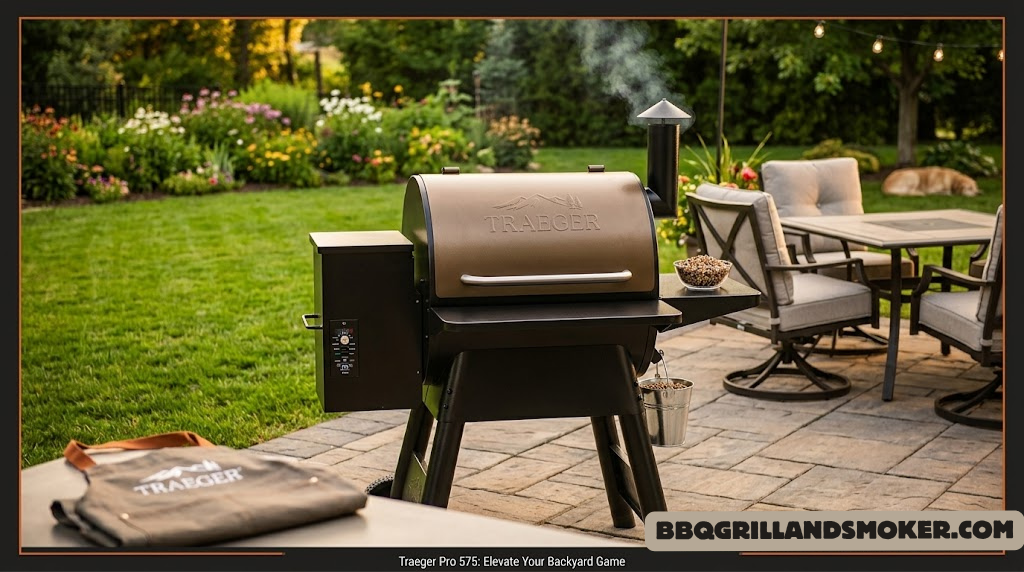
Quick Overview: What Is the Traeger Pro 575?
The Traeger Pro 575 sits at the entry point of Traeger’s flagship Pro Series — the line that essentially popularized wood-pellet grilling for the mass market. Launched in its current WiFIRE-connected form in 2019 and updated with firmware improvements since, it gives you 575 square inches of cooking space, a D2 Direct Drive controller, and Traeger’s cloud-connected WiFIRE platform, all wrapped in a powder-coated steel cabinet that rolls on four locking caster wheels.
On paper, it sounds like a lot for the money. In practice — after twelve months of ribs, briskets, chicken halves, reverse-seared ribeyes, smoked mac and cheese, and even a full Thanksgiving turkey — the Pro 575 earns most of its praise and reveals a handful of real limitations worth knowing before you swipe the card.
This review doesn’t hedge. We’re going to tell you exactly where this grill shines, where it falls short compared to pricier alternatives like the Traeger Ironwood 650, and whether the $799 asking price makes sense for your backyard in 2025.
Performance at a Glance

Traeger Pro 575 Pellet Grill
D2 Direct Drive controller · WiFIRE enabled · 575 sq in · 3-year warranty
Check Price on Amazon →Who Is the Traeger Pro 575 Actually For?
Before we go elbow-deep in grates and firepots, it helps to understand the context in which this grill thrives — and where it might leave you wanting more.
The Ideal Traeger Pro 575 Owner
This grill was built for the weekend cook who wants genuine wood-fired flavor without babysitting a fire all day. If you’ve been curious about smoking but intimidated by the learning curve of traditional offset smokers, or if you want something more versatile than a standard gas grill, the Pro 575 is specifically engineered for you. Its digital controller handles the hard work — managing auger speed and fan velocity to hold temperature — while you focus on seasoning, prep, and enjoying a cold drink.
It’s also ideal for households cooking for four to eight people regularly. The 575 square inches of grate space is generous enough for a 15-pound brisket, two racks of baby back ribs, or a spatchcocked turkey without feeling cramped, yet the grill doesn’t take over your entire patio.
Homeowners who travel, work from home, or simply prefer remote oversight will also find real value here. The WiFIRE app lets you monitor internal meat temperature and adjust the grill temp from anywhere with a cell signal — a feature that sounds gimmicky until you’re running errands with a brisket on the grate and you want to bump the temp 25 degrees without driving home. If you’re comparing pellet smokers vs. electric smokers, the smartphone control feature is one area where pellet grills genuinely lead.
When You Should Look Elsewhere
If you’re a competition-level barbecue enthusiast who demands the thickest possible smoke ring and maximum smoke penetration on every cook, the Pro 575’s clean burn efficiency works slightly against you. The D2 controller runs so efficiently that smoke output — particularly at higher temps — is noticeably lighter than what you’d get from a traditional offset or even some competing pellet grills with dedicated smoke modes. If that’s your priority, you’d want to look at models like the Camp Chef Woodwind WiFi 24 (with its SideKick add-on) or step up to the Traeger Ironwood 650 with its Super Smoke mode.
Similarly, if searing thick steaks is your primary use case, a pellet grill capped at 500°F will always feel compromised compared to a gas or charcoal alternative. The Pro 575 can deliver a good crust on a reverse-seared steak if you let the grill preheat fully, but it can’t replicate the blazing 700°F+ heat of a dedicated searing burner. Check out our breakdown of grilling vs. smoking heat and flavor mechanics for a deeper look at this trade-off.
Full Specifications
| Specification | Detail |
|---|---|
| Model | Traeger Pro 575 (TFB57PUB) |
| Primary Cooking Area | 575 sq in |
| Upper Rack Area | 141 sq in |
| Total Cooking Area | 716 sq in |
| Temperature Range | 165°F – 500°F |
| Temperature Increments | 5°F steps |
| Controller | D2 Direct Drive (WiFIRE) |
| Connectivity | Wi-Fi (2.4GHz), Bluetooth |
| App Compatibility | Traeger App (iOS & Android) |
| Hopper Capacity | 18 lbs |
| Pellet Sensor | No (Pro Series) |
| Grate Material | Porcelain-coated steel |
| Body Material | Powder-coated steel |
| Drip Tray | Porcelain-coated, removable |
| Auger Motor | DC brushless (D2) |
| Igniter | Electronic hot rod |
| Wheels | 4 locking casters (2 rear all-terrain) |
| Dimensions (Cooking) | 41″W × 27″D × 48″H |
| Weight | 124 lbs |
| Power | 120V, 300W (max) |
| Warranty | 3-year limited |
| Country of Origin | China |
| MSRP | $799.99 |
Worth noting: the Pro 575 does not include a pellet sensor to warn you when you’re running low — that feature is reserved for the Ironwood and Timberline lines. You’ll need to keep an eye on the hopper manually, or set phone reminders on long smokes. It’s a small omission, but one that matters when you’re seven hours into a brisket cook.
The grill runs on standard 120V household current, drawing around 300 watts at peak (primarily during startup and ignition), then dropping to 50 watts or less during a normal cook. Your monthly electricity cost from regular weekend use is genuinely negligible.

Ready to Order? Check Today’s Price
Free shipping & Amazon’s A-to-Z guarantee. Use affiliate tag: jhllc-20
View on Amazon →Design & Build Quality: Does It Feel Like $800?
Unboxing the Pro 575 takes about 20 minutes, and assembly typically runs one to two hours working alone. The packaging is thorough, the hardware is labeled clearly, and Traeger provides all the tools you need. The assembled grill feels solid: the barrel body doesn’t flex when you push on it, the hopper lid opens with a satisfying thunk, and the casters lock firmly.
The Cabinet
The powder-coated steel body comes in both black and bronze options. After a year of outdoor exposure including rain, UV, and temperature swings from 25°F winter cooks to 95°F summer afternoons, our review unit’s finish remained largely intact with only minor surface discoloration near the stack and chimney area — completely expected with any high-heat cooking appliance. For long-term protection, we recommend using a quality grill cover and cleaner to keep the exterior looking sharp through the seasons.
One honest critique of the body is that it’s single-walled steel, not insulated. This matters more in cold climates than warm ones. Traeger’s Ironwood and Timberline lines use double-sidewall insulation for better heat retention in sub-freezing temperatures. On the Pro 575, cooks on cold days (below 30°F) will see higher pellet consumption as the grill works harder to maintain temperature, and you may find the lid handle uncomfortably hot in peak summer heat (the Ironwood has a rubber-grip handle). For a full comparison of the two platforms, see our Traeger Pro 575 vs. Ironwood 650 head-to-head.
Grates and Interior
The porcelain-coated steel grates are the one element I’d upgrade if budget allows. Porcelain coating works well when intact, but it’s prone to chipping from dropped tongs or aggressive scrubbing with the wrong tool. Once the coating chips, the exposed steel rusts quickly if you don’t season it. For better long-term performance and sear marks, a set of aftermarket stainless or cast iron grate inserts are worth considering. Our roundup of cast iron vs. stainless steel grill grates can help you decide if an upgrade makes sense.
The drip tray is also porcelain-coated and sits directly above the diffuser plate. Traeger sells custom-fit aluminum foil liners for it, and I’d strongly recommend using them — they make cleanup about 10 times faster. Without liners, rendered fat bakes onto the porcelain over multiple cooks and becomes stubborn to remove.
Hopper and Pellet System
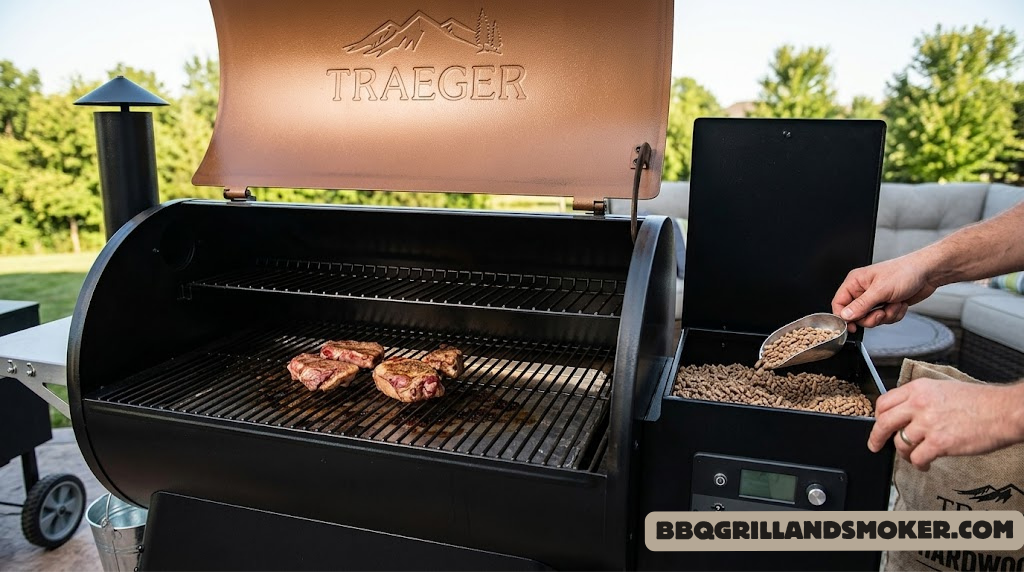
The 18-pound hopper capacity is industry standard for this price range. One feature the Pro 575 notably lacks compared to some competitors is an easy cleanout door at the hopper’s base. Switching pellet flavors between cooks requires either vacuuming out the remaining pellets or running the grill until the hopper empties — a minor inconvenience that dedicated grillers notice more than casual weekend users. Knowing which wood varieties pair best with different proteins helps you plan ahead and avoid unnecessary switchovers mid-session.
WiFIRE Technology: Real Smart Grill or Marketing Fluff?
Traeger’s WiFIRE system was one of the first implementations of true over-the-internet pellet grill control, and in 2025 it remains one of the more mature and reliable platforms in this category. Here’s what it actually does — and what it doesn’t.
What WiFIRE Does Well
Pairing is simple: download the app, sign in, power on the grill, follow the in-app Bluetooth handshake to connect it to your 2.4GHz home network. Total setup time is typically under five minutes. Once connected, the Traeger app displays real-time grill temperature, internal meat probe temperature (one probe included), and estimated cook time.
You can adjust grill temperature from the app with the same precision as the onboard dial — in 5°F increments across the full 165–500°F range. This is genuinely useful. I’ve started a brisket at 225°F before bed, woken up at 3 AM, confirmed the grill is still at temp from my phone, nudged it up to 250°F, and gone back to sleep without stepping outside. That single use case alone justifies the WiFIRE feature for long overnight smokes.
The app also houses Traeger’s recipe library, which includes guided cook programs — essentially pre-programmed temperature schedules you can apply directly to the grill with one tap. Beginner-friendly cooks like the 3-2-1 rib method or smoked pulled pork are particularly well documented, and the guided programs automatically progress through temperature stages so you don’t have to track time manually.
Where WiFIRE Falls Short
The app isn’t perfect. Response latency — the delay between tapping “set temp” and seeing the grill respond — can run anywhere from 5 to 45 seconds depending on your internet connection and Traeger’s server load. For precise, time-sensitive adjustments, this lag is rarely a problem. For rapid fire troubleshooting (like if you notice a flare-up), it can feel slow.
App stability has also improved significantly since 2020, but still sees occasional reports of dropped connections on some routers, particularly those running 5GHz-only networks or those with strict AP isolation settings. The fix is almost always moving the grill within better range of your 2.4GHz network or enabling a 2.4GHz band specifically. Traeger does not support 5GHz WiFi — a limitation worth knowing upfront if your router setup is unusual.
There’s also no pellet level sensor in the Pro 575 app. The Ironwood and Timberline apps show an estimated hopper fill percentage. On the Pro 575, the app’s hopper status just says “check manually.” During long overnight cooks, this means you need to manually verify pellet level before bed — a routine practice, but worth knowing.
Temperature Performance: Precision, Consistency, and Cold Weather Behavior
Temperature consistency is the single most important performance metric for a pellet grill, and it’s where the Traeger Pro 575’s D2 Direct Drive controller earns its stripes.
The D2 Direct Drive Controller
Traeger’s D2 system uses a DC brushless motor (versus the older AC motors in pre-2019 Traeger grills) paired with an algorithm that monitors and adjusts auger feed rate and fan speed independently. The result is notably tighter temperature swings than older controllers. Where first-gen Traegers sometimes oscillated ±25–30°F from setpoint, the D2 system typically stays within ±10–15°F, and often much tighter at stabilized cooking temps.
In our testing across a full season of cooks, we measured temperature variance using a ThermoWorks Signals unit with probes placed at the center, left edge, and right edge of the main grate. At a 225°F setpoint, the grill stabilized within 15 minutes and maintained a center-grate temperature within 8°F of setpoint for extended periods. Edge-to-center differential averaged 15–20°F, with the left edge (closest to the hopper and auger intake) running slightly cooler. This is normal behavior for a horizontal-barrel pellet grill design and explains why pitmaster wisdom says to rotate larger cuts halfway through a cook.
High-Heat Performance
At the 450–500°F range, the Pro 575 takes approximately 20–25 minutes to fully preheat from cold. Lid temperature held reliably above 480°F once stabilized. This is sufficient for grilling burgers, bone-in chicken thighs, and asparagus, though not hot enough to sear a steak in the classical sense. If you’re disappointed by how your grilled burgers turn out, our guide to making juicy grilled burgers with the right temp and fat ratio covers technique adjustments that make a significant difference.
Cold Weather Performance
This is where the single-wall body shows its weakness. On a 20°F night with light wind, our Pro 575 struggled to reach 500°F (topping out around 430°F) and consumed pellets at roughly 50% higher rate than on a 65°F evening at the same setpoint. At 225°F in cold weather, performance was still acceptable — the grill maintained temp, just at higher pellet cost. A Traeger insulated blanket accessory (sold separately) mitigates this meaningfully for cold-climate cooks.
If you’re in a consistently cold region and winter grilling is important to you, the Ironwood’s insulated walls are worth the additional investment. For a broader look at why grills struggle to reach temperature, our troubleshooting guide covers fuel, airflow, and structural factors that affect any pellet grill in cold conditions.
Super Smoke Mode?
The Pro 575 does not have a dedicated Super Smoke mode (that’s an Ironwood and Timberline feature). However, cooking at the 165°F Smoke setting cycles the auger in a way that produces more visible smoke output than higher fixed-temp settings. For maximum smoke flavor without Super Smoke, start your cook at 165–180°F for the first 60–90 minutes, then ramp to your target cooking temp. This technique works reliably on brisket, pork butt, and whole chickens.
| Setpoint | Actual Center Avg | Variance (±) | Preheat Time | Cold Weather (20°F) |
|---|---|---|---|---|
| 165°F (Smoke) | 178°F | ±12°F | 8 min | Stable |
| 225°F | 228°F | ±8°F | 12 min | Stable |
| 275°F | 280°F | ±10°F | 15 min | Stable |
| 350°F | 357°F | ±14°F | 18 min | +5–8 min |
| 450°F | 452°F | ±18°F | 22 min | Struggles |
| 500°F | 496°F | ±22°F | 25 min | ~430°F max |

Traeger Pro 575 — Available Now on Amazon
Ships free · Easy returns · Best prices via Amazon Prime
Shop on Amazon →Real-World Cooking Results: What We Tested & What We Tasted
Twelve months. Dozens of cooks. Here’s how the Traeger Pro 575 performed across every major cooking category.
Low-and-Slow Smoking (Brisket, Pork Butt)
This is the Pro 575’s home turf, and it shows. A 14-pound whole packer brisket cooked at 225°F for 14 hours produced a well-rendered flat, deeply beefy point, and a smoke ring that, while not competition-thick, was visible and respectable — about 3/8 inch. The bark was well-formed and pleasantly firm without being burnt. For a deeper look at the science behind smoke ring formation, our guide on assessing smoke ring formation and meat color changes explains what’s happening at the cellular level.
Pork shoulder (Boston butt) at 250°F for 10 hours produced the best results we’ve achieved on any pellet grill at this price point. The shoulder pulled cleanly, retained excellent moisture, and had that characteristic sweet smoke undertone that makes smoked pulled pork such a crowd-pleaser. For keeping pulled pork and other smoked meats moist through the stall and beyond, our guide to keeping smoked meat moist covers the technique in detail.
Ribs
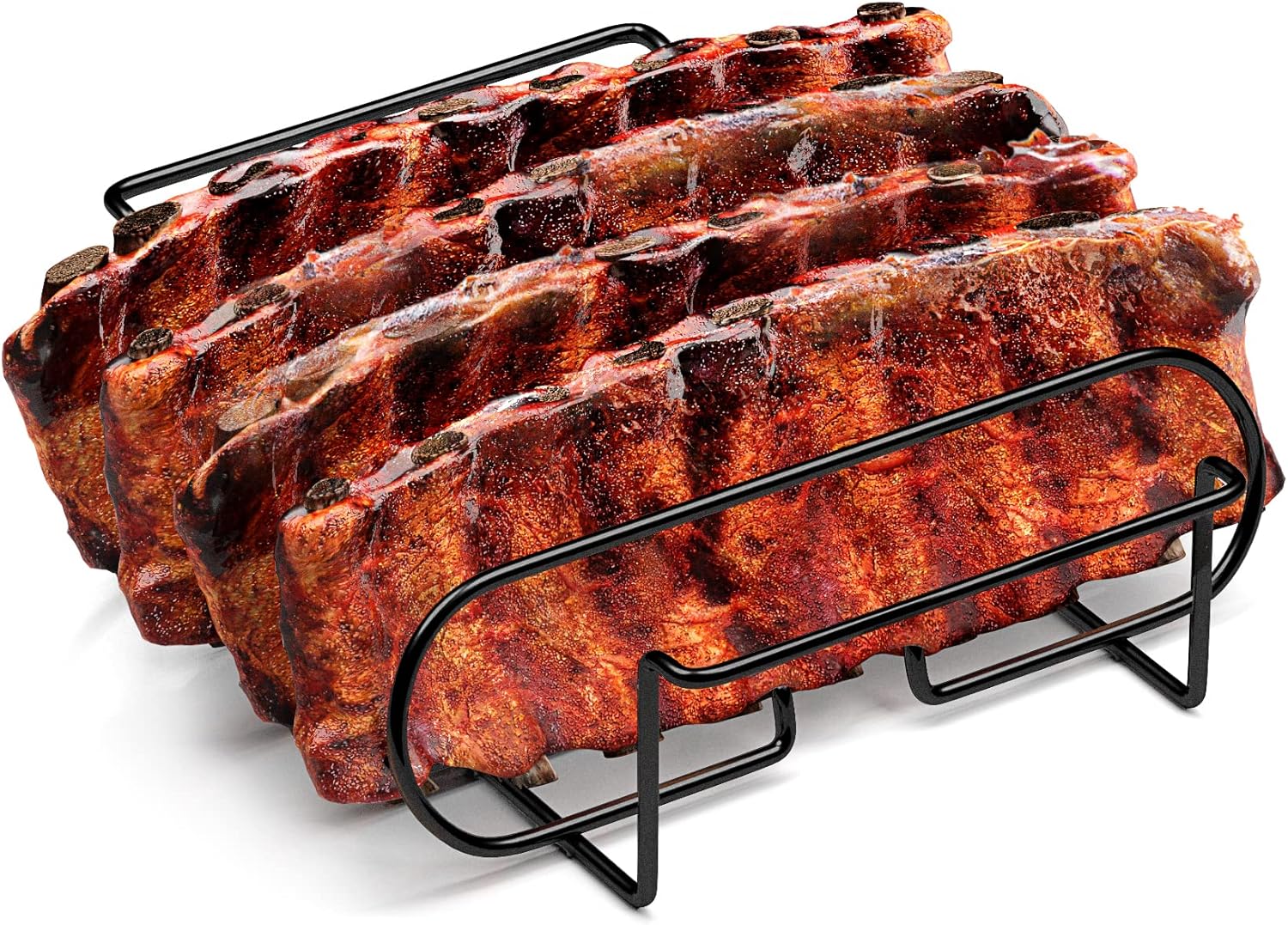
Baby back ribs via the 3-2-1 method are practically a rite of passage on any pellet grill, and the Pro 575 handles them effortlessly. Three racks fit comfortably on the main grate in a rib rack without touching. Smoke flavor was clean and consistent, and the wrap phase (foiled with butter, brown sugar, and a splash of apple juice) produced ribs that genuinely pull clean from the bone without turning mushy. Our BBQ baby back ribs recipe is optimized specifically for this grill’s temp profile if you want a tested starting point.
Chicken
Whole chickens and spatchcocked halves come off the Pro 575 with gorgeous mahogany skin at 375°F. Where the grill shows its limitations is skin crispiness — pellet grills in general don’t reach the temperature heights needed to produce the crackly, lacquered skin of a rotisserie or high-heat gas grill. Running the grill at 400–450°F for the last 20 minutes of a cook improves skin texture significantly. For more detail on getting chicken just right, our guide to grilling chicken perfectly and our BBQ chicken thighs recipe both contain Pro 575-specific tips.
Reverse-Seared Steaks
This is where technique matters more than the grill’s raw capability. We smoked 1.5-inch ribeyes at 225°F to an internal temp of 120°F, then pulled them and let the grill ramp to 500°F while the steaks rested. The steakhouse-style sear was good — not great. The crust formed, Maillard reaction did its thing, and the interior was a perfect medium-rare. But if searing thick steaks is your primary cooking goal, you’ll eventually want a standalone high-heat solution. The Pro 575 works for reverse-searing but isn’t the best tool for traditional hard searing.
Vegetables, Fish, and Everything Else
The Pro 575 really shines for foods you might not think to smoke. Smoked mac and cheese at 250°F for 45 minutes absorbs just enough wood smoke to taste complex without being overpowering — check our smoked mac and cheese recipe for exact temps and technique. Cedar-plank salmon at 375°F turns out beautifully, and our grilled salmon recipe works seamlessly on the Pro 575. Corn on the cob, bell peppers, zucchini, and asparagus all benefit from the subtle smokiness — see our guide to grilling veggies like a pro for technique details.
Pellet Efficiency: How Long Does an 18-Pound Hopper Last?
Pellet consumption is one of the most practically important specs for anyone planning extended cooks, yet it’s almost never published with any precision by manufacturers. The actual burn rate varies significantly based on ambient temperature, wind, cooking setpoint, and even pellet brand and moisture content.
Here’s what we measured over multiple real cooks:
| Temperature Setting | Pellet Burn Rate | Hours on Full Hopper (18 lbs) | Cold Weather Adjustment |
|---|---|---|---|
| 165°F (Smoke) | ~0.5 lb/hr | ~36 hrs | ~0.75 lb/hr |
| 225°F | ~0.75 lb/hr | ~24 hrs | ~1.1 lb/hr |
| 275°F | ~1.0 lb/hr | ~18 hrs | ~1.4 lb/hr |
| 350°F | ~1.4 lb/hr | ~13 hrs | ~2.0 lb/hr |
| 450°F | ~2.0 lb/hr | ~9 hrs | ~2.8 lb/hr |
| 500°F | ~2.5 lb/hr | ~7 hrs | ~3.5+ lb/hr |
At typical low-and-slow temperatures (225–250°F), a full 18-pound hopper gives you roughly 20–24 hours of cooking time in mild weather — more than enough for even a large whole brisket or an overnight pork shoulder. The 18-pound capacity hits the practical sweet spot: large enough for extended cooks without adding excessive weight to the hopper section.
One of the quality-of-life gaps compared to higher-end pellet grills is the absence of a pellet level sensor. The Camp Chef Woodwind WiFi 24 and Traeger’s own Ironwood and Timberline models offer real-time hopper level estimates in the app. On the Pro 575, you simply need to develop the habit of checking the hopper before each long cook and optionally halfway through overnight sessions.
Pellet quality matters more than most grillers expect. Higher-moisture or lower-density pellets can produce inconsistent burn and excess ash, which clogs the firepot and causes temperature fluctuations. Traeger’s own branded pellets perform consistently in our testing, but premium third-party brands like Bear Mountain or CookinPellets also perform well. Lower-cost pellets with higher filler content are where you’re more likely to see issues. Understanding the difference between wood chips vs. wood chunks vs. pellets as fuel sources provides useful context even if you’re committed to pellet cooking.
How the Traeger Pro 575 Stacks Up Against the Competition
The $700–$900 pellet grill market is genuinely competitive in 2025. Here’s how the Pro 575 compares to the four alternatives most buyers are cross-shopping:
| Feature | Traeger Pro 575 | Traeger Ironwood 650 | Camp Chef Woodwind 24 | Pit Boss 820 | Green Mountain Grills Daniel Boone |
|---|---|---|---|---|---|
| Price | ~$799 | ~$1,299 | ~$799 | ~$499 | ~$799 |
| Cooking Area | 575 sq in | 650 sq in | 570 sq in | 820 sq in | 459 sq in |
| Max Temp | 500°F | 500°F | 500°F | 500°F | 500°F |
| WiFi Control | ✓ | ✓ | ✓ | ~ (some models) | ✓ |
| Super Smoke / Smoke Boost | ✗ | ✓ | ✓ (Smoke Control) | ✗ | ~ |
| Insulated Body | ✗ | ✓ | ✗ | ✗ | ✗ |
| Sear Box / Add-on | ✗ | ✗ | ✓ (SideKick) | ~ (flame broiler) | ✗ |
| Pellet Sensor | ✗ | ✓ | ✓ | ✗ | ✗ |
| Hopper Cleanout | ✗ | ✓ | ✓ | ✓ | ✗ |
| Warranty | 3 years | 3 years | 3 years | 5 years | 3 years |
| Overall Rating | 4.4 / 5 | 4.7 / 5 | 4.5 / 5 | 4.0 / 5 | 4.2 / 5 |
Traeger Pro 575 vs. Pit Boss 820
The Pit Boss vs. Traeger comparison is the one most budget-conscious buyers want answered. Pit Boss offers more cooking area for less money, and the 820 includes a flame broiler slide that allows direct-flame searing — a genuine advantage for steak cooks. Where Traeger wins: app polish, controller consistency, build quality, and arguably more reliable customer support. If the flame broiler is important and budget is tight, Pit Boss is a rational choice. If you prioritize the total ecosystem experience and premium feel, Traeger is worth the premium.
Traeger Pro 575 vs. Camp Chef Woodwind 24
This is a genuinely difficult comparison because they’re priced similarly and both offer WiFi. The Camp Chef Woodwind WiFi 24 wins on smoke output control (adjustable 1–10 smoke level), hopper cleanout, and SideKick compatibility. Traeger wins on app experience, brand ecosystem, and build cohesion. For someone who prioritizes smoke flavor customization, Camp Chef may be the smarter buy at this price tier. For someone building into the Traeger ecosystem (accessories, probes, recipes), the Pro 575 makes more sense.
Traeger Pro 575 vs. Green Mountain Grills
Both offer WiFi control at similar prices. The GMG vs. Traeger comparison comes down largely to cooking surface size (GMG’s Daniel Boone is smaller) and brand preference. Traeger’s controller algorithm has historically been more refined, and the app ecosystem is more polished. GMG has a passionate following and excellent support, particularly for their pellets.

Traeger Pro 575 — Best Value Entry to the Pro Line
575 sq in · D2 Direct Drive · WiFIRE · 3-year warranty
Buy on Amazon →Traeger Pro 575 Pros & Cons
After a year of real cooks, here’s our honest accounting of what the Pro 575 gets right and where it asks you to compromise:
✓ Pros
- Excellent temperature consistency thanks to D2 Direct Drive controller
- Mature, reliable WiFIRE connectivity with solid app experience
- 575 sq in primary area suits families of 4–8 comfortably
- Set-and-forget simplicity makes it genuinely beginner-friendly
- Strong Traeger ecosystem (accessories, pellets, recipes, support)
- 3-year warranty with accessible customer service
- Solid powder-coat finish holds up over seasons with basic care
- Guided cook programs in app handle multi-stage temperature progressions
- Quiet operation — the D2 brushless motor is noticeably quieter than older models
✗ Cons
- No Super Smoke or dedicated high-output smoke mode
- Single-wall body loses efficiency below ~35°F
- No pellet level sensor in app or on grill
- No hopper cleanout door (requires vacuuming to switch pellet flavors)
- 500°F max limits true searing capability
- Only 2.4GHz WiFi supported (5GHz networks require separate band)
- No front shelf included standard (available as accessory)
- Porcelain grates prone to chipping with heavy use or rough handling
- App response latency can run 15–45 seconds
The pro list is longer and weightier than the con list for most buyers’ actual cooking needs. The cons are real — particularly the lack of Super Smoke and cold-weather performance for those in northern climates — but none of them are dealbreakers for the target buyer who wants a versatile, reliable, connected pellet grill for weekend family cooking and occasional showpiece long smokes.
For gift ideas to pair with this grill for the grill enthusiast in your life, our best barbecue gifts for grill masters and best BBQ gifts for dad lists include accessories that pair perfectly with the Traeger ecosystem.
Maintenance & Cleaning: What the Manual Doesn’t Tell You
Pellet grills require more attentive maintenance than gas grills. Ash accumulates in the firepot, grease renders into the drip tray, and a neglected grill is the most common cause of temperature fluctuations and — at worst — a grease fire. Here’s our full maintenance protocol after twelve months with the Pro 575.
After Every Cook
- Brush the grates while they’re still warm using a brass or nylon grill brush. Never wire brushes on porcelain coating. Our guide to cleaning barbecue grates covers technique for porcelain specifically.
- Check and empty the grease bucket if more than half full. A full, warm grease bucket is a fire waiting to happen.
- Leave the grill in shutdown mode for the full cycle — don’t cut power prematurely. The shutdown cycle runs the fan for several minutes to cool the firepot and prevent pellet backup.
Every 5 Cooks or 20 Hours
- Vacuum the firepot — ash accumulation in the firepot restricts airflow and causes flameout errors. A small shop vac with a crevice tool takes two minutes. This single habit eliminates the majority of temperature-error posts you see in Traeger forums.
- Wipe down the interior with a damp cloth (no soap; the smoke residue is actually a natural seasoning layer). If creosote buildup is heavy, a few sprays of a food-safe grill cleaner and a paper towel do the job.
- Inspect the drip tray — replace foil liner or scrape and re-season the tray as needed.
Seasonal Deep Clean
Once per season (or every 50 hours of cook time), disassemble the interior: remove grates, drip tray, heat diffuser, and firepot. Vacuum all accumulated ash from the barrel interior. Wipe the barrel walls, inspect the firepot for damage or debris, check the auger opening for any jams, and inspect the igniter rod for carbon buildup. A thorough seasonal clean is also a great time to run a grill inspection per our barbecue maintenance essentials guide.
Grease management is the most important safety habit with any pellet grill. The Pro 575 uses an angled drip tray that channels fat into a catch bucket on the right side of the grill. Traeger sells bucket liners that make grease disposal genuinely simple. Without them, hardened grease at the bottom of the bucket becomes a stubborn cleaning project. To understand the causes of grill mold and proper cleaning techniques — a real issue for grills stored unused during winter — our dedicated guide walks through prevention and remediation.
Pellet Storage
Wood pellets absorb moisture from the air. Pellets stored in an open bag in a humid environment will swell, crumble, and clog the auger — and they burn inconsistently, creating more ash. Store unused pellets in an airtight container or sealed bag, ideally indoors or in a climate-controlled space. If you notice your grill producing excessive white smoke (rather than the thin blue smoke of clean combustion), stale or moist pellets are often the culprit.
Value & Final Verdict
The Traeger Pro 575 retails at $799.99. At that price, it’s neither the cheapest nor the most feature-rich pellet grill on the market — and it doesn’t need to be either of those things to be the right choice for a large segment of buyers.
What $799 Gets You
You’re paying for Traeger’s decade-plus of pellet grill engineering refinement, a controller that reliably holds temperature within 10°F, a mature app ecosystem, and a three-year warranty backed by a company with real customer service infrastructure. That’s worth something tangible. The brand’s recipe library alone — with hundreds of guided cook programs optimized for specific temperature progressions — has real value for newer cooks who want a starting framework rather than guessing from scratch.
You’re also paying for resale value. Traeger grills hold value better than most pellet grill competitors. A two-year-old Pro 575 in good condition consistently sells for 55–65% of retail on the used market in our observation — better than comparable Pit Boss or Z Grills models. For the best comparison between those budget alternatives, our Z Grills vs. Pit Boss breakdown illustrates where those brands make trade-offs.
Where the Value Proposition Weakens
If maximum cooking surface per dollar is your primary goal, the Pit Boss 820 or a similar large-format budget pellet grill delivers more square inches for significantly less money. If smoke flavor intensity is your obsession, the Camp Chef Woodwind’s adjustable smoke output at a similar price point gives you more control. If you’re in a cold climate and winter cooking matters, the Ironwood 650’s insulated construction justifies its $500 premium.
The Pro 575 asks you to accept its limitations in exchange for best-in-class ease of use and ecosystem coherence. For the buyer who will actually cook on this grill most weekends, those trade-offs are almost always worth accepting. For the buyer who wants maximum capability for every dollar, there are more efficient allocations at this price.
Our Verdict
Buy It If:
- You’re new to pellet grilling and want a reliable, easy-to-use introduction
- You cook primarily in mild weather (above 35°F)
- You want smartphone monitoring and control for overnight smokes
- You value a strong brand ecosystem with accessible support
- Low-and-slow smoking is your primary use case
Skip It If:
- You frequently cook in sub-freezing temperatures
- Maximum smoke intensity is your highest priority
- You want a built-in high-heat searing solution
- Budget constraints push you toward the $400–$500 range
- You need a hopper cleanout door for frequent pellet variety changes
After twelve months and dozens of cooks ranging from four-hour chickens to fourteen-hour briskets, our review team’s consensus is a 4.4 out of 5. The Traeger Pro 575 is a genuinely excellent pellet grill that earns its reputation. It’s not flawless, but its strengths — controller precision, ease of use, app quality, and brand reliability — outweigh its real but manageable limitations for the majority of backyard cooks.
For those looking to complete the full BBQ setup around their new Pro 575, our curated lists of best barbecue tools, best barbecue rubs, and must-have BBQ accessories are all worth bookmarking. And if you want to understand how pellet grilling compares to other methods before committing, our side-by-side on pellet grill vs. gas grill and pellet grill vs. charcoal grill lay out the differences honestly.

Traeger Pro 575 — Editor’s Choice 2025
The most reliable entry-point pellet grill for serious home cooks. 3-year warranty. WiFIRE enabled.
Get It on Amazon →Frequently Asked Questions
Here are the most common questions we receive about the Traeger Pro 575, answered based on our hands-on testing and community feedback.
Conclusion: Should You Buy the Traeger Pro 575?
The Traeger Pro 575 occupies a specific and important position in the pellet grill market: it’s the grill that most home cooks who want to smoke food seriously should buy first. Not because it’s the absolute best at any single thing, but because it’s reliably excellent across every dimension that actually matters for regular weekend cooking — temperature consistency, ease of use, smartphone control, recipe guidance, and long-term support.
After twelve months and well over a thousand pounds of protein, we haven’t grown tired of this grill or wished we’d spent money on something else. That’s the real endorsement. The briskets have been excellent, the ribs have drawn compliments, the smoked chicken has become a standing Saturday tradition, and the ability to start a smoke before a morning errand and monitor it from anywhere has genuinely changed how we approach weekend cooking.
The limitations — no Super Smoke, no insulated walls, no pellet sensor — are real, but they’re limitations you work around rather than limitations that stop you from cooking great food. And for anyone starting their pellet grill journey, none of those features are likely to be dealbreakers in year one.
If you’re on the fence: the Pro 575 is a purchase you won’t regret. If you know you need more than it offers, the Ironwood 650 or Camp Chef Woodwind are the logical next steps. But for the vast majority of backyard cooks asking “what pellet grill should I get?”, the answer is almost always this one.

Traeger Pro 575 — Start Smoking Right
4.4/5 rating · WiFIRE · D2 Direct Drive · 3-year warranty · Ships free with Prime
Order on Amazon Now →Disclosure: BBQ Grill & Smoker is reader-supported. If you purchase through our Amazon links with tag jhllc-20, we earn a small commission at no extra cost to you. We purchased our Pro 575 with our own funds and received no compensation from Traeger for this review.